|
BERGMANN
& COMPANY
1881
to 1889
|
|
|
SOCKET
RESEARCH SECTION - Moving Tongue Sockets
|
THIS PAGE WAS CONTINUED
FROM HERE
http://www.antiquesockets.com/bergmann5.html
|
The Bergmann No. 3 Socket - The Moving Tongue Lineup
|
ABOUT
THE LINEUP
The No. 3 Bergmann socket is part of a lineup.
A socket line up simply means that a socket design was carried through
different mergers or sister companies, as well as different periods
of time. In this case starting as an Edison/Bergmann invention and
then living on through later company mergers.
The lineup shown below is for the Bergmann moving tongue socket.
Please check back from time to time for updates to this section.
If a future update is ever added to this page, it will be added
in the format of a red dated headline
to make it easy to find.
Since the No. 3 socket design extended through many years, we will
cover the entire lineup of moving tongue sockets and then move on
to the Bergmann No. 4 socket, which would be the next oldest socket
after the first moving tongue.
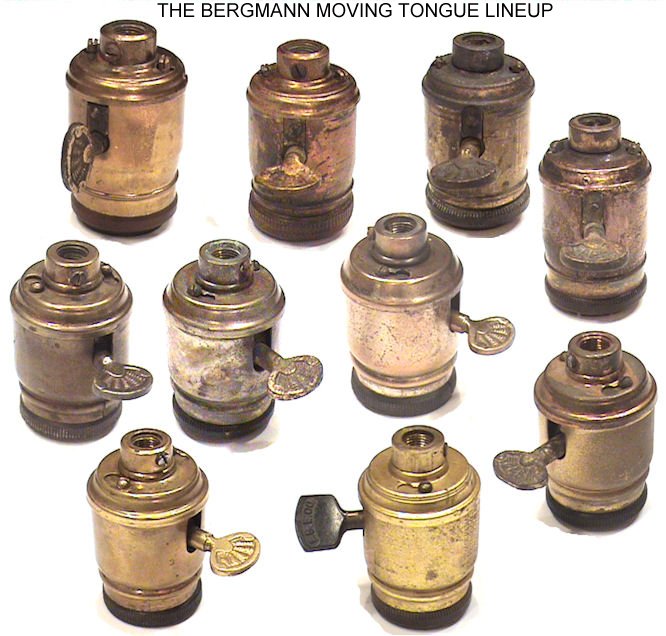
As you can see from the lineup examples shown above, not too much
can be seen from one simple group picture of the out side of these
sockets. While there are a number of differences on the out side
that will be pointed out, the lineup will also consist of changes
to the socket innards, different patent dates added missing or misprinted
on the shells, as well as many more changes that help to ID sockets
from different time periods.
|
Common Terms & General Knowledge That Will Relate To This
Section
|
Before getting
into each different moving tongue socket, we should go over some
general knowledge information that will help you to understand each
different socket in the lineup more clearly.
ABOUT
THE SOCKET
The moving tongue was the second "turn key" socket invented
by Bergmann.
The turn key is simply the off and on switch, which was also called
a cock in the old days.
The first socket with a switch was the Bergmann
No. 1; The
Bergmann No. 2 (socket lineup), was the acorn socket(s) which
never had a turn key or switch on them.
There were several reasons why Edison and Bergmann needed to upgrade
or re invent the older (no. 1) key socket.
PROBLEMS WITH THE FIRST WOODEN
SOCKET INNARDS
This first Bergmann key socket was made with wooden innards, which
would swell in moisture and sometimes cause the thin brass shell
to crack. Also as the wood swelled, you could no longer take the
socket apart now being like a cork in a bottle.
Another downfall was that these older wooden innards needed to be
hand carved, filed, sanded, etc., which was a lot of work to produce
in mass quantity. The real goal was to find a better and easier
material to work with, that did not require much time or effort
to manufacture.
I can document many orders for these sockets.
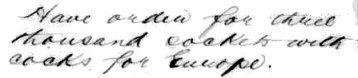 One
would think that for such an early time in history, that there was
only a small number of sockets being manufactured. One
would think that for such an early time in history, that there was
only a small number of sockets being manufactured.
WRONG! - I started calling special attention to this fact as I came
across more and more orders during my research.
While there were orders for 100 and 200 every now and then, most
of the orders that I came across started at 500 sockets! There was
also the occasional order for over 1000 sockets at once, as seen
in the telegram sent to Bergmann from Samuel Insull shown above
on your right which says "Have
order for three thousand sockets with cocks for Europe".
Insull was then asking if they could be shipped from their company
in London, so as not to over ship by fulfilling the order and shipping
from the U.S. to Europe.
My point is, that with all of the growing interest in incandescent
lighting at the time - There was not just a small need to upgrade
the old style wooden socket - There was a big one!
THE
SEARCH FOR A NEW MATERIAL
The largest problem during this time was the material that was to
be used in the place of wood.
Many different compositions and insulating materials were tested
before this socket was invented.
Even though the moving tongue socket was not applied for patent
until April 10th 1884, most of the material testing was already
complete and documented in the Menlo
Park Notebook No. 143 which covered the time periods from December
2 1882 and March of 1883. Note worthy is the fact that some of the
compositions and different formula combinations tested were used
on later moving tongue sockets, as well as other items such as switch
bases.
The main reason for the tests and experiments found in this notebook,
was to find or invent a good composition material (for the use of
sockets and lamp bases). Most importantly this composition 'cement'
was to be a direct replacement for wood as an insulating material
for lamp bases, socket innards, safety fuses, etc.. Wooden socket
collars during this time, were replaced with hard rubber and different
wood fiber based compositions.
On December 28th 1882 (while this testing was still well underway),
Edison sent samples along with a
letter to Charles Batchelor.
 He
stated in his letter "I have just got a new compound that I
think will be good for sockets of lamps". He asked that Batchelor
test the compound himself and report back. Edison was clear about
the reason for this testing when he stated: He
stated in his letter "I have just got a new compound that I
think will be good for sockets of lamps". He asked that Batchelor
test the compound himself and report back. Edison was clear about
the reason for this testing when he stated:
"Bergmann is going to experiment with
the compound to see if he cannot mould the sockets thus displacing
wood"
Also in the notebook, after each variant of different composition
mixtures it states "made socket" (meaning lamp base) and
then it was tested to see how it held up to different tests.
Even though I can document several changes and updates to the first
Bergmann turn key socket, there is no evidence that this socket
ever used anything other then wood for it's cylindrical block (shown
as "A" in the
patent). The "disk" lower case "h" was likely
upgraded from wood to vulcanized fiber as evident from the pictures
shown of it on this site.
For someone wishing to read and learn more about defects in early
Edison items (that needed to be fixed or upgraded), you can study
through the 1882 (broken link)
and 1883 (broken link)
Edison defect books. (Note that the defect books were downloaded
from the Edison
papers project at rutgers.edu, and converted to PDF for easy
viewing for the readers on this site).
THE MOVING TONGUE WAS THE FIRST EDISON
/ BERGMANN TURN KEY SOCKET MADE WITHOUT USING WOOD
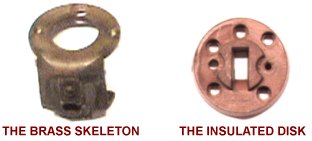 The
moving tongue was the first turn key socket made without using wood
for any part. The
moving tongue was the first turn key socket made without using wood
for any part.
The moving tongue ingeniously used a brass frame (called the skeleton),
that replaced the wooden cylindrical block of the first socket design.
The moving tongue then used what was called the "insulated
disk", which was mounted to the skeleton and provided the insulated
environment (or starting place) to connect to both isolated positive
and negative terminals.
Bergmann's search for the best insulating material
(to be used for the socket's insulated disk), is what will cause
many changes as we go through the first several sockets in this
lineup.
|
HOW THE MOVING TONGUE SWITCH WORKS - Also tells us how
it gets it's name
|
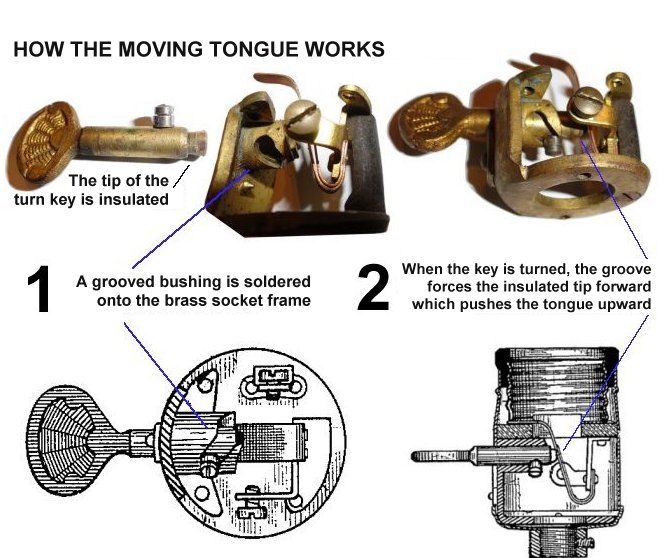
 THE
MOVING TONGUE - A SIMPLE CONCEPT THE
MOVING TONGUE - A SIMPLE CONCEPT
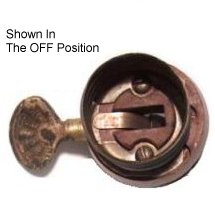
When you turn the key on the socket, the key moves inwardly and
pushes the tongue (center contact) forward (upwardly). The picture
on the right shows the switch in the off position. If you can picture
a bulb screwed in the socket, you will see that the tongue in this
position would not be touching the center contact of the bulb.
However, as you can see from the second picture on your right (shown
with the key in the on position), when the key is turned and the
tongue moves forward (upwardly), it is then forced to touch the
bulb's center contact (which makes the electrical connection).
TIME
FRAMES
This moving tongue socket was sold and used by Bergmann & Company
(Edison & Bergmann) from 1884 until 1889. It was then sold by
the Edison General Electric Co. (Edison Only) from 1889 until 1892.
THE DIFFERENCE
BETWEEN BERGMANN & E.G.E MOVING TONGUE SOCKETS
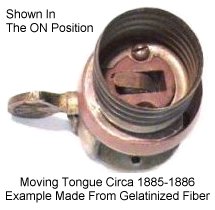 Moving
tongue sockets made by Bergmann & Co., are mostly found with
red gelatinized fiber innards like those shown here on your right
(I will cover other early
materials used on moving tongue sockets below).
Those made by Edison General Electric are most always made from
porcelain. There are some that were made by E.G.E (right after the
merger in 1889 and until the first part of 1890) that were made
of red gelatinized fiber (but rare to come by). These normally can
be easily identified by them having the the two
vertical slits found on the threaded socket base. Note that
it would also be possible to have an innard without the slits in
an E.G.E. shell, but this would have been put together from older
parts (right at the time frame of the merger) and really should
be considered as Bergmann innards inside of an E.G.E. Shell Moving
tongue sockets made by Bergmann & Co., are mostly found with
red gelatinized fiber innards like those shown here on your right
(I will cover other early
materials used on moving tongue sockets below).
Those made by Edison General Electric are most always made from
porcelain. There are some that were made by E.G.E (right after the
merger in 1889 and until the first part of 1890) that were made
of red gelatinized fiber (but rare to come by). These normally can
be easily identified by them having the the two
vertical slits found on the threaded socket base. Note that
it would also be possible to have an innard without the slits in
an E.G.E. shell, but this would have been put together from older
parts (right at the time frame of the merger) and really should
be considered as Bergmann innards inside of an E.G.E. Shell
The General Electric Company took over in 1892. It is likely that
G.E. sold out the remaining E.G.E. sockets and parts, however, so
far there is no evidence that G.E. ever produced a moving tongue
socket (or sold one with their name or the GECO trademark on it.
The oldest G.E. catalog that I have access to (so far) is 1894 and
it does not contain moving tongue sockets.
We also have magazine and book ads from 1892 to 1894 with no evidence
of the moving tongue ever being sold by G.E.
For these reasons, the moving tongue line up stops with EGE in 1892.
ABOUT
INSULATED TIP MATERIALS
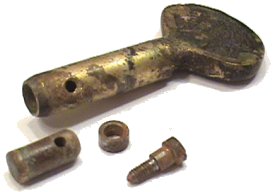 The
tip used on the first turn key socket (Bergmann
No. 1) was made of metal and the turn key itself was made of
metal. There was an insulated piece made from hard rubber (vulcanite),
which screwed into the turn key shaft and insulated the metal tip
from the metal turn key. In the first socket there were two spring
metal contact pieces that were slightly separated, in which connection
was made when the turn key touched both pieces at the same time
(thus the need to insulate the turn key from the tip. The
tip used on the first turn key socket (Bergmann
No. 1) was made of metal and the turn key itself was made of
metal. There was an insulated piece made from hard rubber (vulcanite),
which screwed into the turn key shaft and insulated the metal tip
from the metal turn key. In the first socket there were two spring
metal contact pieces that were slightly separated, in which connection
was made when the turn key touched both pieces at the same time
(thus the need to insulate the turn key from the tip.
The design of the turn key on the moving tongue socket is changed
as seen in the patent.
The tip is now made of an insulating material, which is designed
to push the spring metal center contact (tongue) into
the contact position. While the first Bergmann key used hard
rubber for it's insulation, there is no evidence of the moving tongue
socket ever using it. The patent for the moving tongue simply states
"insulating-tip". My no. 1 moving tongue uses the red
gelatinized fiber material for the tip. Many of my other early Bergmann's
use gelatinized
fiber as well, but at one point a different more durable green/brown
colored clay based (likely Kaolin)
and asbestos composition started being used. For more information
about the identification of this clay based composition material,
see my particle
grain chart as well as the pictures below it which use this
insulating-tip material as an example. For an example of the gelatinized
fiber tip material see this
link, where it is used in an example. (more on these materials
soon).
DATING OF
TIP MATERIALS
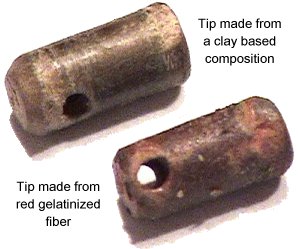 There
is so much confusion in regards to the time frames of these insulating
tip materials (from a dating standpoint). There
is so much confusion in regards to the time frames of these insulating
tip materials (from a dating standpoint).
I have no doubt that gelatinized fiber was used first, however I
would expect to be able to state that it was used until a specific
time and then this new material started being used. It is possible
that both materials were used at the same time, or that one was
used and then switched back, and then back and forth again.
There just seems to be no rhyme or reason of any kind, as for a
time frame for the use of either material.
I have checked my sockets and have compared other collections, only
to become more and more confused.
Possible causes of this material confusion could be that some turn
keys may had been swapped out or changed on some sockets. It could
also be that keys were mixed into a large bin at the factory, which
always mixing could feasibly produce this constant mixture of materials
through time. I really am not sure what the answer is, but I am
sure of the fact that the material makes no difference as to any
solid or useful dating criteria.
You can read more about vulcanized fiber here,
gelatinized fiber here,
or a note and detailed picture of the gelatinized fiber insulating-tip
here,
MORE ABOUT
INSULATED TIPS
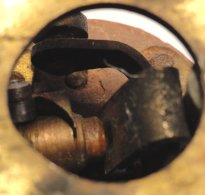
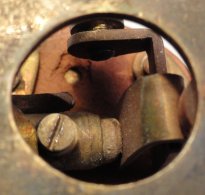
For
a quick inspection, you can simply shine a light down into the
top of your moving tongue socket and inspect the tip.
Note that some tips made of gelatinized fiber could be worn
down, which in some cases can cause your socket not to work
properly when turning it off and on. This can normally be adjusted
by bending the spring metal just a tiny bit (rather then trying
to repair the tip itself. |
 |
 |
| Sometimes
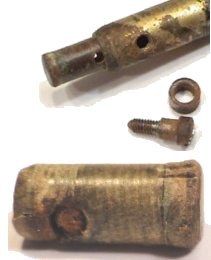
you can come across a moving tongue that has a broken screw
on the key shaft. |
Picture
showing a red
gelatinized fiber tip
|
Picture
showing a clay
composition tip
|
In
a case like this, a repair of some kind might be needed to produce
a working socket.
If the insulating-tip is broken or damaged, the best solution
might be to replace the screw and file down the tip (from the
back end) if needed.
OR, if your piece is too small, pack the inside of the turn
key shaft (just before the threaded screw hole, so that enough
of the tip will stick out of the shaft to work the key when
turned.
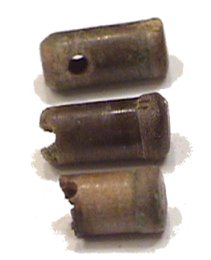
The picture to the right shows a insulating-tip with a rusty
broken screw piece stuck in the threaded hole. Other pictures
show tips that became brittle over years and broke loose at
the threads. |
|
|
If you feel the need to id the insulating-tip material on your socket
(red or brown) and can't see it well, you can feel comfortable using
a cotton swab with a touch of alcohol on it as the gelatinized fiber
is not soluble in it. I believe the brown tip is partially soluble
in alcohol (likely using a chemical binder). However, in my tests
after 24 hours of soaking a tip only caused it to soften and I was
only able to scrape a small amount of material loose from the edges.
There
were many different insulating
materials used in the early days. There were also many different composition
recipes that were lost or never properly documented. Mostly because
of a lack of public testing and general knowledge, some compositions
were either changed or recipes
faded
when new scientific information came to light.
An example of this would be learning how basic properties change,
when mixed with another material or ingredient used in a composition.
After time more public and also independent testing began, as well
as larger companies performing their own tests and sharing the results.
Examples could be testing of dielectric strength, dielectric
loss, surface leakage (when dealing with either conductivity or resistance)
and an ever growing list of new tests added as time progresses.
TESTING EXAMPLES
A short example of a test list could be - an artificial aging test
of the material, flash and fire tests, rate of drying, penetration,
absorption of moisture, effect of high temperature, electric arc,
hardness, toughness, fracture, melting point, brittleness, workability,
shrinkage, flexibility, chemical testing, solubility in water, oil,
etc..
As more testing became available, recipes for compositions and products
were changed, perfected or simply thrown away.
In the real early days (early 1880's) there was almost no testing
information to be found on any of these
early compositions. Most of them simply became trade names and products
of one company, while a competitor simply made a slightly different
recipe and then came up with his own trade name. To list all of these
'trade names' or insulating products, we would need to turn this site
into a book on the topic.
I have decided to make a sub
section (which I will link to and from my research on this page)
for anyone wishing to learn more about different insulating materials,
and how some of them relate to Edison and Bergmann items.
TYPES OF INSULATING
MATERIALS
In short there are different types of insulating materials, which
I list into different categories such as: Solids,
Plastics
and Liquids.
Solids are split into two different
categories of Natural Solids (asbestos,
bone,
chalk,
ivory,
marble, wood, etc.) and Fabricated
Solids which is broken down into further sub categories
of Vitrified
Materials (glass, porcelain, etc.), Fibrous
Materials (cellulose, fabrics, fibers, papers, etc.)
Molded Compositions (asbestos
compositions, asphalt
/
bitumen
compositions,
hard
rubber, etc.)
Plastics
includes asphalt, raw natural rubbers, waxes, etc. Liquids
is broken into sections of liquid, solidified and modified.
Some of the items that fall into these sections would be japans,
shellac,
varnish,
etc..
Now each of these materials can be molded or mixed
with each other (or any number of different chemicals, minerals, etc.)
To make up all kinds of different compositions.
Then, sometimes
vulcanized,
fired, or put through different processes to complete them.
MOLDED INSULATION
Molded insulation's are either cold molded or hot molded depending
on which binding agents and methods are chosen.
If it is a chemical reaction that takes place with a mixture (without
heat), this would be called a cold molded composition.
It can still have hard, stony, vitreous materials, fibers, etc. added
to the mixture, but the binding agent would be one of two classes.
It would be either a pitch, or resin that is dissolved using chemicals,
or a direct chemical reaction such as lime, silica and water mixed
with magnesia. An example of other chemical mixtures would be oxide
of magnesia mixed with chloride of magnesia or zinc oxide with zinc
chloride.
Hot molded compositions are normally molded using pressure and heat
at the same time. Normally the binding
materials
used for hot molded compositions, are those that are hard when cold
and soft when heated. Most any of the raw insulating materials can
be mixed with the binder as an inert ingredient. Often times the materials
are mixed together by use of a grinder and then heated to fuse the
binders while being placed into a hot mold and compressed. The composition
is then allowed to cool and harden under pressure.
INACTIVE INGREDIENTS
Depending on the use or specific need of the insulation, a choice
will be made for the method of molding and types of binders that are
needed. The next step would be the selection of the inert or inactive
ingredients that will make up the final composition. The inert ingredients
can be anything such as ground up stone, sand,
kaolin (natural clay), fibers, etc..
It is common for these fillers to be up to 20 times the bulk of the
active ingredients. I will include a list of known inert ingredients
as I get closer to completing the new section which I have simply
be titled "Early
Known Insulating Materials".
When I post up my personal composition test results, I will mostly
deal with melting and softening points as well as some characteristics
of different insulation.
Note: There is one composition
material used on a moving tongue (no. 9), that is still yet un identified
at this time.
I am still researching and testing many different materials and hope
as the research is completed, to either identify the material or at
least narrow it down.
|
PATENT DATES FOUND ON MOVING TONGUE &
OTHER BERGMANN, E.G.E & GE SHELLS
|
|
Patent
Approved
Date
|
Patent
Applied for Date
|
Patent
Number
|
Description
/ Notes
|
| Dec
27 1881 |
Mar
26 1881 |
251,554 |
Edison
No. 2 Socket
Patent for the first Edison screw-thread
Date
should be found on all Bergmann, EGE and first G.E. shells |
| Dec
27 1881 |
May
27 1881 |
251,596 |
Edison
No. 3 Socket
Johnson patent for bevel ring screw base and turnkey switch
Date
should be found on all Bergmann, EGE and first G.E. Shells |
| May
2 1882 |
Feb
25 1882 |
257,277 |
Edison
No. 4 Socket
Bergmann patent for the center contact on Edison screw base
sockets
Date
should be found on all Bergmann, EGE and first G.E. Shells |
| Oct
3 1882 |
Feb
4 1880 |
265,311 |
Edison
No. 1 Socket
Patent for Edison baseless bulb and socket
Date should be found on E.G.E. or first
G.E. Shells
However, note that only the most early E.G.E. (normally red
fiber or other non-porcelain innards) are missing this patent
date. |
| Jan
10 1883 |
N/A |
16095 |
Edison
No. 4 Socket (Canada Patent)
The Canadian patent for the center contact on the Edison screw
base sockets. U.S. patent no. 257,277 above (but here assigned
to Johnson).
Date should be found on Bergmann shells
However, note that early E.G.E. Shells missing the Oct.3.1882
date (shown above) will still be using this date.
Never used on G.E. Shells |
| Feb
12 1884 |
Oct
9 1882 |
293,552 |
Bergmann
No. 2 Socket
Patent for the Bergmann Acorn socket and shade holder
Date
should be found on all Bergmann, EGE and first G.E. Shells |
| May
13 1884 |
Oct
9 1882 |
298,658 |
Bergmann
No. 1 Socket
Patent for the first "Bergmann" Turnkey socket (wooden
innards)
This date (or the mis-printed date
below) should be on all Bergmann and EGE shells |
| May
18 1884 |
N/A |
N/A |
Bergmann
No. 1 Socket (MIS-PRINT)
Same as above (MAY.13.1884)
This was a mis printed date (shown
above) on some EGE shells |
| Jan
20 1885 |
Apr
10 1884 |
311,100 |
Bergmann
No. 3 Socket
Patent for the Bergmann moving-tongue socket
Date
should be found on all Bergmann, EGE and first G.E. Shells
(However, note that if the socket was manufactured before
this date or a moving tongue during patent applied time, this
date would be missing from the shell)
|
| May
17 1887 |
Nov
27 1885 |
363,183 |
Thomson-Houston
patent for socket switch obtained by G.E after merger in 1892.
Date found only on first G.E. Shells |
| Sep
11 1888 |
Jun
2 1888 |
389,280 |
Patent
for the 1888 design rotary switch socket (was irrelevant to
the moving-tongue socket, but yet found on the shell until it
was removed in 1890).
Date found on Bergmann shells manufactured
after 1888 and early E.G.E. Shells that still have the Jan 10
1883 date stamped on them. |
| APR
15 1890 |
Oct
18 1889 |
425,741 |
Patent
for the two vertical slits found on the threaded sleeve of some
Edison socket bases. J. J. Bradley patent assigned to EDISON
LAMP COMPANY.
Date found on E.G.E shells manufactured
after 1890
Note that some Bergmann shells can contain the innards with
slits, but should not have the patent date on the shell. The
patent date should only be found on shells marked "Edison
General Electric Co."
NOTE WORTHY is the fact that SOME socket
shells having the 1890 patent date, also have backward
N's. These are found with brass but also with
hard rubber keys, as well as second generation (but not first
generation) porcelain innards, which would date these to later
after 1890 and drawing closer to 1892. |
| MAY.5.1891 |
Mar
15 1890 |
451,656 |
Thomson-Houston
patent for socket switch obtained by G.E after merger in 1892.
Date not found on moving tongue sockets
- This date should only be found on first G.E. Shells |
Note that a special
thanks goes to Adam Allerhand who many years ago did the research
part of looking up patent numbers for the patent dates shown above
and publishing them publicly. Though it has been a long time since
then and much more research has been done, he in my opinion should
be respected as one of the first real socket researchers that had
a large influence in my personal researching experience.
For more information
about moving tongue socket patents and markings on each of the shells
in this lineup, see this link.
Moving Tongue No. 1 - The First Bergmann
Moving Tongue
|
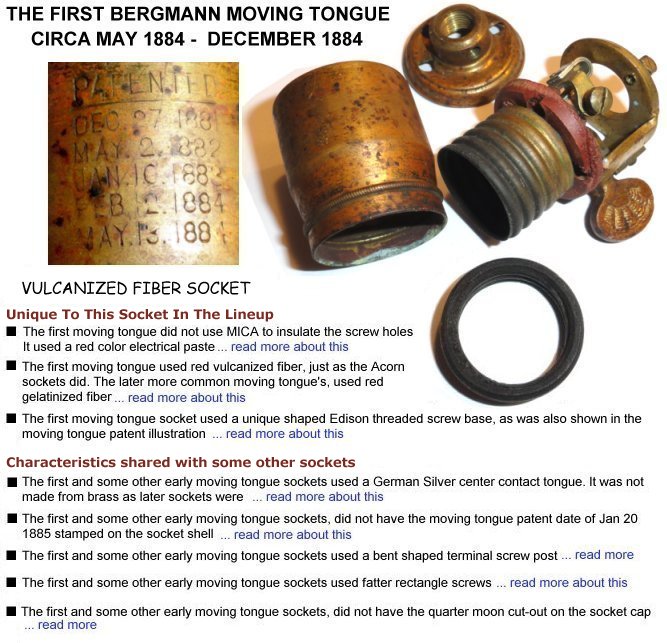
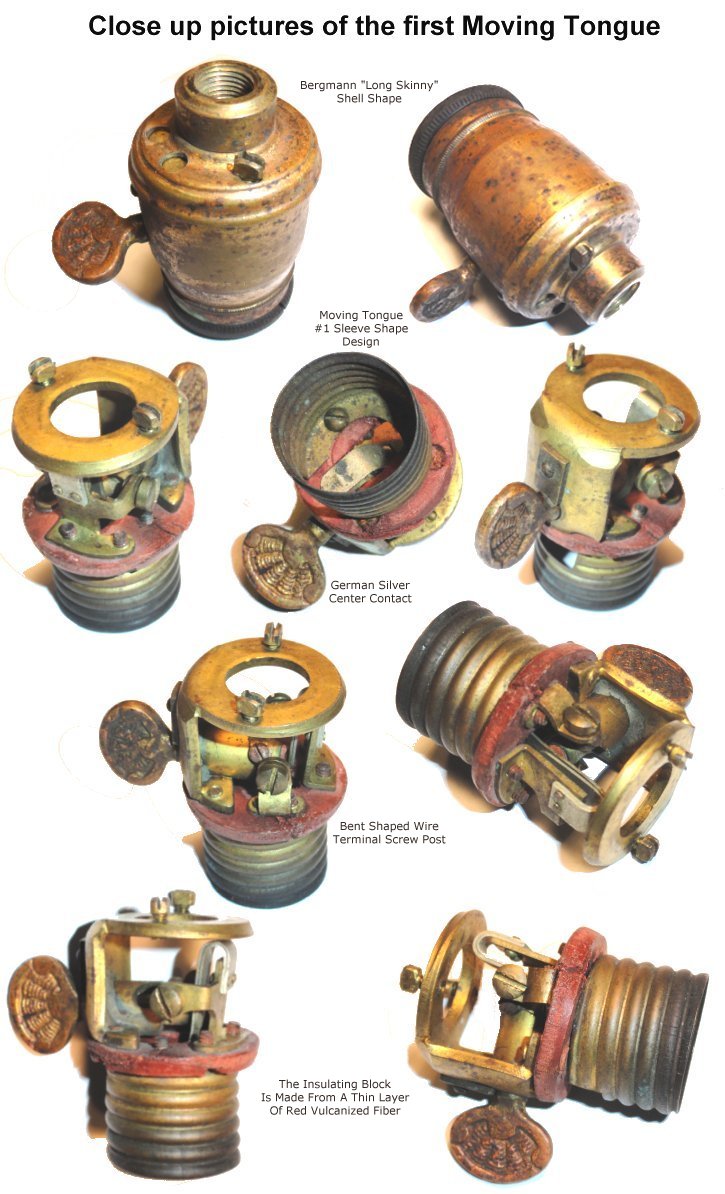
Moving Tongue No. 1 - No Mica - Uses
Electrical Cement For Insulation
|
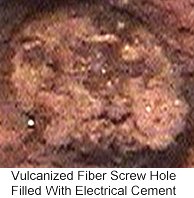
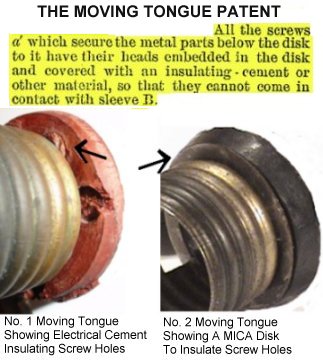 As
shown described in the patent capture on your right (according to
the patent), the first moving tongue socket used an insulating cement
material to fill the screw holes. This cement can clearly be seen
in the picture of the first moving tongue on your right, which was
made of red vulcanized fiber. As
shown described in the patent capture on your right (according to
the patent), the first moving tongue socket used an insulating cement
material to fill the screw holes. This cement can clearly be seen
in the picture of the first moving tongue on your right, which was
made of red vulcanized fiber.
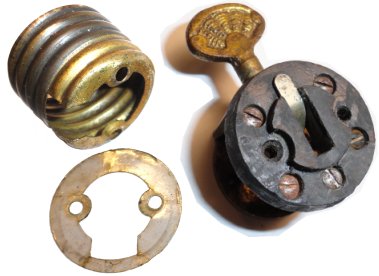
This
No. 1, is much different from all other moving tongue sockets. After
this first socket, you will notice that all of the other moving
tongues use a round sheet of mica as an insulator. From the picture
above on the left, you can understand more of how the mica disk
covered and insulated the screw holes, as shown in the picture of
the disassembled no. 2 moving tongue sample. (also see the
mica section for other Bergmann moving tongue sockets)
A better view of how the electrical cement (or fiber paste) worked,
is more clearly seen in the picture of the broken vulcanized fiber
plate shown below to your right in the next
section called "Used
Red Vulcanized Fiber".
 This
red colored (red lead pigment) electrical cement was invented, along
with a series of experiments that resulted in several different
cements and compositions. These were competed and documented between
the dates of December 2 1882 and March of 1883. The cement experiments
were documented in Menlo
Park Notebook No. 143 which covered the period November 1882
to June of 1883. These notes document the chemical experiments made
by George Gibbs and Thomas P. Conant on storage batteries, carbon
filaments, cements for sockets, mica insulation for dynamo brushes
and their experiments to produce marks on paper (probably for an
electric meter). The last half of the book is by Conant alone and
relates only to his electric meter experiments. Note worthy is that
while this paste was used for as a composition material to construct
fuses right away, it was also documented that lamp sockets were
made (bulb bases). In fact it is documented that with each different
mixture and test there was a socket made to see how it held up against
different tests. (More about this topic
here...) Even though this material was used on the vulcanized
fiber socket about a year later (to fill screw holes), there is
no documentation so far of any socket innards being made of these
compositions, between the wooden Bergmann no 1 and this first moving
tongue made of vulcanized fiber. This
red colored (red lead pigment) electrical cement was invented, along
with a series of experiments that resulted in several different
cements and compositions. These were competed and documented between
the dates of December 2 1882 and March of 1883. The cement experiments
were documented in Menlo
Park Notebook No. 143 which covered the period November 1882
to June of 1883. These notes document the chemical experiments made
by George Gibbs and Thomas P. Conant on storage batteries, carbon
filaments, cements for sockets, mica insulation for dynamo brushes
and their experiments to produce marks on paper (probably for an
electric meter). The last half of the book is by Conant alone and
relates only to his electric meter experiments. Note worthy is that
while this paste was used for as a composition material to construct
fuses right away, it was also documented that lamp sockets were
made (bulb bases). In fact it is documented that with each different
mixture and test there was a socket made to see how it held up against
different tests. (More about this topic
here...) Even though this material was used on the vulcanized
fiber socket about a year later (to fill screw holes), there is
no documentation so far of any socket innards being made of these
compositions, between the wooden Bergmann no 1 and this first moving
tongue made of vulcanized fiber.
There is however evidence of plugs, fuse housing, switch bases and
other electrical parts being constructed from these different materials
during this time frame. While it is true that at later dates some
of these materials where used as insulating blocks on moving tongues,
it is important to know that it was not done during this time frame
or before this vulcanized fiber version. We will get into which
moving tongues used these materials as we progress through the moving
tongue lineup.
 During
this time frame there were many complaints and problems being experienced
with parts made of wood. Socket innards were swelling with moisture
which caused expanding and breaking of the brass shells. There were
also many shells that could not be taken apart because of the expansion;
shade holders would not fit on to the shells any longer; switch
bases made of wood were burning from arcing and high heat, etc..
For these reasons, great importance was being put on the testing
of composition materials and the process of vulcanization. This
includes materials that could be vulcanized such as rubbers, papers,
fibers and the like. During
this time frame there were many complaints and problems being experienced
with parts made of wood. Socket innards were swelling with moisture
which caused expanding and breaking of the brass shells. There were
also many shells that could not be taken apart because of the expansion;
shade holders would not fit on to the shells any longer; switch
bases made of wood were burning from arcing and high heat, etc..
For these reasons, great importance was being put on the testing
of composition materials and the process of vulcanization. This
includes materials that could be vulcanized such as rubbers, papers,
fibers and the like.
In attempting to keep the costs down and because time was also an
issue, many of these early products did not survive the test of
time very well. This is seen in some of the early acorn sockets
that more appear to be simply paper lightly glued together and now
coming apart (as shown on your right).
A good vulcanized fiber product was several layers of paper, that
was put through a chemical process. It was then compressed together
and dried for a length of time. The drying and compressing process
for a thickness of what is shown on your right would have been about
a year and we know that this time was likely not taken on this sample
or it lacked some other important step.
It is documented that Bergmann did test fiber product samples from
different companies, but there is no way at this time to know which
materials were manufactured by Edison companies; licensed to manufacture;
or directly purchased from other companies. From reading through
so much documentation including lab books, personal letters and
notes, the first thought on Edison's mind when discovering a new
chemical process or material, invention, etc., was "how"
was it manufactured, and then off to the testing lab to try it out
- thus making their own less expensive version.
Moving Tongue No. 1 - Used Red Vulcanized
Fiber - Not Lava
|
LAVA VS. VULCANIZED FIBER
 When
you read the moving
tongue patent, you will notice that Bergmann clearly states that
"I prefer to use a...material such as lava". While Bergmann
did make this statement, it is also clear from the illustrations and
text of the patent, that lava was an after thought. It was a statement
that was most obviously added without updating illustrations or other
text in the patent. It could be that Bergmann was already testing
the new vulcanized fiber socket after the patent application was completed,
but not yet mailed in. Likely he planned on using a new material,
with what he called "lava" first on his mind. When
you read the moving
tongue patent, you will notice that Bergmann clearly states that
"I prefer to use a...material such as lava". While Bergmann
did make this statement, it is also clear from the illustrations and
text of the patent, that lava was an after thought. It was a statement
that was most obviously added without updating illustrations or other
text in the patent. It could be that Bergmann was already testing
the new vulcanized fiber socket after the patent application was completed,
but not yet mailed in. Likely he planned on using a new material,
with what he called "lava" first on his mind.
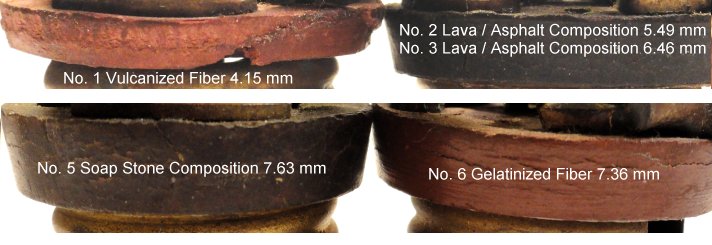
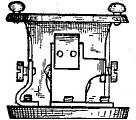 This
is proven by simple facts. First, the patent illustrations of the
thickness of the insulated block being this fiber sample (shown right
and below); the threaded Edison base shape
also being made for this type sample; the cement
paste was made to bind to this type of fiber material, not lava
or asphalt (in this case bitumen
would had then
been used for the paste); and finally the next socket (moving tongue
no. 2) only months after the patent application was filed, is made
of a black material that looks like lava. While it was not lava, this
black composition was made from materials with volcanic properties.
Also, notice the patent illustration shown on your right. Patent illustrations
(as well as catalog illustrations) are most always drawn to scale,
and will rarely look different from the current product (at the time
the illustration is being drawn). There is no doubt when comparing
the size of the insulated block in the patent illustration with the
vulcanized fiber thickness, that this is what the artist was looking
at. This
is proven by simple facts. First, the patent illustrations of the
thickness of the insulated block being this fiber sample (shown right
and below); the threaded Edison base shape
also being made for this type sample; the cement
paste was made to bind to this type of fiber material, not lava
or asphalt (in this case bitumen
would had then
been used for the paste); and finally the next socket (moving tongue
no. 2) only months after the patent application was filed, is made
of a black material that looks like lava. While it was not lava, this
black composition was made from materials with volcanic properties.
Also, notice the patent illustration shown on your right. Patent illustrations
(as well as catalog illustrations) are most always drawn to scale,
and will rarely look different from the current product (at the time
the illustration is being drawn). There is no doubt when comparing
the size of the insulated block in the patent illustration with the
vulcanized fiber thickness, that this is what the artist was looking
at.
So far, there is NO EVIDENCE of Bergmann ever using "lava",
or "simulated
lava" which was new at that time and growing in popularity.
It is more likely that Bergmann simply changed his mind; or misidentified
the material; or had a language gap; or misunderstanding of what sounded
like lava to him. An example of this would be other products at the
time that sounded "volcanic", or that were made from materials
with volcanic properties. Examples of such names would be Ebonite
and Vulcanite,
which can sound like something black and volcanic. However, I only
used these names to point out their existence and how some names can
sound. These examples (being vulcanized rubber) would not have melted
during heat tests, as my Bergmann fragment sample did. After my testing
and research, I know that the composition consists of the volcanic
black pitch, asphaltum
(mostly composed of bitumen). I trust that this is what Bergmann meant
by the term "lava", since this was the next material to
be used after the patent was filed. To make this case even stronger,
I can document Edison using different asphaltum products such as Insulite.
I also found a note
from Edison in a technical notebook, written to Charles Batchelor
to see Bergmann for a sample of a molded material. He gives the recipe
of the composition which consisted of asphalt as the only binder.
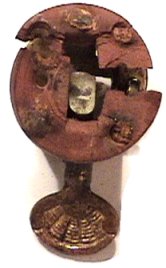 The
first moving tongue socket is not hard to identify seeing it is so
different from all of the others that you will ever come across. The
first moving tongue socket is not hard to identify seeing it is so
different from all of the others that you will ever come across.
This was a really short time span (within only months) where rapid
changes and improvements were being made. You will easily notice this
fact from these first few sockets in this line up. This first vulcanized
fiber moving tongue is not only the most rare of them all, but also
likely to be one of the most fragile.
It was made from regular red vulcanized
fiber, just like the acorn
sockets were.
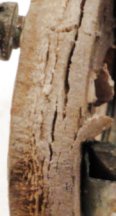
Unfortunately however this socket used more drilled holes and had
moving parts, which applied stress to the insulating plate. Needless
to say, these early innards were easily cracked and broken as shown
in the picture to your right. If you find one of these (or other early
'lava' moving tongues) intact you should feel holy in some way. A
word of caution, if you have one intact, treat it with kid gloves!
- I have experienced intact sockets breaking into pieces, by simply
turning the key. These first sockets however, because of the paper
construction of the vulcanized fiber innards, do glue back together
nicely. The black asphalt composition innards also are just as fragile.
I have held many of these in my hand so far, with only two being found
completely intact. These two also having cracks ready to crumble when
you turn the key or tighten the socket collar. These can also be repaired
and strengthened, but should never be thought to use as a working
example on an actual lighting fixture. This is my personal opinion
based from my first hand experience with them.
I would love to hear about or see any versions of these early Bergmann
moving tongue sockets that differ from those that I show on this site.
Moving Tongue No. 1 - The Edison Screw
Base As Seen In The Patent Illustrations
|
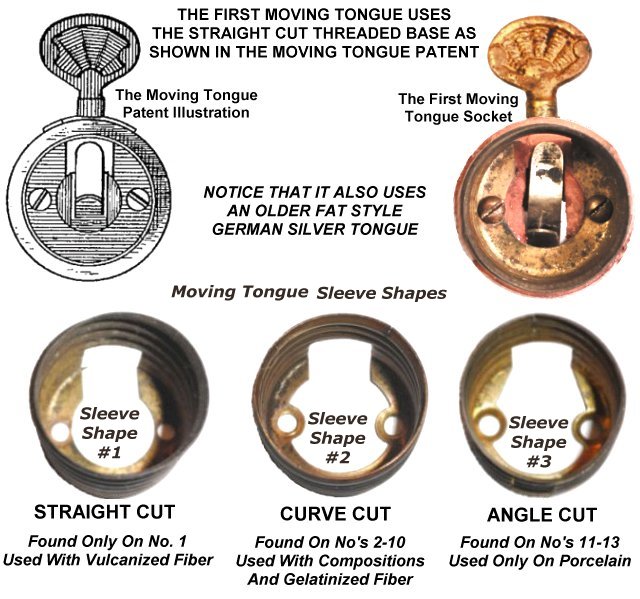
 From
the original moving tongue patent illustration shown above, it is
easy to see that the threaded base sleeve was much different from
those found on the molded innards. Note worthy is the fact that
molded innards started showing up only months after this patent
was applied for in 1884. From
the original moving tongue patent illustration shown above, it is
easy to see that the threaded base sleeve was much different from
those found on the molded innards. Note worthy is the fact that
molded innards started showing up only months after this patent
was applied for in 1884.
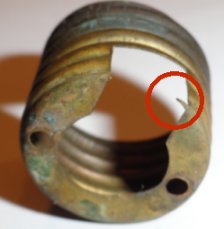
Also notice that with the early vulcanized fiber innard, a much
more crudely made sleeve was used. As shown on this sample (close
up on your right), you will notice a sharp piece of brass sticking
out from where it was cut and not filed down or trimmed later.
Also note worthy is the fact that while German silver was still
used for the center contact of the No. 2 moving tongue, the example
on this no. 1 moving tongue used a much thicker or wider version
of it.
Moving Tongue No. 1 - German Silver
Center Contact
|
|
Note
that this section also covers moving tongue socket no. 2 for
German silver
And sockets 3 - 13 for the brass center contact tongue
|
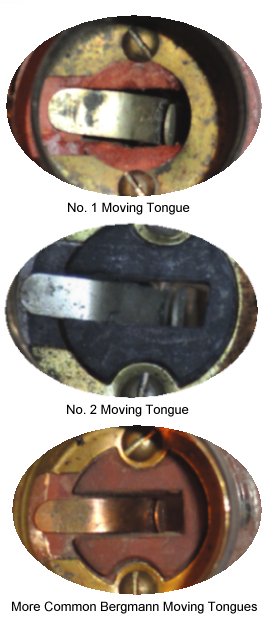
As seen above,
this first moving tongue used a silver colored center contact (likely
German silver) that is much wider then silver contact used on others
that follow it.
 As
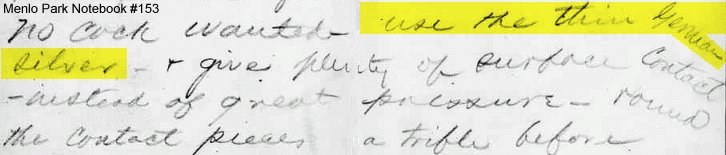
shown above, I can document the use of German silver on early Edison
sockets. I also have come across purchases and continuous comments
(Edison employee's) about German silver and Bergmann's special sources
for purchasing the best quality of it. I can also document people
at E.G.E. looking for those contacts after Bergmann was no longer
with the company. As
shown above, I can document the use of German silver on early Edison
sockets. I also have come across purchases and continuous comments
(Edison employee's) about German silver and Bergmann's special sources
for purchasing the best quality of it. I can also document people
at E.G.E. looking for those contacts after Bergmann was no longer
with the company.
I can not however document its use on these early moving tongues,
but because of the fact that these socket contacts are not plated
they really can't be anything else. This is because nickel alone
would be too hard and brittle and other silver colored metals at
the time would have been too soft for this use. German silver was
a well known metal of choice for electrical manufacturers for "spring
metal" at this time in history.
WHAT IS GERMAN SILVER?
I know what you might be thinking, but I will stop you right here
and now.
German "SILVER" is not the precious metal that you might
be thinking of when comparing it to what you might already know
about, such as Sterling Silver, Coin Silver, Italian Silver and
many other more precious and well known terms.
German silver is an alloy that was made up from different proportions
of nickel, copper and zinc.
Each manufacturer had his own recipe which may differ for their
intended results. For example some would agree that the best quality
(but also hard to work with) would be two parts nickel, four parts
copper and two parts zinc.
However, if the items were to be stamped or maybe hammered, more
copper would be added. If something was to be cast in a mold, some
manufacturers state that two percent lead would also be added.
This German silver alloy is known to be harder and more durable
then brass and can also produce a nice polished product.
Later, German silver was used for household items such as forks,
spoons, teapots, etc., but plated with real silver over the alloy.
This use however even though being German silver under the plate
was no longer called or associated with it's name. These new products
were called by names such as: navoline, argentoid, silveroid, nikeline
(and some other names). Some of these can also contain small amounts
of tin, cadmium or other white type metal.
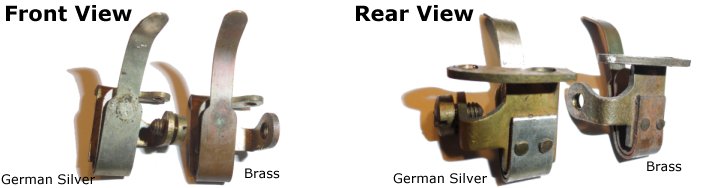
German silver was only used on the first two moving tongue sockets
(as well as all other Edison & Bergmann sockets made before
1884). After this point, brass and copper type metals are used.
Moving Tongue No. 1 - Patent Dates Missing
|
|
Note
that this section also covers other Bergmann moving tongue
sockets (no.2, 3, 4, 5)
|
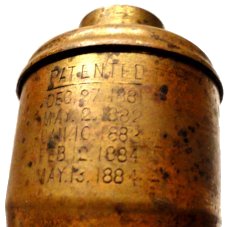 The
last patent date on the shell that these innards are found in is
stamped MAY.13.1884. This was the patent for the Bergmann No. 1
socket with the wooden innards (assigned patent no. 298,658).
The moving tongue (311,100)
was patent applied for on April 10th 1884. So, we know that this
socket material was being used sometime after May of 1884 because
the date is stamped on the shell. We also know that the patent was
approved on Jan 20 1885 at which time or shortly after the new patent
date would had been added to the shell. I trust that we can safely
date the innard materials (used on the sockets found in these shells)
between these dates. The
last patent date on the shell that these innards are found in is
stamped MAY.13.1884. This was the patent for the Bergmann No. 1
socket with the wooden innards (assigned patent no. 298,658).
The moving tongue (311,100)
was patent applied for on April 10th 1884. So, we know that this
socket material was being used sometime after May of 1884 because
the date is stamped on the shell. We also know that the patent was
approved on Jan 20 1885 at which time or shortly after the new patent
date would had been added to the shell. I trust that we can safely
date the innard materials (used on the sockets found in these shells)
between these dates.
As far as the vulcanized fiber innards, it would also be safe to
end their life several months before the patent approved date. This
is evident from the fact that there are more socket innard changes
coming up next in the lineup, which are also found in shells missing
the Jan. 1885 patent date. We need to allow some time for these
changes to take place in a manufacturing environment (even if it
would be only a few months). From all of the patent evidence (and
mention of lava), it is clear that there is no need to go out of
our way and try to pin down exact dates for the vulcanized fiber
innard, as this was an extremely short lived prototype.
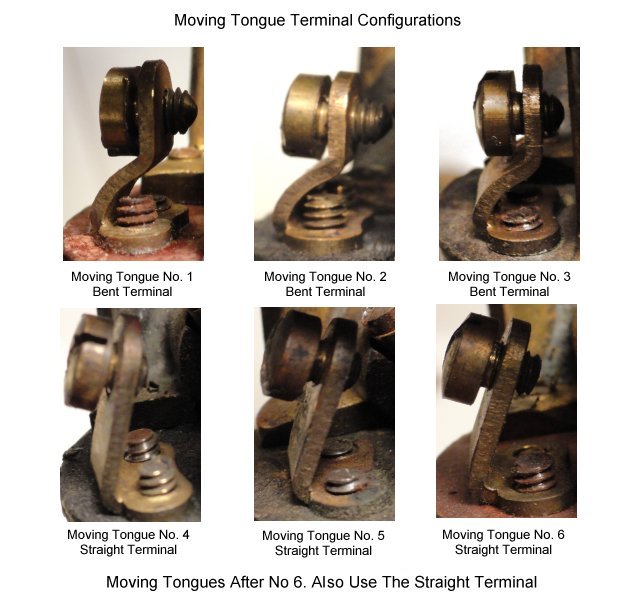
Moving Tongue No. 1 - Bent Wire Terminal
Post
|
|
Note
that this section also covers other Bergmann moving tongue
sockets (numbers 2 & 3)
|
As
shown below, the first moving tongue used a bent wire screw terminal.
Just as the shell and patent date example above, this bent terminal
shows the short time frame between these socket materials. Innards
1 through 4 shown below are all found in these shells without quarter
moon cut-outs on the caps and the the sockets own patent date,
not yet found on the socket shells.
During this short 'patent applied for' time frame of about 8 months,
we have a material change from vulcanized fiber to asphalt/lava,
a center contact material change from German silver to brass and
this terminal from bent to straight as well as a few other documented
changes shown on this page.
Moving Tongue No. 1 - Fatter More
Crudely Made Screws
|
|
Note
that this section also covers other Bergmann moving tongue
sockets (no.2, 3, 4, 5)
|
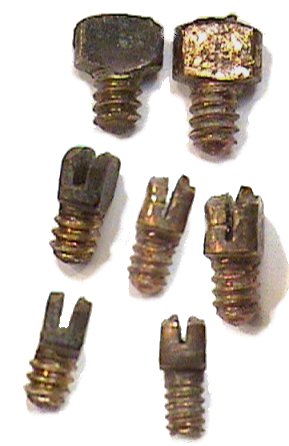 You
will notice that the older sockets (ones that are normally found
without the quarter moon cut out on the socket cap), use these larger
more primitive rectangle screws. You
will notice that the older sockets (ones that are normally found
without the quarter moon cut out on the socket cap), use these larger
more primitive rectangle screws.
Notice three on the left side are shorter with less threads. These
also have more perfectly shaped rectangles and clean and even slits
for a screw driver.
The four on the right are fatter / thicker, longer and have different
slits cut with no two being exactly the same.
These were made by hand and very crudely.
I first noticed (and thought) that the thread was different because
it did not seem like these screws were fitting into newer Bergmann
moving tongues. After a closer look it was evident that the new
sockets were tapped / threaded, but not all the way through. Also
because the smaller shorter screws are always used, they never need
to be turned down into the hole that far where it would show.
However, because these older longer screws would require to be screwed
into the brass further, it becomes tight where the female threads
stop.
This is the reason that you will notice that the short screws work
on the older sockets, but the older socket screws will not work
on the newer sockets unless you tapped the holes further down.
Another thing noteworthy about these older screws is that they will
not work on the older caps really well. With some of the screws,
you might be able to fit them through the rectangle holes on the
caps with much wiggling and fiddling, but most of them simply will
not fit through the rectangle slots on the caps. A problem never
heard of with the newer caps and screws. If you own one of these
early Bergmann's just get use to completely removing the screw to
remove the cap. Also for most of them you will need to use a very
thin blade on your screw driver.
Moving Tongue No. 1 - No Quarter Moon
Cut-Out On The Cap
|
|
Note
that this section also covers other Bergmann moving tongue
sockets (no.2, 3, 4, 5)
Also Sockets 6 & 7 which have the cut-out)
|
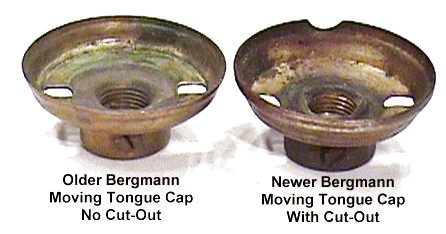 As
shown and talked about already in this section briefly, the older
moving tongue sockets (no. 1 through no. 5) do not have the quarter
moon cut out. (Note that socket no.5 is not fully
documented but based on some evidence) As
shown and talked about already in this section briefly, the older
moving tongue sockets (no. 1 through no. 5) do not have the quarter
moon cut out. (Note that socket no.5 is not fully
documented but based on some evidence)
It would probably be good to mention, that any Bergmann moving tongue
without this cut-out is a really rare socket to come by. Jump for
joy any time that you find one, but be sure that you take a closer
look if you think that you spot one.
Always remember that the cap could be on backwards (you might not
notice that the cut-out is on the opposite side, where it does not
belong or show very well).
I will tell you that among my small group of collector friends,
years had passed by before one of these had ever shown up.
In fact, it was only a good guess that one even existed for the
longest time. We had deducted and reasoned that one had to exist,
but had never seen one, or even a picture of one in a catalog. This
is because Bergmann never updated his images of sockets in his catalogs
once the first image was created. The only skinny Bergmann key socket
ever shown in a Bergmann catalog was the no 1 Bergmann socket that
had the wooden innards.
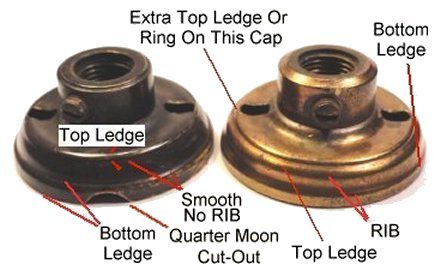 Another
difference with these caps is that on the older one without the
quarter moon, there is a bead / rib between the bottom of the cap
ledge and the top ledge / border. This can easily be felt by running
your finger up and down over the rib. Another
difference with these caps is that on the older one without the
quarter moon, there is a bead / rib between the bottom of the cap
ledge and the top ledge / border. This can easily be felt by running
your finger up and down over the rib.
The newer caps with the cut-out do not have the rib. They only have
a straight feel from the bottom and the top ledge.
The older socket without the cut-out has a bottom and top ledge
as well as the RIB (or bump that sticks out).
It also has a third ledge or ring on the top, above the top ledge.
Note worthy is the fact that this older cap is of the same design
as the Bergmann no.1 socket.
You might also want to view this section,
where the inside of the cap is measured.
Moving
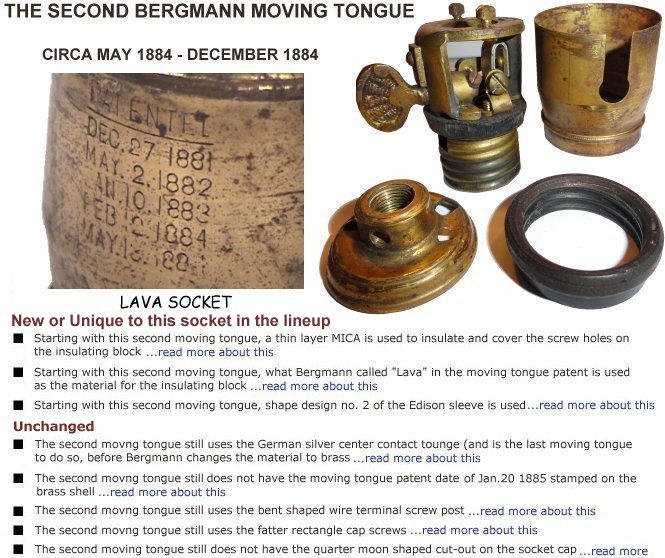
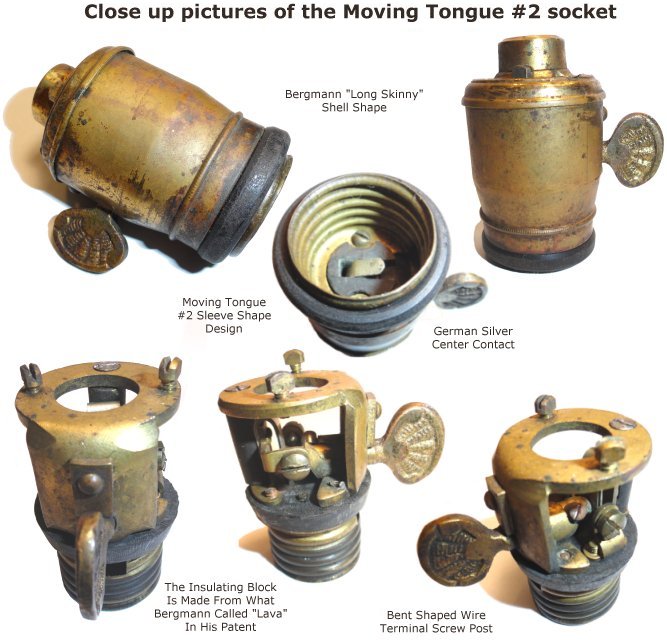
Tongue No. 2 - The First Bergmann Lava Socket
|
Moving Tongue No. 2 - Uses Mica To Cover
The Screw Holes On The Insulated Disk
|
|
Note
that this section also covers all other Bergmann moving tongue
sockets
|
Starting
with this no. 2 moving tongue, electrical cement
is no longer used to insulate or cover the screw holes on moving
tongue sockets. Starting with this socket, all other moving tongue
sockets in this lineup will use mica as an insulator.
Noteworthy is the fact that the shape of the mica will change on
the porcelain innards (lineup sockets 11 through 13) , to fit the
new shape of the #3 Edison threaded sleeve.
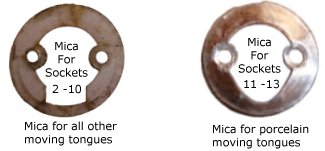
Note that mica is also talked about in the first moving tongue section
covering the topic of electrical cement in place
of mica.
Moving Tongue No. 2 - Uses
What Bergmann Called "LAVA" For The Insulated Disk
|
|
Note
that this section also covers other Bergmann moving tongue
sockets (no. 3 & 4)
|
There seems like
there is so much to talk about there when it comes to this material
and the history behind it, the misunderstandings, etc., etc..
WHAT WAS LAVA IN THE EARLY DAYS?
If you are reading in order, you know that I have already talked a
little about the moving tongue patent and the subject of "lava"
here in this section. I have also provided
some information and history on the subject of what was called 'lava'
in the early days in my materials section here.
Short and to the point is the fact that in the moving
tongue patent, Bergmann made the statement "I prefer to use
a...material such as lava". However, at the time the patent was
first written, it is clear that vulcanized fiber was currently being
used. Also about the time that the patent was written, there was much
advertising and talk about a new 'lava' type of electrical insulation
going around. The material that was used for the insulating block
on these sockets, was not the material that was known as lava in those
early days.
THE LEGITIMACY OF BERGMANN'S ASPHALT
COMPOSITION BEING CALLED "LAVA"
This material is a composition made using an asphalt
binder and likely clay as an inert ingredient. I have done much testing
on this material and will publish my tests in a sub section and link
it here at a later date. The fact that asphalt
consists of "real" volcanic properties, there was nothing
all that wrong for the day and time for Bergmann to call his material
lava compared to the legitimacy of the current artificial
lava being named such.
Even though I know that this material is not what the world today
would term or think of as "real" lava 'rock'; and even though
I also know that it is not the material that later became to be known
as 'lava' (artificial
lava);
I feel it is correct historically (because of the fact that Bergmann
called this material lava), that I identify it as he may had called
it - the "Lava" socket.
MOVING TONGUE LAVA MATERIAL
CLAIM USED IN A PATENT TRIAL
During a court trial many years after the company had changed leadership
- and Bergmann was long gone - the point of lava being claimed in
the moving tongue patent was brought up to prove a point in a continued
court case (1894) against EE&S (electrical Engineering and supply
company). General Electric was using the Bergmann statement "A
is a disk of insulating material. I prefer to use a non-combustible
and non-carbonizable material, such as lava.", To include porcelain
as a "non-combustible" material and find EE&S in infringement
against the Bergmann patent. Needless to say, G.E. Was not allowed
such a monopoly, also commented that neither would there be for lava
which no one wanted to use anyway.
EDISON
ELECTRIC LIGHT CO. v. ELECTRIC ENGINEERING & SUPPLY CO.
The character of the insulation is left optional, the patentee
merely expressing a preference for material having the characteristics
of lava. He does not claim lava or any other material specifically.
Assuming that he discovered lava as applied to this art and
that its substitution for the materials previously used constituted
invention, and, assuming further, that the claims can be limited
to lava, it is not easy to see upon what principle he acquired
a monopoly of porcelain which is the material used by the defendant.
Especially is this true when it is remembered that Bergmann
did not use porcelain until two years after the date of his
patent, although, us above stated, its use was suggested by
Gordon five years prior to that date.
An examination
of this record must convince the impartial reader that the
use of non-combustible insulating material in this and analogous
situations was not new with Bergmann and that its advantages
were recognized by a number of electricians long prior to
the date of his patent. If the disk claims are construed broadly
as covering all kinds of non-combustible insulating materials
they are clearly void because non-combustible material had
been used in similar combinations, and if these claims are
limited to lava the defendant does not infringe for the reason
that it uses porcelain and not lava.
If the
court were dealing with a foundation patent it is not unlikely
that porcelain would be regarded as an equivalent for lava
in the same way that soapstone and glass, broadly speaking,
might be so regarded. But, as will be seen hereafter, Bergmann
is not entitled to the benefit of the doctrine of equivalents.
He was the first to use lava. It would seem from the record
that no one cares to dispute his right to its exclusive use.
Lava is not the commercially successful insulating material
of to-day; porcelain is. To give Bergmann a monopoly of porcelain
and all similar substances because he was the first to adopt
a material which no electrician wishes to use at the present
time, would not only do injustice to the defendant, but to
all others who have made or are endeavoring to make improvements
in this art. --------------------Circuit
Court, N. D. New York. February 27, 1896 No. 6.071
|
A
BERGMANN RECIPE FOR A MOLDED ASPHALT COMPOSITION
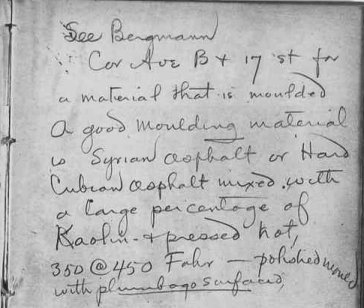 Asphalt
based compositions were not new to Edison
or Bergmann, as their use of these materials predate his electrical
inventions. In the early years Edison and Bergmann experimented
and used hard rubber as well as different asphalt
and rubber compositions for his other inventions,
such as his phonograph in the late 1870's. Asphalt
based compositions were not new to Edison
or Bergmann, as their use of these materials predate his electrical
inventions. In the early years Edison and Bergmann experimented
and used hard rubber as well as different asphalt
and rubber compositions for his other inventions,
such as his phonograph in the late 1870's.
I can document several uses and testing of different asphalt
binding compositions through the electrical years, but the best
example is a laboratory notebook that I found belonging to Charles
Batchelor (shown right).
The entire notebook contains his experiments and notes which were
written in his own hand, with exception to the first page.
The first entry was by Edison in which he wrote some instruction
about a molded composition.
Edison told Batchelor that he could get a sample of a good molded
material from Bergmann (he gives his address).
 Edison
then describes the molded material as made from hard asphalt (Cuban
or Syrian) mixed with a large percentage of kaolin
(a natural clay material). It is then pressed in a hot polished
brass mold from about 350 to 450°
F. Edison
then describes the molded material as made from hard asphalt (Cuban
or Syrian) mixed with a large percentage of kaolin
(a natural clay material). It is then pressed in a hot polished
brass mold from about 350 to 450°
F.
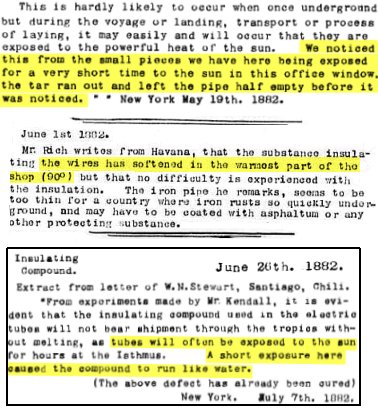
There are also the 1882 (broken link)
and 1883 (broken link)
Edison defect books which also reflect an early use of tar and asphalt
for insulation in wire tubes used for early underground wiring insulation.
As shown on the right, exposure to the sun on a hot day could cause
the asphalt to soften and in some of the reports even run out of
the tubes.
In another excerpt (shown right) 90 degrees for a softening (not
melting) point is mentioned, which is close enough for refined Cuban
asphalt which has one of the lowest melting points of 115-160 degrees
depending on hardness. As a reminder, it was also the Cuban asphalt
that was mentioned by Edison as being used by Bergmann in the Batchelor
note book above.
You can read more about asphalt and bitumen based compositions using
this
link, or more about asphalt and its properties and history here.
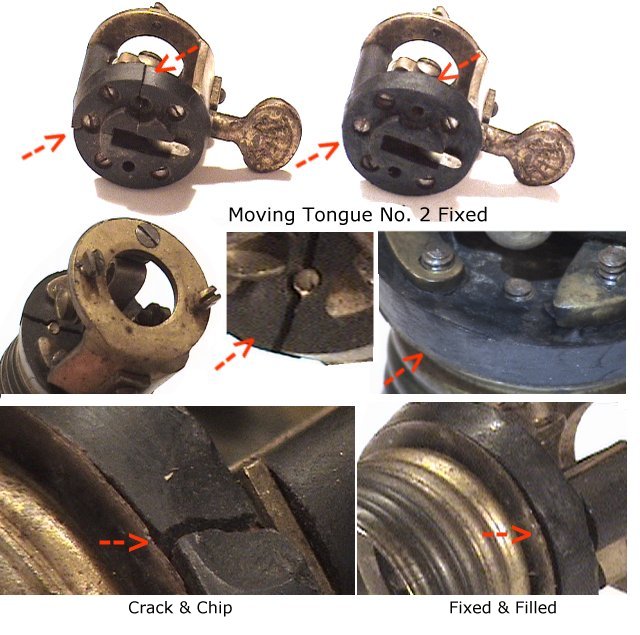
THE REPAIR OF FRAGILE LAVA SOCKETS
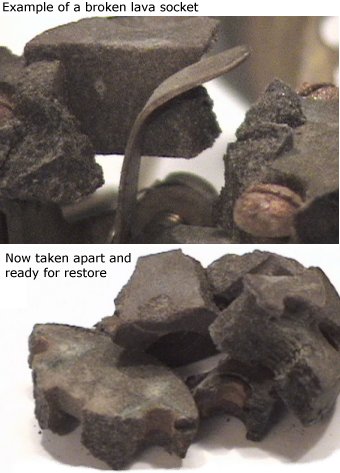 Well,
just to get down to the point of the material that was used on these
sockets, it did not survive the test of time well. Well,
just to get down to the point of the material that was used on these
sockets, it did not survive the test of time well.
So far all that I have seen have dried out, warped, cracked and
become extremely brittle. I have handled several handfuls of these
lava sockets to this date and only two were not broken in some way.
One of these two broke into pieces when I turned the key on it.
Needless to say, I have had lots of experience in repairing these
lava sockets.
I have discovered the best methods to not only repair these insulating
disks, but strengthen and revive the material so that they are strong
and ready for use once again. Most times when you see one of these
in original condition, you will notice that it has become warped
or bent out of shape. This change in the structure of the material
has caused multiple cracks. This is because the parts were screwed
tight and firm to the disk. The parts trying to hold the disk together
actually caused cracking from the stress of the parts, which were
forcing the disk to hold its shape.
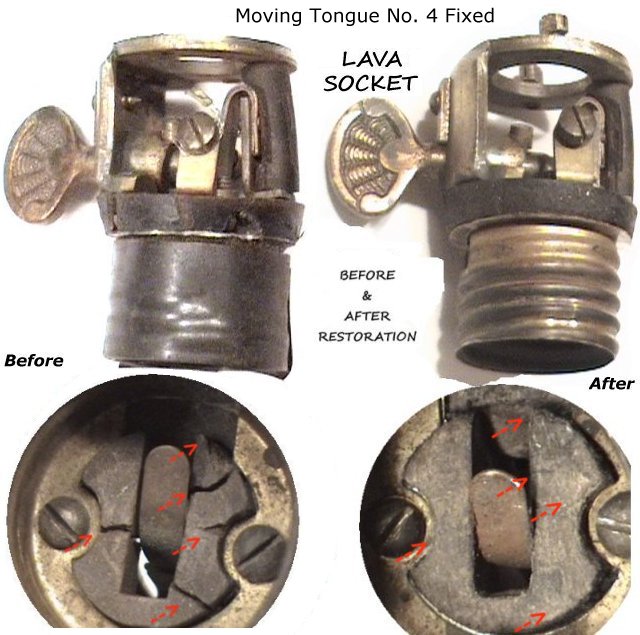
Below are some close up pictures of a few repairs that I have done
on lava sockets.
The first shown directly below, is of a Bergmann no. 4 lava moving
tongue, which you can identify by noticing the straight wire screw
terminal.
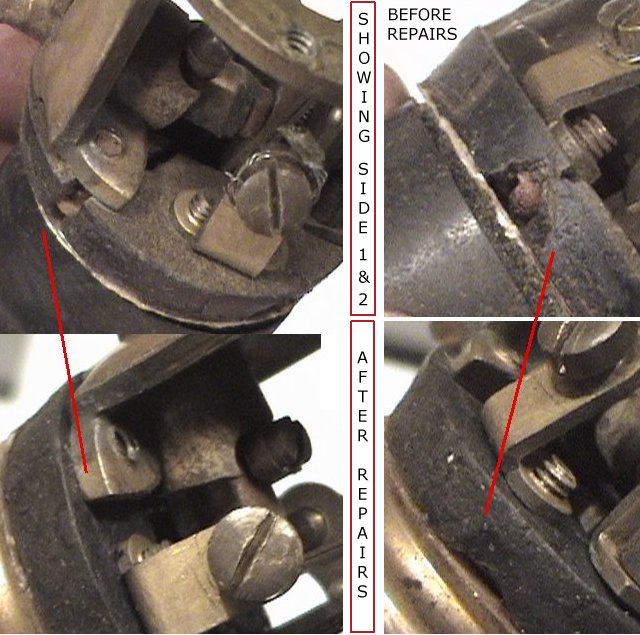
Moving
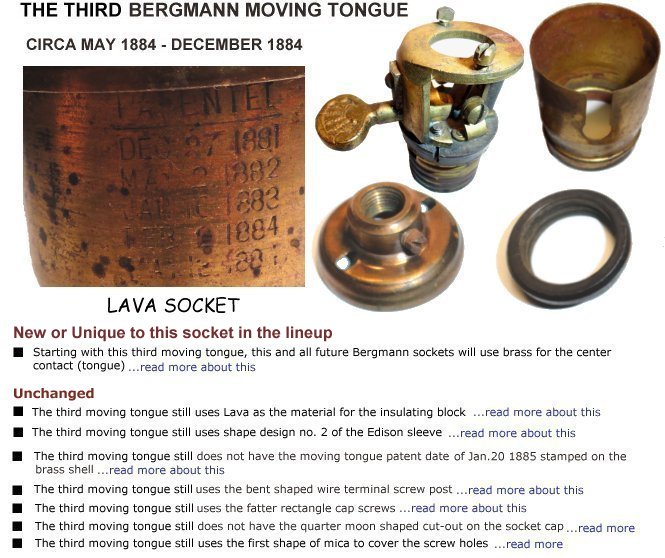
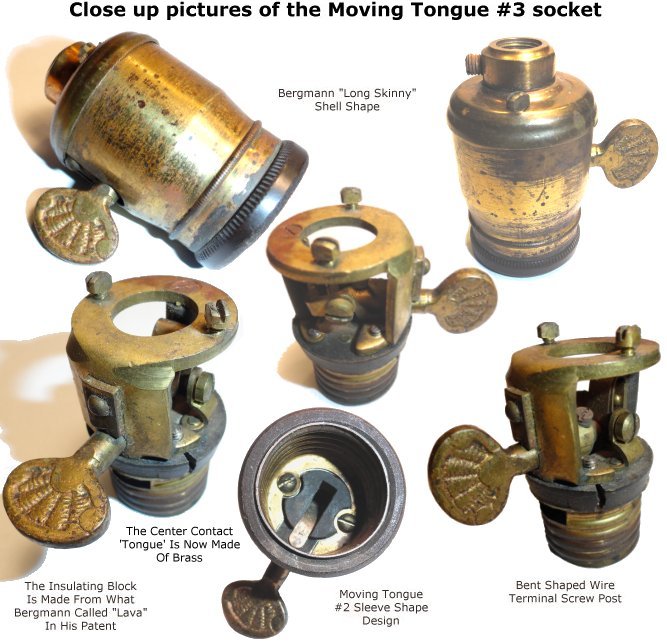
Tongue No. 3 - The Second Bergmann Lava Socket
|
Moving
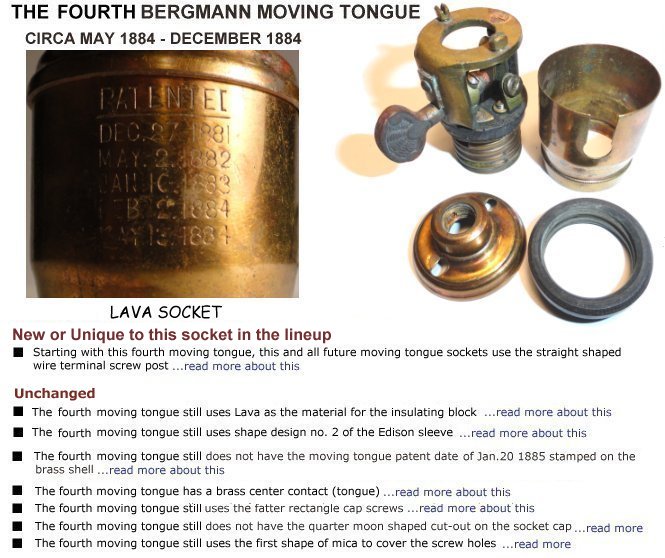
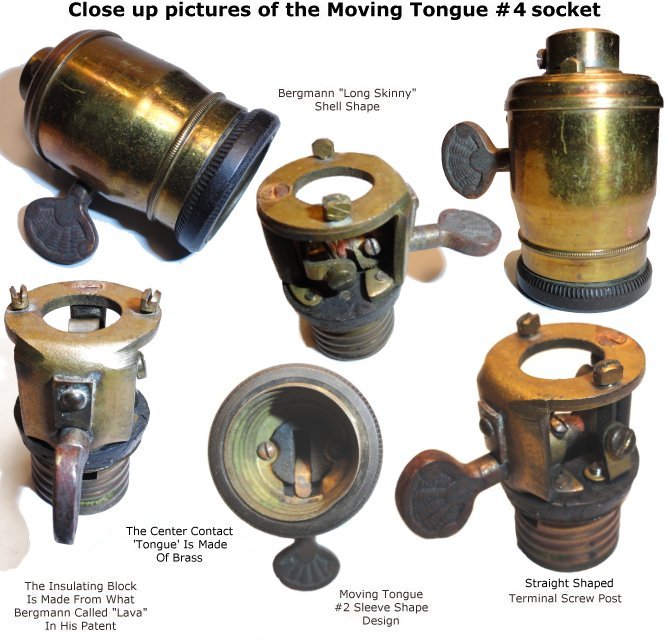
Tongue No. 4 - The Third & Last Bergmann Lava Socket
|
Moving
Tongue No. 5 - The Bergmann Soapstone Socket
|
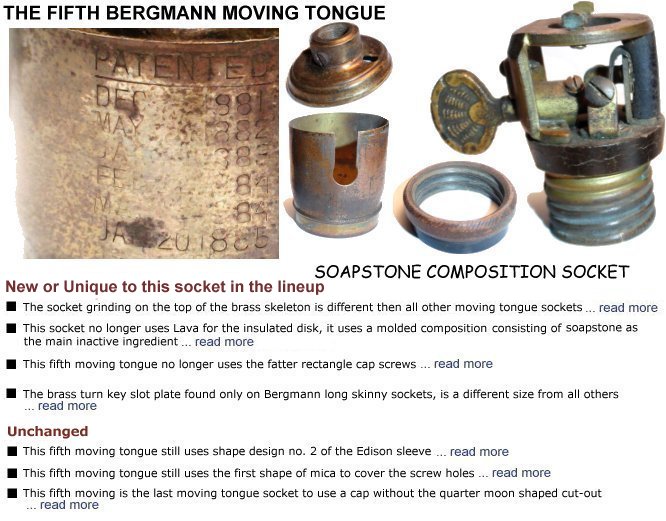
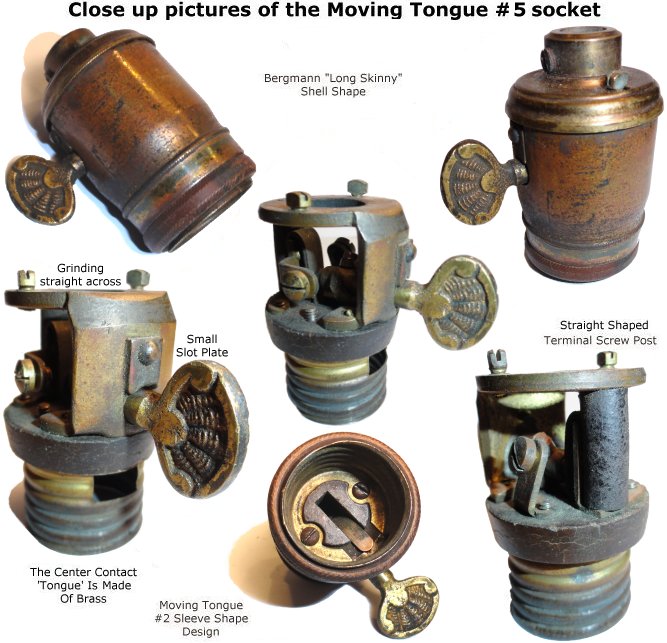
Moving Tongue No. 5 - Socket
Skeleton Shapes & Grinding Marks
|
For
anyone that is lucky enough to own one or more of these early moving
tongue sockets covered so far, they can confirm the different cap
issues that came along with these sockets.
For example the first sockets that used the fatter more crude screws,
(in most cases) required the person taking the socket apart to remove
the screws completely. This was because the screws were to fat or
mis-shaped to fit through the rectangle holes. Later, when the screws
were shaped more perfectly, you could turn the screw to line up
with the rectangle hole and then simply separate the socket from
the cap.
Another example would be that because of the shape and size of the
brass skeleton, sometimes leverage was required to hold the cap
in place while screwing on the collar. Rarely would the cap just
fit into place and most times so much effort was required that sockets
could be damaged simply by someone 'forcing' it to fit correctly
in place.
This issue is/was caused by the skeleton not being bent to the correct
or precise shape. Keeping in mind that this skeleton part when manufactured
was one flat piece, it was then bent or folded over on the bottom
and top which gave it the "L" shape. If it was bent just
a bit too much (or not bent enough), the cap was hard to line up
straight on the shell when screwing the socket tightly together.
The above could also play a part when lining up of the ground rounding
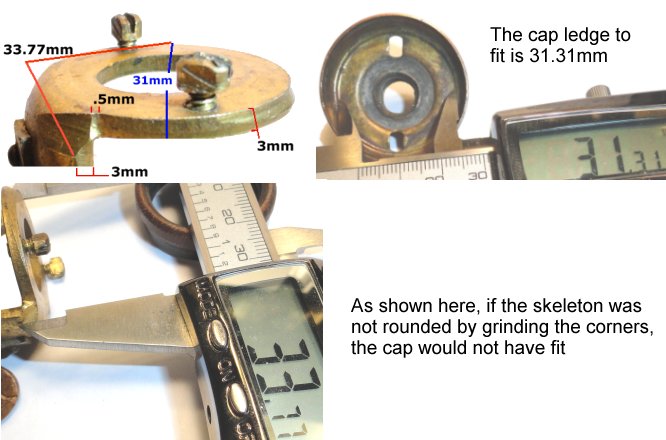
into the top ledge of the cap. Since this piece was a thick flat
(3mm) chunk of brass, when it was folded over, it was not completely
round. To fix this issue and make the cap seat properly, the corners
were ground off making the top of the skeleton perfectly round to
fit into the top ledge of the cap.
 |
All of the moving tongue sockets had the corners grounded until
after 1890, when the skeleton design changed to perfect the porcelain
version of the sockets. There were three different porcelain moving
tongue sockets, which were moving tongue numbers 11, 12 and 13.
Only sockets 12 and 13 did not need grinding and were manufactured
close to or during the time period of 1891 / 1892.
Grinding corners through the years has always been really consistent.
This includes all eleven sockets that required grinding with exception
to only this no. 5 socket.
To illustrate this statement, below I show the first five sockets
and the grinding required to to fit the caps.
The measurement given is the size if it was not ground, illustrating
how far off the cap would have been without grinding.
The cap would require the socket to be less than 31.31 mm for it
to seat properly.
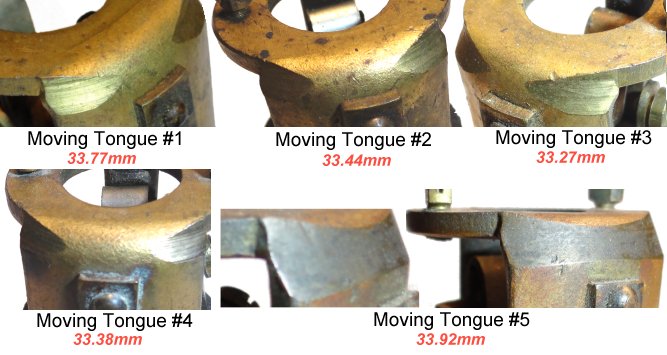
These measurements do not change because of any changes from socket
to socket, but rather because they were all done by hand. The bending
also would have caused small changes as well. Some were bent more
or less then others causing the small differences. The grinding
is what made the top of the skeleton round and to the correct size.
You will find some sockets ground more or less then others, which
sometimes because of incorrect bending would require more or less
grinding.
The no. 5 socket is no different, it is the same 3mm thickness as
the other sockets.
This tells me that Bergmann was on his way to fixing the cap design
and possibly trying things differently.
Since this no. 5 socket is so different - new material, different
size slot plate, and then this over grinding, it points to something
much different. By the time the next moving tongue socket comes
along, we have a new material change and a new style cap. This helps
add to the evidence of this being more of a prototype moving tongue
socket. Also about this time is found a new socket (rotary switch
socket Bergmann No. 4) which uses the same soapstone material for
it's insulated disk, and REQUIRES the cap change. It is evident
that this moving tongue no. 5 socket required a cap without the
quarter moon by the size and position of the new slot plate.
Moving Tongue No. 5 - Different Slot
Plate Size
|
Only moving tongue sockets found inside of skinny Bergmann shells
required the slot plate. In this lineup, this would be moving tongue's
no. 1 - 7. Slot plates on all moving tongue sockets are 11.50mm
high, with exception to this moving tongue no. 5 which is only 8.50mm.
The positioning is also a bit different, but the main point is that
it is evident that from it's size and position to require a cap
without a cut-out. This socket innard was found in a box with a
few caps without cut-outs, but no actual brass shell. It is possible
that this was some kind of prototype socket, so if anyone else out
there has anything like it, I would love to hear back about your
socket similarities or possible differences.
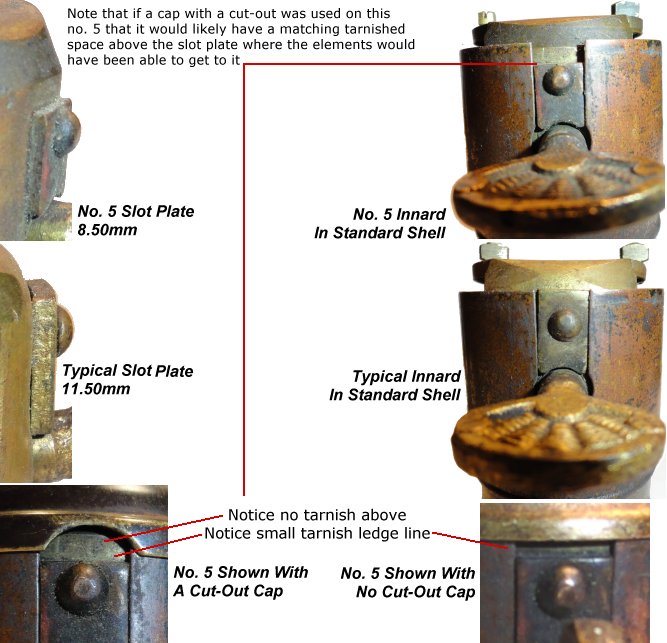
Note that from the above it is evident that this No. 5 soapstone
moving tongue sample used a cap without the cut-out.
However because this time period was close to when this change took
place, we can not eliminate the possibility of a socket using this
material being found using the new cap. OR, the next socket shown
below No. 6 (made of gelatinized fiber) being found in a shell without
a cut-out on the cap.
Moving Tongue No. 5 - New Molded
Soapstone Composition Material Used For Disk
|
This No. 5 moving
tongue also used a soapstone composition for the insulated block.
Note that the next Bergmann section will cover the rotary socket which
also used this soapstone composition for its insulated block. There
are other Bergmann sockets that also used and continued to use soapstone
after these moving tongue sockets. I have no answer as to why Bergmann
started using gelatinized fiber on moving tongue's, while selecting
to use soapstone on other sockets.
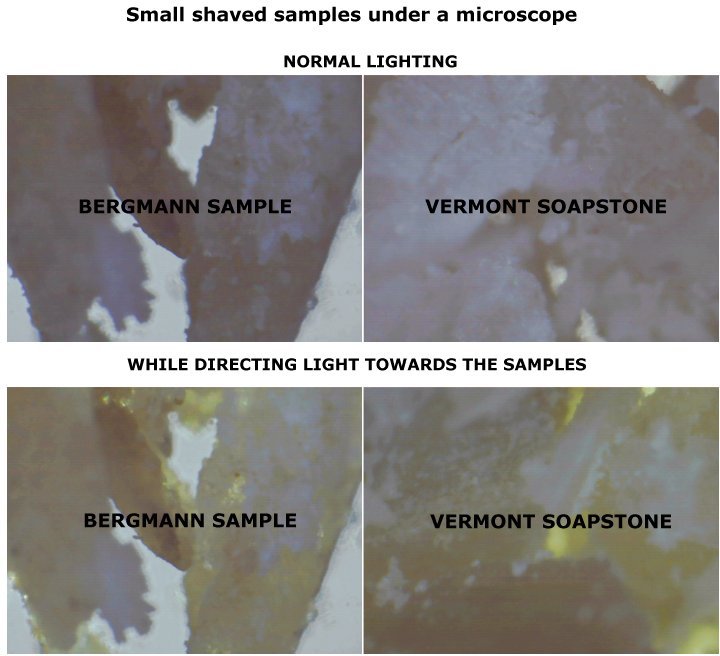
The microscope captures below document the soapstone material, but
please do see my soapstone
section where I go into much more detail (as well as show more
socket examples).
Moving
Tongue No. 6 - The First Gelatinized Fiber Moving Tongue Socket
|
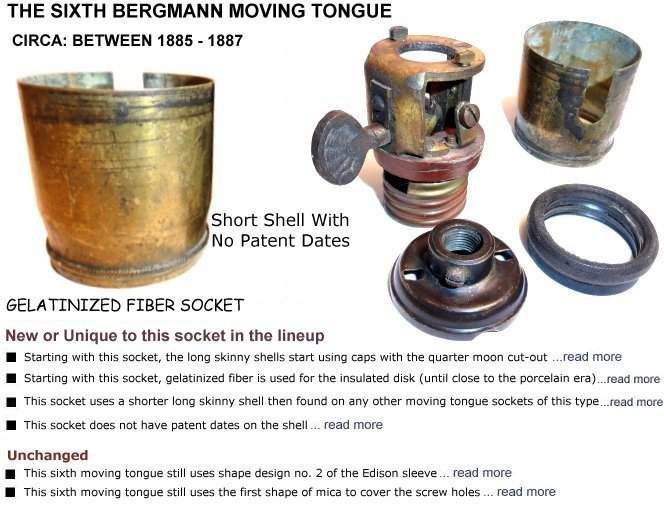
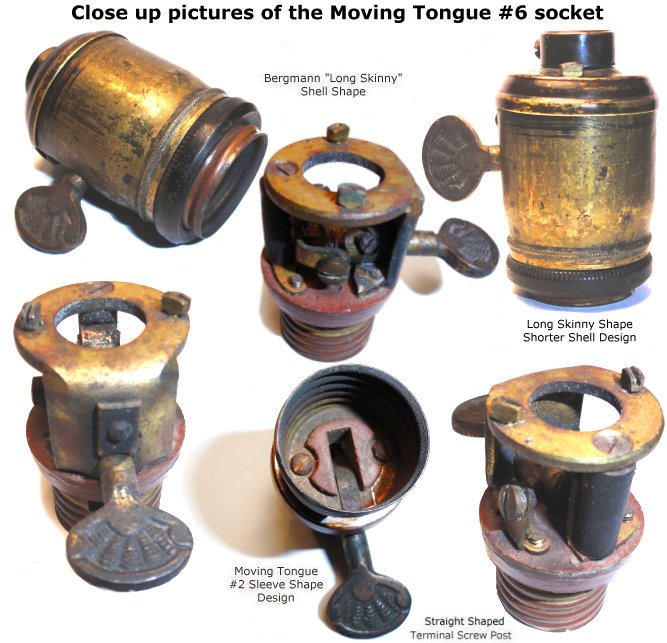
Moving Tongue No. 6 Uses "Gelatinized
Fiber" For The Insulated Disk
|
|
Note
that this section also covers other Bergmann moving tongue
sockets (no.7, 8 & 10)
|
Note
that the socket before this one (the moving tongue No. 5 soapstone
socket) used a cap without the cut-out on it.
Since this time period was close to when the change took place,
we can not eliminate the possibility of either a No. 5 socket with
a cut-out, OR this No. 6 socket (made of gelatinized fiber) existing
in a shell without the cut-out on the cap.
I talked about gelatinized fiber a bit in the introduction part
of this page in the section called Insulated
Tip Materials.
I also made a small table with links called "insulating
material known to be used on moving tongue sockets".
The topic of gelatinized fiber along with a good background history
is
covered here and some pictured examples of different types of
fiber are linked
here. I touched on the differences between the EGE and Bergmann
moving tongue sockets here in this section,
which also comments on and talks about the gelatinized fiber versions.
As you can tell from these links, I have already gone into lots
of detail on gelatinized fiber.
I am still looking for some quotes that I dug up a while ago, which
were a few different telegrams going back and forth between Edison
and some others, about Bergmann meeting with someone to try out
the new fiber. When I find them again, I will link it here as it
will help with dating.
While all of the sockets in this list (including this shell) are
extremely rare to come by, it is this material (gelatinized fiber)
that will seem most common to you in your search for Bergmann moving
tongue sockets. Most of the ones that you will come across will
be the fat Bergmann shell designs, some fiber and some porcelain
(porcelain being EGE not really Bergmann) but don't worry - you
will come across one of these gelatinized fiber skinny's from time
to time.
Gelatinized fiber was the insulating material of choice for Bergmann
when it comes to moving tongue sockets.
It was used on this no. 6 as well as no. 7, 8 & 10. No. 9 was
a new composition being tested, and 11, 12 & 13 were EGE sockets
made with porcelain innards.
Gelatinized fiber was, is and always will be the material loved
by those that used these sockets back in the early days, and those
that collect them today.
Moving Tongue No. 6 - Has A
Shorter Shell Compared To All Other Long Skinny Designs
|
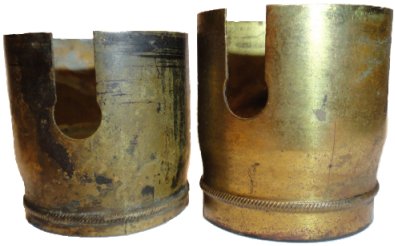 As
shown in the picture on your right, the first shell is the no. 6.
The shell next to it is standard long skinny Bergmann shell design,
which is pictured so that you can compare the difference. As
shown in the picture on your right, the first shell is the no. 6.
The shell next to it is standard long skinny Bergmann shell design,
which is pictured so that you can compare the difference.
It is unknown as to why this shell is shorter then all other long
skinny moving tongue sockets. It is obvious that the space under
the ornate rib is shorter, but there are some different thoughts
as to why.
Some think that the collars (flanged rings) at the time were much
thicker or higher.
These thicker collars would have covered most of the exposed threads
(though the electrical codes at the time did not require this).
It is also true that there was a migration of different types and
materials for these collars; The first Bergmann turn key socket
used wood and then was later
documented as being upgraded to hard rubber. The patent for the
moving tongue documents that collar as "a flanged ring,
K, of hard rubber or other suitable
insulating material, is screwed between sleeve B and shell I".
I should also mention that I own a thicker collar (obtained from
one of my short moving tongue sockets) that is made of a
wood and fiber based composition. This proves to me that
there was experimenting in progress to some degree, because of it's
existence. However, this is not proof as to a reason for the existence
of the short shell. As shown in the pictures below, the thicker
collar would have covered the threads completely, if a standard
Edison shade holder was placed between the collar and the socket
shell tube.
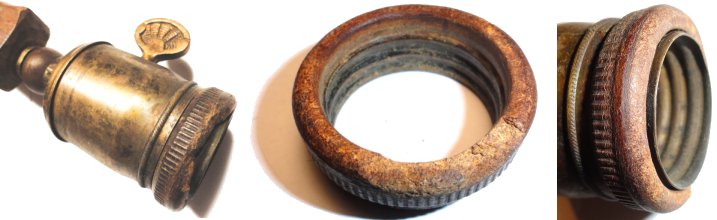
 Others
feel that the short socket tube had to do with shade holders. There
is a Bergmann shade holder that was applied for patent on Oct 9,
1882 along with the first acorn socket (patent no. 293,552).
While in 1882 this holder was similar to the standard Edison holder,
some time after it's patent approved date of Feb 12 1884 (because
the date is on it and not marked patent applied for - so, possibly
before), a built in hard rubber collar was added to it. It is however
documented as existing with the collar Sept. 26, 1885 (see below). Others
feel that the short socket tube had to do with shade holders. There
is a Bergmann shade holder that was applied for patent on Oct 9,
1882 along with the first acorn socket (patent no. 293,552).
While in 1882 this holder was similar to the standard Edison holder,
some time after it's patent approved date of Feb 12 1884 (because
the date is on it and not marked patent applied for - so, possibly
before), a built in hard rubber collar was added to it. It is however
documented as existing with the collar Sept. 26, 1885 (see below).
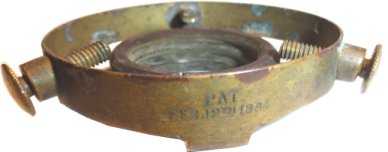
This shade holder would hide the extra threads under it. However,
it could also have been used with a standard hard rubber collar
which would then allow the shade holder and shade to be used under
the first collar by screwing it tightly on to the exposed threads.
So, it is also possible that the short shell design, was to accommodate
this type shade holder. There is a patent (no.
361782 some illustrations shown below) that illustrates this
shade holder with two collars, but with the second collar screwed
on to the exposed threads. This patent also helps date the collar
being added to the holder having a patent applied date of Sept.
26, 1885, which means that at least we know the collar was added
to the holder by that date.
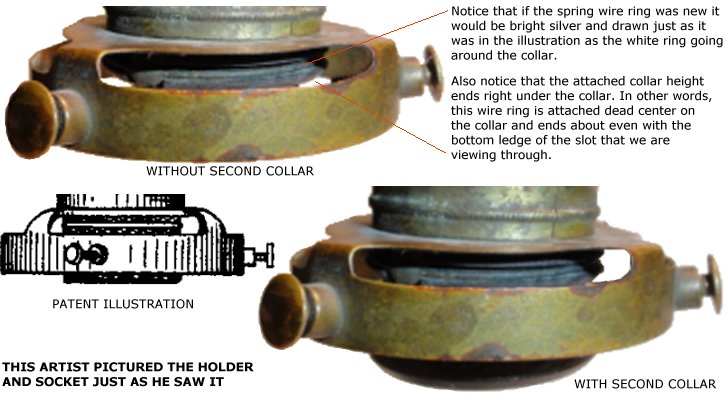
 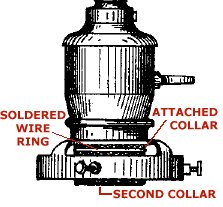
It is also noteworthy that without the two collars, If the shade
holder was removed while the socket was on a fixture, it would have
fallen apart. So, by using two collars, the first one would hold
the socket together while you were still able to remove the shade
or holder that was screwed on to the exposed threads under the first
collar.
So, maybe you can think of other reasons or 'special purposes' for
this short shell. Let me know and I will post them up here for others
to read. I guess both of these could be correct too, if taken in
the light of this socket being used with this shade holder and the
thicker composition collar used if the holder was no longer needed.
Moving Tongue
No. 6 - No Patent Dates On The Shell
|
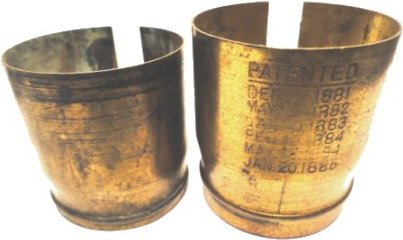 Another
mystery about this socket. Another
mystery about this socket.
THERE ARE NO PATENT DATES ON THIS SHELL
If you follow these types of sockets, you will know that Bergmann
turn key sockets always have dates on them, unless they were rubbed
off during an aggressive cleaning. HOWEVER- in these cases, you
will always find at least a few numbers or letters showing through
somewhere on the shell (even if only lightly).
METHODS OF DETECTING PATENT MARKS
There are also other ways to tell if a shell has ever been stamped.
Here are some quick guide lines for your use. First, you will most
always notice at least some of the dates or letters stamped through
to the inside.
The early sockets guessing 1884 through 1886 appear to have been
stamped by hand, not always being even or at the same place on the
shell. If you are holding the shell with the key hole facing towards
you, these stampings will mostly be positioned at twelve o'clock,
but some will be at either one o'clock or eleven o'clock (just a
bit off).
Another method that you can use is a measurement of the shell thickness.
If you measure the shell by the stamping area (using a digital caliper),
you will notice small (but very noticeable) variations in thickness
where the metal was hit.
Also, if you examine the inside of the shell from the eleven o'clock
to the one o'clock positions, you will notice where the finish/lacquer
has been scraped away or at least a noticeable rectangle shadow
where it was stamped. I have become really good at noticing this
by taking the blind test with about 20 or so shells in front of
me. Not looking where the dates were stamped (covering the outer
shell with my hand), looking into the shell while turning it and
finding the exact place where the shell was stamped every time.
(if you ever try this, always be sure to not mix up your innards
or caps as it is important to keep your sockets all original).
I am guessing from my samples (based on those missing the 1885 date),
that somewhere close to 1886 a new method was used to stamp the
shells. This new method caused only light dates (hard to see) to
appear on the outside, no metal stretching (so no thickness changes)
and only the shadows on the inside of the shell (without the dates
bleeding through). Later (about 1888) with the thicker fat Bergmann
shells, something changes again as almost ALL of the dates can be
seen coming through to the inside of the shell (not just a few letters
and numbers as in the later thin long skinny shells).
See below where I show some shadows found on some of my long skinny
shells.
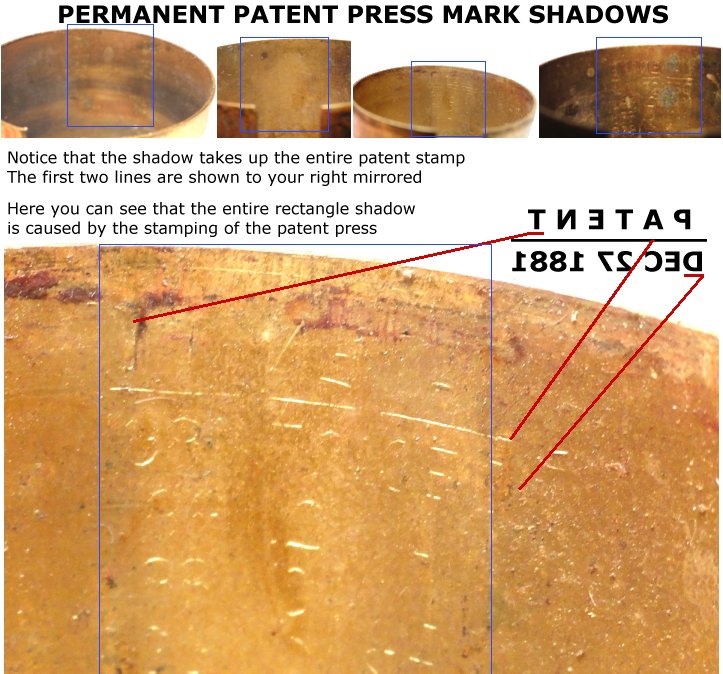
Here are some
full size images in a PDF (broken link) so that you can zoom into the edges
and have a closer look if you care to.
Now that we have covered the fact that we can tell if a shell has
ever been stamped, I should bring up the point that these short
sockets show no dates or individual letters or numbers ANYWHERE
inside or out. I will also mention the fact that I took hours with
a high powered microscope on all four of my sockets. They also have
no stamping shadows on the inside of the shell and the thickness
does not change around the diameter of the shell.
I have no real good answer as to why these shells do not have patent
dates on them, since the shells before them and right after them
did. Off the wall guesses would be that possibly the stamping method
used, required the longer shell to fit some kind of die to be stamped.
Another thought would be that since stamping methods did change
about this time, maybe they were in wait for the new machine or
what ever was needed or required to complete the task.
I should also mention that there is nothing to document that this
no. 6 and the upcoming no. 7, fall into these numbered positions.
The only difference between these two sockets is the shell size
and the patent dates (back on the shell). The innards are the same.
In fact, since the number 8 moving tongue is a fat Bergmann shell,
maybe it would make more sense to say that the method for the stamping
of the shells did need to change and this was in progress at the
time. Well, we really do not know - I just present these thoughts
to make you aware of the different possibilities, in hope that something
will make sense for now, until (hopefully) at some future time we
learn more.
For my test bed (of short long skinny's), three have been obtained
from one source and another from a completely different source -
all four matching in size and missing patent dates. It is evident
that these sockets were not just a fluke or modified by someone
for some special use and so become part of this socket lineup.
Moving
Tongue No. 7 - The SECOND Gelatinized Fiber Moving Tongue
Socket
|
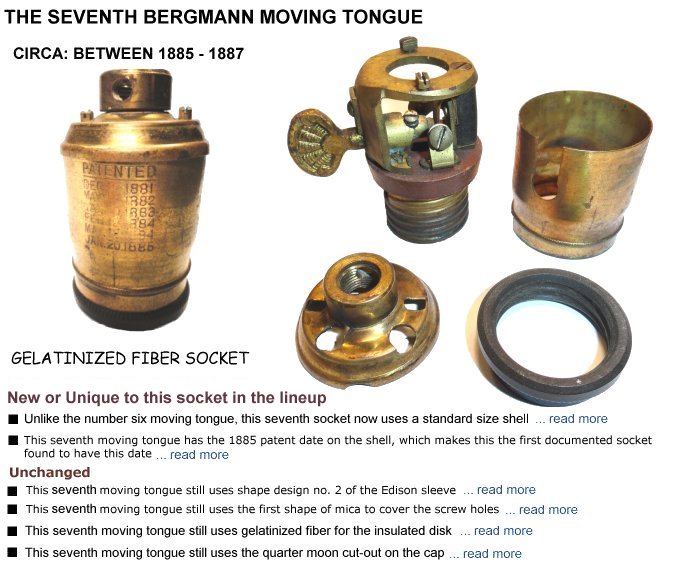
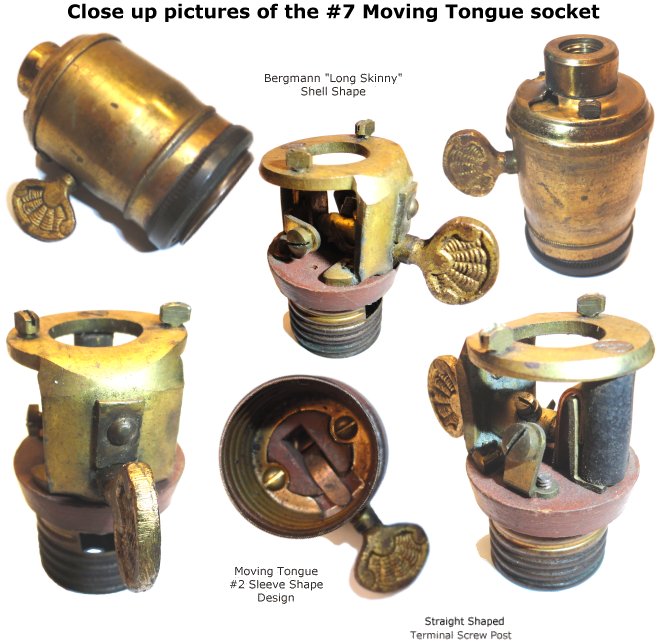
Moving Tongue No. 7 - The First
Socket Documented With The 1885 Patent On The Shell
|
Just
as all other moving tongue sockets, this shell is of the normal
size for long skinny's.
As shown above in the socket no. 6 section,
that gelatinized fiber socket used a shorter skinny shell.
Also, this no. 7 moving tongue socket, shows the patent dates, which
also now includes the Jan 20 1885 patent date (no.
311,100) which was for the moving tongue itself.
Keeping in mind that moving tongue no. 4 (and those before it),
did not yet have the date on them. You will also remember that no.
5 was found in a box without a shell (but proven to still use a
cap without a cut-out), we still do not know if it would have used
a shell with or without the 1885 patent date on it. NEXT, we have
moving tongue no. 6, which did not have patent dates - SO,
in this lineup, this moving tongue no. 7, is the first documented
socket to have the 1885 patent date on it.
If you have a no. 5 or no. 6 socket with patent dates found on the
shell, I would sure like to hear about it - please do contact me
at my email 
Moving
Tongue No. 8 - The First FAT Shell Moving Tongue Socket
|
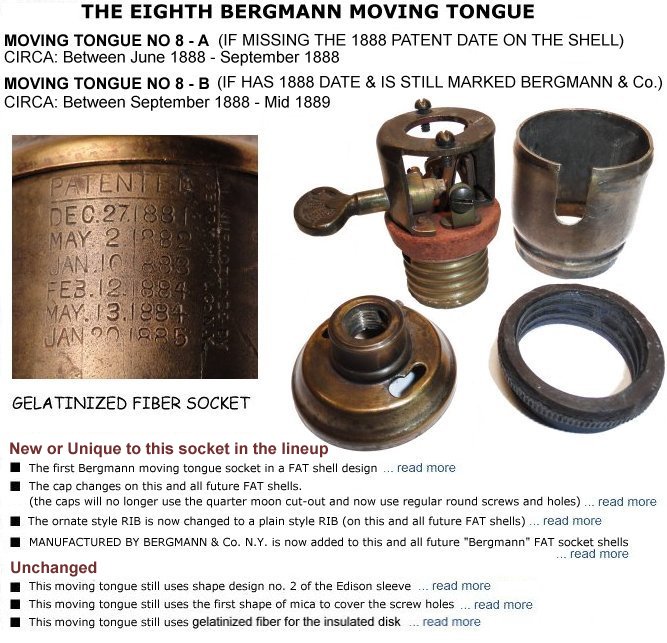
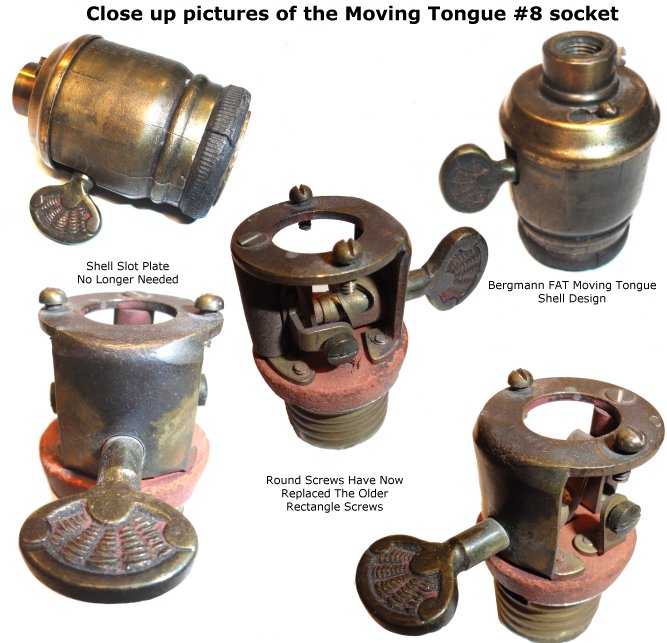
Moving Tongue No. 8 - The Bergmann
Moving Tongue In A FAT Shell
|
|
Note
that this section also covers all of the remaining moving
tongue sockets (no.9, 10, 11, 12 & 13)
|
Up until this time
in history, Bergmann had been manufacturing the 'long skinny' sockets
and shells.
It is not documented exactly when this change took place, but we can
document for sure the date of the second Bergmann rotary switch socket
which was illustrated it in a FAT shell. Since this socket's patent
was applied for on June 2 1888, we know that these shells existed
at this time in history.
DATING USING CATALOGS
 One
draw back with finding an earlier date that I have talked
about before, is the fact that Bergmann did not update their catalog
illustrations. Once an item was illustrated (a picture drawn for that
item), that item will always look the same in future catalogs, even
though the item might go through several different upgrades or changes.
An example of this (there are so many) would be a catalog in 1889
(Bergmann's last catalog) that still shows the no. 1 key socket (1882
socket) even though it went through many different changes (example
this FAT shell). Acorn sockets also still show the no. 1 ribless acorn
which is also already nonexistent for so many years (see ribless
acorn dating dilemma for more info). Also, another problem existed
when resellers in wholesale electric catalogs, used those same out
dated images for their new catalogs. One
draw back with finding an earlier date that I have talked
about before, is the fact that Bergmann did not update their catalog
illustrations. Once an item was illustrated (a picture drawn for that
item), that item will always look the same in future catalogs, even
though the item might go through several different upgrades or changes.
An example of this (there are so many) would be a catalog in 1889
(Bergmann's last catalog) that still shows the no. 1 key socket (1882
socket) even though it went through many different changes (example
this FAT shell). Acorn sockets also still show the no. 1 ribless acorn
which is also already nonexistent for so many years (see ribless
acorn dating dilemma for more info). Also, another problem existed
when resellers in wholesale electric catalogs, used those same out
dated images for their new catalogs.
DATING USING OLD ILLUSTRATIONS AND HISTORY
Concerning Bergmann items, a life saver for researchers is when an
inventor uses a Bergmann socket to illustrate his invention (maybe
a lamp shade) and has an illustration made (which will now document
the socket's existence at the time and date the illustration was published).
So, since Bergmann catalogs did not change their catalog illustrations,
most times we need to document Bergmann socket changes by locating
the first appearance of different shells in the history of patent
illustrations, ads or catalog images of other inventions. However,
at this time we have not found any that pre date the rotary socket
patent.
DATING USING PATENTS
The first actual Bergmann documentation for this FAT shell the patent
for the rotary switch socket (patent 389,280)
which was applied for on June 2 1888. Since this is a FAT shell socket,
we know that FAT shells existed when this patent was applied for.
So, to get even closer, we would need to find documentation that shows
an illustration of a FAT shell before June 2nd 1888. Unfortunately,
at this time we have not found anything to document this. If you come
across anything, please do share (so that the information can be made
public.
DATES ON SOCKET SHELLS
 Another
method for dating would be a fat shell that contains (or is missing)
a patent date, but not yet another. For example, if we had two (or
more) sockets that we could trust (meaning from two or more entirely
different sources) we could date changes about socket innards, caps
and outer shells. Hypothetically: Lets say we have moving tongue
sockets -without- the 1885 patent date; and caps -with- the quarter
moon cutout. This would tell us not only that the cut-out was used
before 1885, but that the skinny rotary socket did as well (since
the quarter moon style cap was originally made for that socket). To
use this type of dating method in this case, we would need a FAT shell
with a patent missing that was before it's patent date of September
11, 1888. This would tell us that the FAT shell most likely existed
during that time since the date was missing. Unfortunately, the closest
patent date possible going backwards would be the moving tongue patent
Jan 20 1885. So going backwards if these FAT shells existed during
this time, we could hope to find one missing this date which is likely
not possible since we have skinny shells with the 1885 patent date.
The closest date moving upwards, is the rotary switch patent which
was applied for on June 2, 1888 and approved on September 11, 1888.
So, the only thing that a patent date could do for us here in this
case, would be if we had a rotary switch in a FAT shell that was missing
it's own patent date (which we do), but unfortunately this only tells
us that the FAT shell existed before the patent approved date of the
rotary switch (September 11, 1888) and we already know this because
the FAT shell is illustrated in the patent itself. So, using this
method did not produce anything that we would hope for. However, later
we will find some use for this method when dating E.G.E moving tongue
(and other) sockets using the 1890 patent dates. Another
method for dating would be a fat shell that contains (or is missing)
a patent date, but not yet another. For example, if we had two (or
more) sockets that we could trust (meaning from two or more entirely
different sources) we could date changes about socket innards, caps
and outer shells. Hypothetically: Lets say we have moving tongue
sockets -without- the 1885 patent date; and caps -with- the quarter
moon cutout. This would tell us not only that the cut-out was used
before 1885, but that the skinny rotary socket did as well (since
the quarter moon style cap was originally made for that socket). To
use this type of dating method in this case, we would need a FAT shell
with a patent missing that was before it's patent date of September
11, 1888. This would tell us that the FAT shell most likely existed
during that time since the date was missing. Unfortunately, the closest
patent date possible going backwards would be the moving tongue patent
Jan 20 1885. So going backwards if these FAT shells existed during
this time, we could hope to find one missing this date which is likely
not possible since we have skinny shells with the 1885 patent date.
The closest date moving upwards, is the rotary switch patent which
was applied for on June 2, 1888 and approved on September 11, 1888.
So, the only thing that a patent date could do for us here in this
case, would be if we had a rotary switch in a FAT shell that was missing
it's own patent date (which we do), but unfortunately this only tells
us that the FAT shell existed before the patent approved date of the
rotary switch (September 11, 1888) and we already know this because
the FAT shell is illustrated in the patent itself. So, using this
method did not produce anything that we would hope for. However, later
we will find some use for this method when dating E.G.E moving tongue
(and other) sockets using the 1890 patent dates.
So, basically this is the long way around showing you -why- we can
only document these socket shells to 1888 so far.
If you can share any information to document these FAT shells any
sooner, your information would be more then welcome.
Please mail to
Moving Tongue No. 8 - THE FAT SHELL DESIGN
- (THE CAP)
|
|
Note
that this section also covers all of the remaining moving
tongue sockets (no.9, 10, 11, 12 & 13)
|
As
shown below, the new FAT shell has a new and different shell cap
design.
The cap no longer uses rectangle screws, so it no longer has rectangle
screw holes. It now has the round screw hole along with the turning
slot as shown below in the cap picture on your right.
The first cap was used on the first Bergmann turn key socket (patent
no. 298,658)
applied for patent on October 9th 1882 and then used on moving tongue
sockets 1-5. The second cap was used on the first long skinny rotary
socket that will be covered in the upcoming Bergmann Socket No.
4 line up section. It is sometimes called the "Mystery Socket"
because it has unknown patent information, but is seen in three
patent illustrations for a Bergmann glass shade with screw threads
and/or shade holding system using a hard rubber collar. This patent
was applied for on October 16th 1885 and was assigned patent
no. 337336. This patent is (so far) the earliest known date
for this socket and cap. The third cap was used on the last Bergmann
FAT socket shells. It was then used on E.G.E shells when Bergmann
& Co. merged into the Edison General Electric Company (1889),
until "General Electric" (Thomson/Houston) took it away
from Edison in 1892.
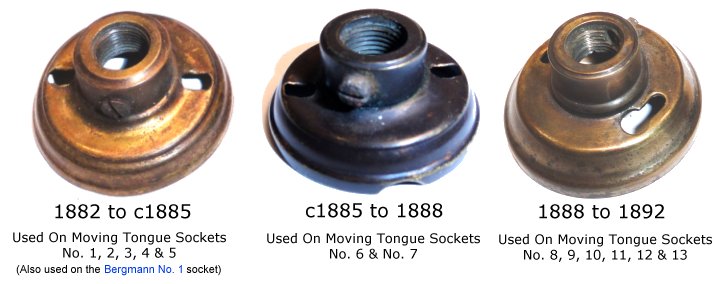
You can also see the section above for the first moving tongue socket,
where I talk about and compare the first and
second caps to each other. I also talk about and measure the
inner diameter of the cap for moving tongue
number five here.
Moving Tongue No. 8 - THE FAT SHELL DESIGN
- (THE RIB)
|
|
Note
that this section also covers all of the remaining moving
tongue sockets (no.9, 10, 11, 12 & 13)
|
As
shown in the images below, the new FAT shell design also took on
a fat plain rib.
Noteworthy is the fact that about the same time that this took place,
the standard keyless socket at the time (the acorn socket) also
took on a fat plain rib (see
here for more info).
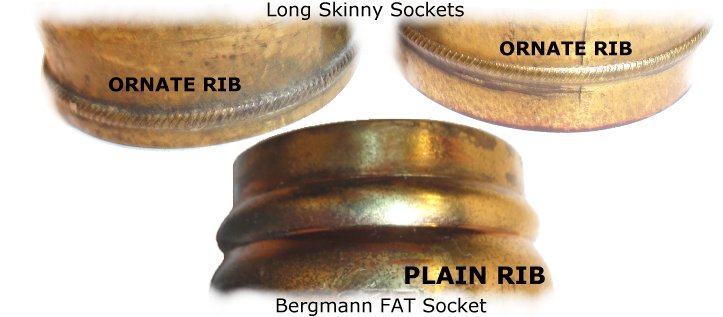
The plain rib lived on through all of the rest of the moving tongue
sockets.
Moving Tongue No. 8 - THE FAT
SHELL DESIGN - (COMPANY NAMES ADDED TO SHELL)
|
|
Note
that this section also covers all of the remaining moving
tongue sockets (no.9, 10, 11, 12 & 13)
|
The
long skinny socket shells that we have covered up to this point,
were all marked with a series of different patent dates with the
word "PATENTED" stamped directly above the dates. Up until
now there have been no company names marked on these shells. However,
starting with this socket moving tongue shells are now marked with
the company name.
Below is a table that covers all of the markings on the moving tongue
shells.
For links to moving tongue patents and additional info,
see my Bergmann patent info chart.
Note that I have changed the color of dates to pay
special attention to, in hopes to make it an easier process to compare
your socket shell dates.
|
LONG
SKINNY SHELL DESIGN
|
|
Moving
Tongue No. 1
Moving Tongue No. 2
Moving
Tongue No. 3
Moving
Tongue No. 4
|
PATENTED
Dec 27 1881
May 2 1882
Jan 10 1883
Feb 12 1884
May 13 1884
|
5
Patent Dates
BERGMANN SOCKET
No Jan 20 1885 Date |
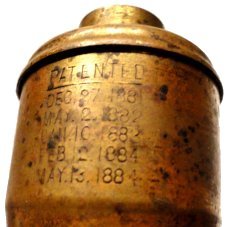 |
Moving
Tongue No. 5
Moving Tongue No. 7
|
PATENTED
Dec 27 1881
May 2 1882
Jan 10 1883
Feb 12 1884
May 13 1884
Jan 20 1885
|
6
Patent Dates
BERGMANN SOCKET |
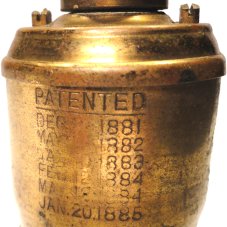 |
| Moving
Tongue No. 6 |
No
Patent Dates
|
No
Patent Dates
BERGMANN SOCKET |
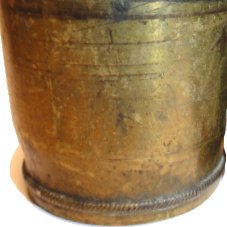 |
|
FAT
SHELL DESIGN
|
| Moving
Tongue No. 8A |
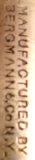
PATENTED
Dec 27 1881
May 2 1882
Jan 10 1883
Feb 12 1884
May 13 1884
Jan 20 1885 |
6
Patent Dates
MANUFACTURED BY BERGMANN & Co. N.Y.
(horizontally)
Patent Dates (vertically)
Note
that this shell still has the Jan 10 1883 date
|
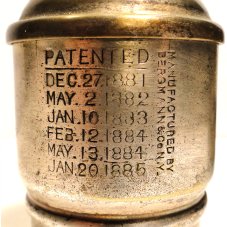 |
| Moving
Tongue No. 8B |

PATENTED
Dec 27 1881
May 2 1882
Jan 10 1883
Feb 12 1884
May 13 1884
Jan 20 1885
Sept 11 1888 |
7
Patent Dates
MANUFACTURED BY BERGMANN & Co. NY
(horizontally)
Patent Dates (vertically)
Has
the 1888 patent date and is the last "Bergmann" moving
tongue shell.
Note that this shell still has the Jan 10 1883 date
Thanks goes to David Christian from our
forums who provided this image. |
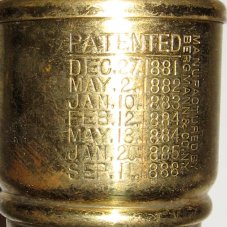 |
Moving
Tongue No. 9A
Moving Tongue No. 9B
Moving Tongue No. 10 |
EDISON
GENERAL ELECTRIC CO.
NEW YORK U.S.A.
PATENTED
Dec
27 1881
May 2 1882
Jan 10 1883
Feb 12 1884
May 18 1884
Jan 20 1885
Sept 11 1888
|
7 Patent Dates
EDISON GENERAL ELECTRIC CO. NEW YORK USA PATENTED (everything
horizontal)
May 18 1884 was mis printed on
this shell. It should have been marked May 13 1884
Note that this shell still has the Jan 10 1883 date |
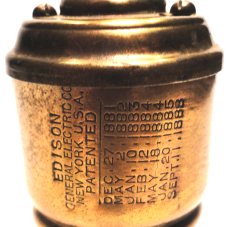 |
Moving Tongue No. 11 |
EDISON
GENERAL
ELECTRIC CO.
NEW YORK USA
PATENTED
Dec 27 1881
May 2 1882
Oct 3 1882
Feb 12 1884
May 13 1884
Jan 20 1885
Apr 15 1890
|
7
Patent Dates
EDISON GENERAL ELECTRIC CO. NEW YORK USA PATENTED (everything
horizontal)
Jan 10 1883 was removed and
replaced with the
Oct 3 1882 patent date (also on future shells)
Sept 11 1888 removed from this
and future shells
Apr 15 1890 was added |
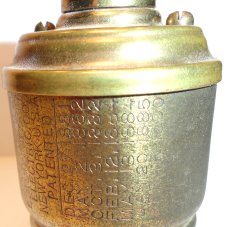 |
Moving
Tongue No. 12
Moving Tongue No. 13 |
EDISON
GENERAL
ELECTRIC CO.
NEW YORK USA
PATENTED
Dec 27 1881
May 2 1882
Oct 3 1882
Feb 12 1884
May 13 1884
Jan 20 1885
Apr 15 1890
|
7
Patent Dates
EDISON GENERAL ELECTRIC CO. NEW YORK USA PATENTED (everything
horizontal)
ALL N's on this and future moving tongue
sockets are stamped backwards |
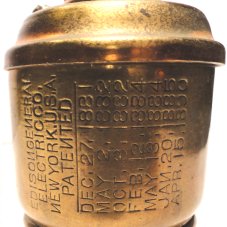 |
Moving Tongue No. 9 - The First
E.G.E Moving Tongue - Circa 1889
|
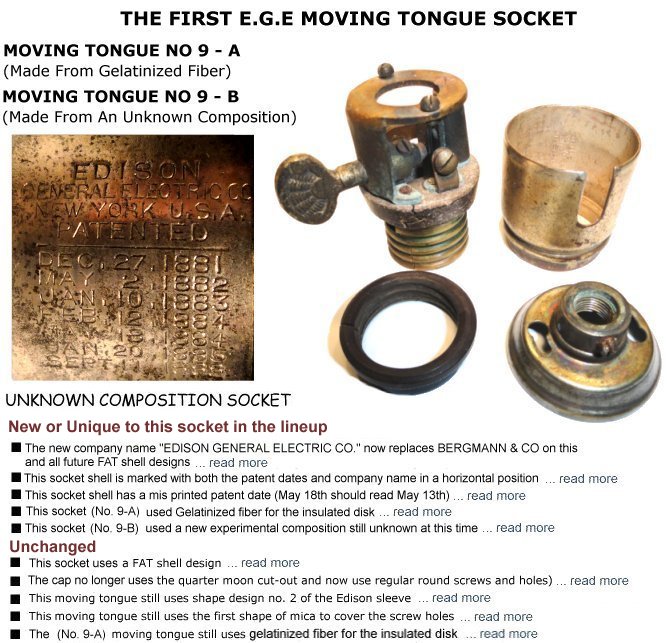
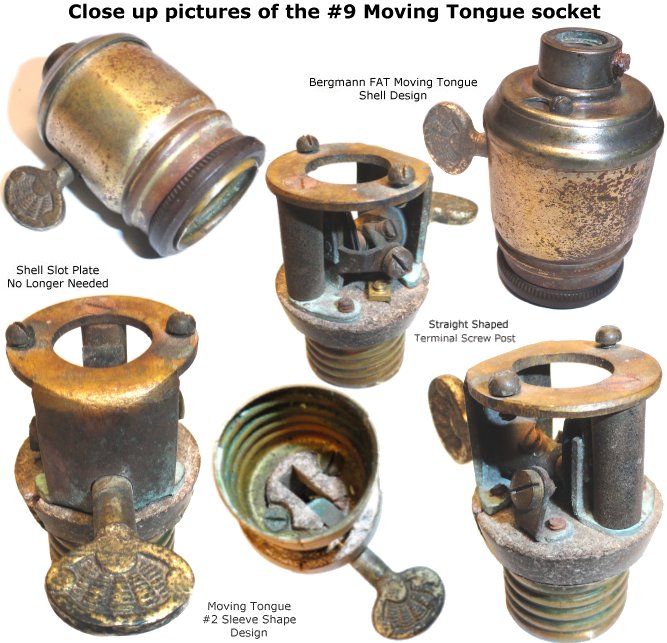
Moving Tongue No. 9 - The First
E.G.E Moving Tongue
|
NAME
CHANGE FROM "BERGMANN & CO." TO THE "EDISON GENERAL
ELECTRIC CO."
Important here at this point in socket history, is to have a clear
understanding of who Bergmann & Co., Edison General Electric
Co. and the General Electric Co. where I talk in a bit more detail
about the company history in the GECO area here,
and the lighting time table here.
In a nutshell though, Bergmann & Co. was basically Edison &
Bergmann. In 1889 Edison had a disagreement with Bergmann and bought
him out. Bergmann & Co. Was consolidated into a new company
which was named "Edison General Electric" (E.G.E.). The
older Bergmann & Co. Was a partnership between Bergmann &
Edison which was dissolved when E.G.E. (Edison's new company) was
created. In 1892 Edison lost controlling interest in his electric
companies and was bought out by Thomson-Houston. At this time E.G.E.
And other Edison electric companies were consolidated into a new
company called "General Electric" (G.E.) which was basically
the Thomson Houston Electric Company (which now owned rights to
the "Edison" name as well as (electrical) Edison trademarks).
When Edison's consolidation took place, the FAT Bergmann socket
shells started being marked with the new "Edison General Electric"
Company name.
SOCKET
STAMPING CHANGED TO HORIZONTAL POSITION
& MIS PRINTED PATENT DATES
At the time of Edison's Bergmann & Co. take over in 1889, there
must had been some major confusion taking place. I have read excerpts
where those now in charge, were asking around and confused about
where Bergmann was purchasing different items from, as he did not
keep very good records. It was also a time in history when changes
were being made which could have also added to some existing confusion.
An example of one of these changes would be a major material change
in socket innards form fiber to porcelain. Along with the company
name change, came a necessary change to the stamping of patent dates
on the socket shell. In order to fit the new name comfortably on
the shell, a change in design was made which was to now print the
patent dates and company name in the horizontal position. It was
probably during the first run of this new design that the May 13
1884 patent date was mis printed as May 18 1884 (shown below). Later
(after fixing the patent date) another type setting change was required,
at which time all of the letter N's were printed backwards (which
I believe to be an indication of a continued confusing environment).
For more about dates on shells see the date
chart
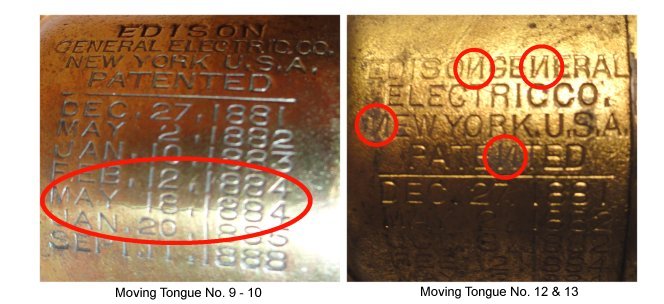
MOVING
TONGUE NO 9-A USED GELATINIZED FIBER FOR THE INSULATED DISK
The key to placing these two socket innards in date order, is the
fact that gelatinized fiber EGE socket innards with slits
in the threads existed (no 10).
The patent for the slits was applied for on October 18th, 1889 by
the Edison Lamp Company. The patent was approved on April 15th,
1890 and assigned patent
no. 425741. The fact is that if you have a FAT shell marked
Bergmann & Co. And it uses innards that have these slits, those
innards were from the time of E.G.E. And not Bergmann as evident
from the slit patent dates. These case scenarios could have resulted
from E.G.E. using up older parts and inventory, or from supply houses
or jobbers doing the same.
MOVING TONGUE
NO 9-B USED AN UNKNOWN COMPOSITION FOR THE INSULATED DISK
Taking into account (shown
above) that there were fiber examples of EGE socket innards
using slits, we must date this socket before or right at the same
time as those since these innards do not use them. In fact, this
could also be a Bergmann invention housed in an EGE shell, which
is more likely. From examining the condition of the sample, it was
obviously a failure as a material to replace gelatinized fiber.
During this time frame and the change to an insulated disk made
from porcelain, E.G.E. could have been using up all of the older
inventory including old failed prototypes.
UPDATE & AFTER THOUGHTS
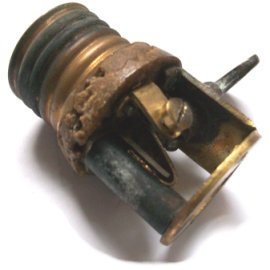 While
getting ready for the next section (the Bergmann no.4 rotary switch
socket) I remembered that the FAT version was popular for using
an after market turn key (likely Mitchell Vance), that also used
an unknown composition for the innards. I bring this up, because
these innards are pictured in a Bergmann shell. When examining my
photos, I believe that the composition might be the same as pictured
here, only in better condition. I also now came across pictures
looking through our forums (linked
here) of what looks to be the same composition, that is also
in a Bergmann shell. While
getting ready for the next section (the Bergmann no.4 rotary switch
socket) I remembered that the FAT version was popular for using
an after market turn key (likely Mitchell Vance), that also used
an unknown composition for the innards. I bring this up, because
these innards are pictured in a Bergmann shell. When examining my
photos, I believe that the composition might be the same as pictured
here, only in better condition. I also now came across pictures
looking through our forums (linked
here) of what looks to be the same composition, that is also
in a Bergmann shell.
Take note now that both examples are pictured in shells without
the 1888 patent date. Also that we commonly come across Bergmann
and E.G.E. Sockets that use gelatinized fiber that have the 1888
patent date.
This only leaves three seemingly logical conclusions to arrive at:
1. Bergmann started using gelatinized fiber and switched to the
unknown composition and then back again, and then later E.G.E. decided
to try it again and switched back as well.
2. Bergmann used both side by side
right through the time of E.G.E.
3. E.G.E. Or possibly even G.E. in 1892 (but less likely), was simply
using up all of the old socket parts.
I will be spending more time testing this composition (as well as
comparing the rotary composition), after I complete these Bergmann
sections. For now (just taking a quick close up look), this unknown
composition might be a mica based composition. This thought comes
from my example definitely having lots of shinny flakes of mica
in the cracks and comparing the look to other mica based composition
inventions that I have put on the side for research time.
Moving Tongue No. 10 - The E.G.E
FIBER Moving Tongue With Slits - Circa Late 1889
|
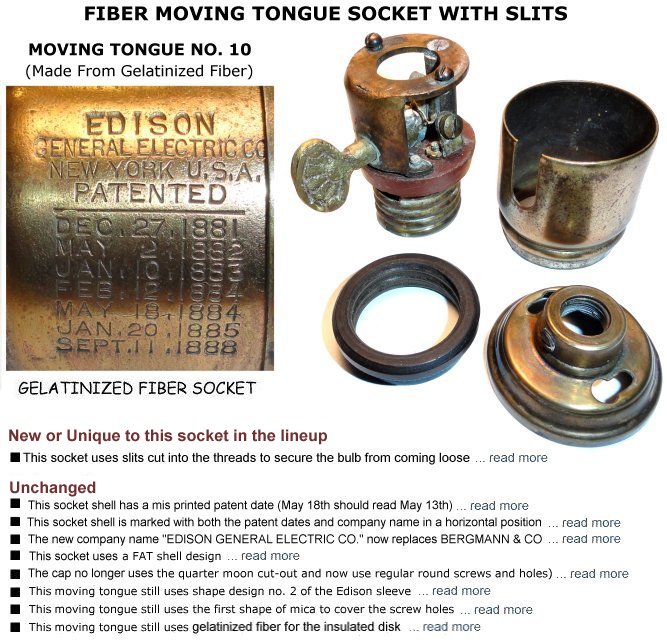
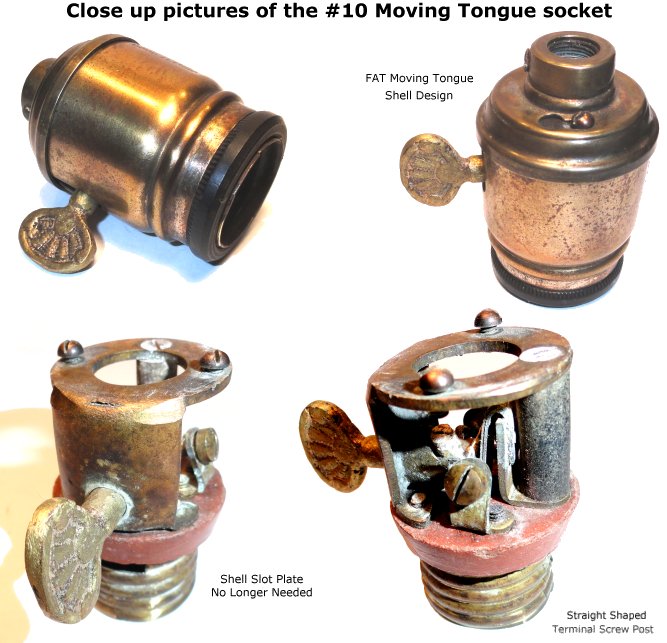
Moving Tongue No. 10 - The E.G.E FIBER
Moving Tongue With Slits - Circa Late 1889
|
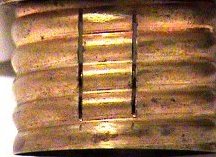 THIS
SOCKET MARKS THE START OF USING SLITS CUT INTO THE THREADED BASE THIS
SOCKET MARKS THE START OF USING SLITS CUT INTO THE THREADED BASE
The slits are a great dating tool for early sockets and sometimes
help make a positive identification between Bergmann and E.G.E. socket
innards. The original purpose of these slits, was to help hold the
bulb in place so that it could not vibrate loose.
 While it may have been good for bulbs, it clearly was not a good idea
for the sockets. These slits caused damage to socket threads by creating
a weakness in the metal. When the socket collar was stuck or tight,
the threads cracked and broke easily.
While it may have been good for bulbs, it clearly was not a good idea
for the sockets. These slits caused damage to socket threads by creating
a weakness in the metal. When the socket collar was stuck or tight,
the threads cracked and broke easily.
Once cracked, the problem even became worse as the hard rubber collar
got stuck on the cracks when turning it. This caused the threads to
break apart or crack even more.
The original patent for these slits was applied for on October 18th,
1889 by the Edison Lamp Company. The patent was approved on April
15th, 1890 and assigned patent
no. 425741.
If you have an E.G.E. Socket shell without the April 15 1890 patent
date, but the innards have the slits, it is a good chance that the
socket falls between the patent applied for time and the patent approved
date.
Since there are no other changes documented on innards from the time
of Bergmann gelatinized fiber until these slits, it is a common concept
that gelatinized fiber innards without slits are Bergmann innards
and those with slits are E.G.E. innards.
THIS
SOCKET, DATING AND THE TIME CRUNCH
Please keep in mind that there is a real short time frame to fit these
(and the remaining) sockets into.
FAT shell designs start in 1888
Bergmann & Co. ends existence (and E.G.E starts) in the later
part of 1889
Slits start showing up on threads in late 1889 to early 1890
Porcelain sockets started being made in 1890
E.G.E ends existence in 1892
Keeping this in mind as we consider the two sockets covered above
(no's 9A & 9B); this fiber socket (no.
10); the shell mis prints; changes in the shell name design; and
finally the different changes through the E.G.E porcelain moving tongue
sockets (no's 11,12 & 13), you will begin to notice that there
is not much room for dating error when only having such a short time
frame to work with.
POSSIBLE MISSING SHELLS HERE
Noticing that the mis printed date (May 18 1884) also shows up on
this shell, we must also entertain the possibility that there might
also exist an EGE shell (either pre or post) that is printed correctly.
To know if you find one of these, your shell must be marked Edison
General Electric Co. AND also have the two patent dates: Jan 10 1883
& Sept 11 1888. Next, it would need to have the correct date May
13 1884 and NOT the mis printed date of May 18 1884.
For more about dates on shells see the date
chart
Moving Tongue No. 11 - The First
PORCELAIN Moving Tongue
|
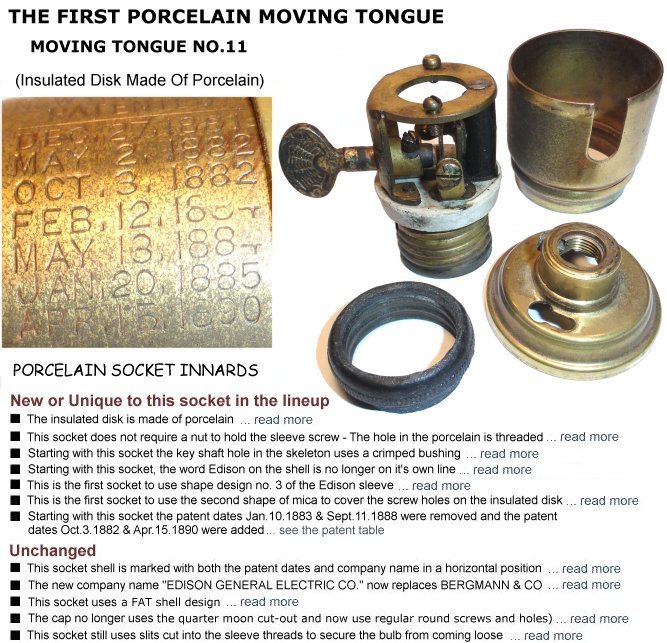
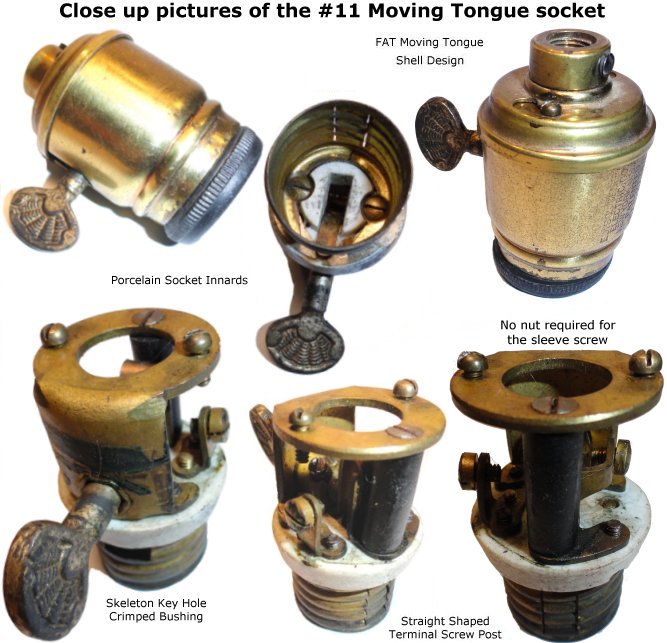
Moving Tongue No. 11 - The First
PORCELAIN Moving Tongue
|
THE
FIRST PORCELAIN INNARDS
This is the first socket that uses porcelain as an insulator for
the insulated disk.
This socket also ushers in a few other basic changes, while the
next two moving tongue sockets bring us to only a couple more minor
changes and the end of this unique and historical socket
THREADED
PORCELAIN INSULATED DISK
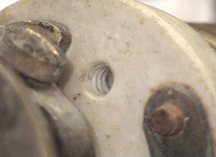  The
first minor difference that will help you to identify this unique
'first porcelain innard', is the fact that (just as all of the others
before this socket) one of the sleeve screw holes in the insulated
disk is threaded. In the next porcelain version of the moving tongue
a smooth hole of a larger diameter is used, with a nut that holds
it on the other side. The
first minor difference that will help you to identify this unique
'first porcelain innard', is the fact that (just as all of the others
before this socket) one of the sleeve screw holes in the insulated
disk is threaded. In the next porcelain version of the moving tongue
a smooth hole of a larger diameter is used, with a nut that holds
it on the other side.
You might had noticed that in the pictures of moving tongue no.
9-B (the unknown composition socket), that it was also shown using
a nut. However, the hole on moving tongue no. 9-B was also threaded.
It only uses the nut out of necessity now, because of the deteriorating
condition of the composition material that was used for insulated
disk. This first porcelain socket uses the threaded hole, which
seemed to work well from the examples that I have of it. Others
may not had been as lucky as me though, since it was soon changed.
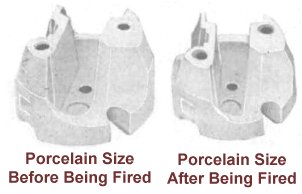 One
fact with porcelain, was the shrinkage during firing. It could had
been that it was simply not as accurate at the time, or to mold
the hole was just harder to do. One
fact with porcelain, was the shrinkage during firing. It could had
been that it was simply not as accurate at the time, or to mold
the hole was just harder to do.
A screw and nut likely seemed like a quick and easy solution to
what ever issues that they came up against.
As shown in the clip from a 1905 Marshall Electric Manufacturing
Company catalog below, it is stated that about twenty years ago
it was "impossible" to get to any degree of accuracy.
It also states that porcelain pieces shrink about 1/7 of the diameter
of it's original un fired size.
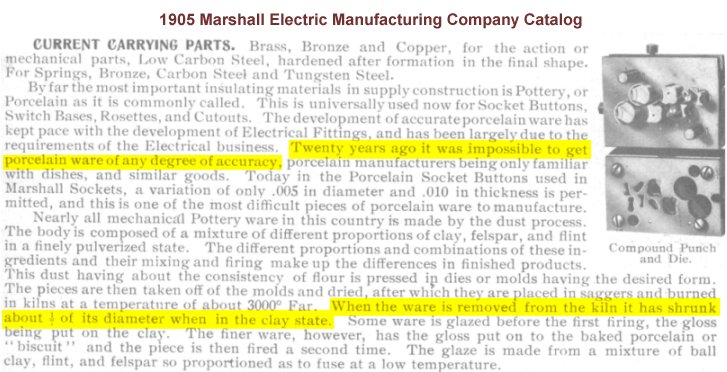
STARTING WITH MOVING
TONGUE NO. 11 THE SKELETON KEY HOLE USES A BUSHING
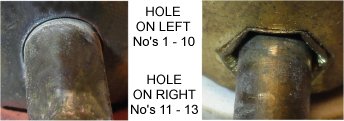 You
will remember that the long skinny Bergmann sockets (which were
before the first FAT Bergmann moving tongue no. 8) used a regular
hole, but with a slot plate to cover the key hole cut into in the
skinny shell. Up until now, all FAT shells simply had a hole drilled
through the skeleton (as shown on your right). On the other side,
the key slides into a bushing that is soldered to the skeleton as
shown in the picture below. You
will remember that the long skinny Bergmann sockets (which were
before the first FAT Bergmann moving tongue no. 8) used a regular
hole, but with a slot plate to cover the key hole cut into in the
skinny shell. Up until now, all FAT shells simply had a hole drilled
through the skeleton (as shown on your right). On the other side,
the key slides into a bushing that is soldered to the skeleton as
shown in the picture below.
Starting with this socket the key bushing is no longer held in place
by solder, but as shown above on your right and the picture below
a new crimped bushing is used.
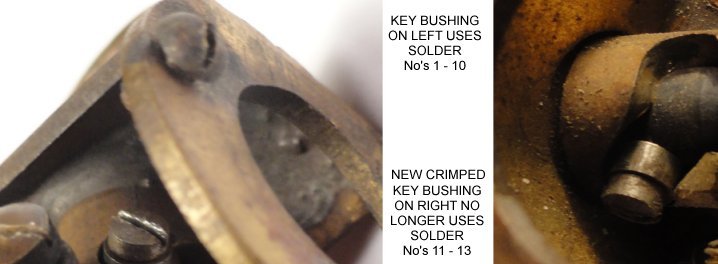
STARTING WITH NO.
11, A CHANGE TO THE POSITION OF SHELL WORDING TAKES PLACE
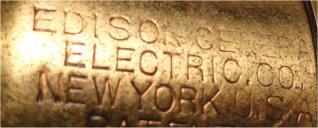 As
you will notice on the other E.G.E. moving tongue sockets that we
have covered so far, the word "EDISON" has been alone
on it's own line and the words "GENERAL ELECTRIC" on the
next line. As
you will notice on the other E.G.E. moving tongue sockets that we
have covered so far, the word "EDISON" has been alone
on it's own line and the words "GENERAL ELECTRIC" on the
next line.
Starting with this shell, the font lettering grows larger and the
words needs to crunch together more to fit properly. Now, the first
line has "EDISON GENERAL" and the second line continues
the rest of the company name.
MORE ABOUT THE MOVING TONGUE NO.
11
This is the first socket to use shape design no. 3 of the Edison
Sleeve which you can read more about by clicking
here
This is the first socket to use the second shape of mica as an insulator,
which you can read more about by clicking here
Starting with this shell the patent dates Jan.10.1883 and Sept.11.1888
are removed, and the patent dates Oct.3.1882 and
Apr.15.1890 have been added. For more information about this change
you can see the patent date chart for moving tongue no. 11 by clicking
here
For other general information about this socket see it's introduction
page by clicking here
Moving Tongue No. 12 - The Second
PORCELAIN Moving Tongue
|
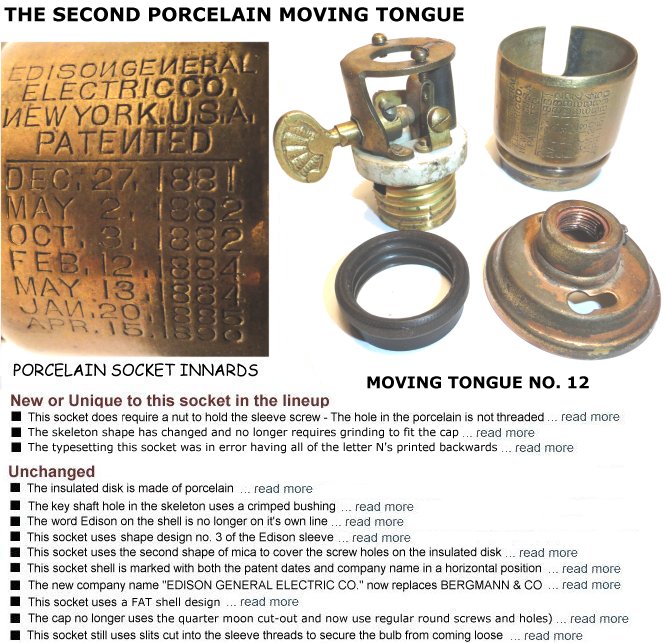
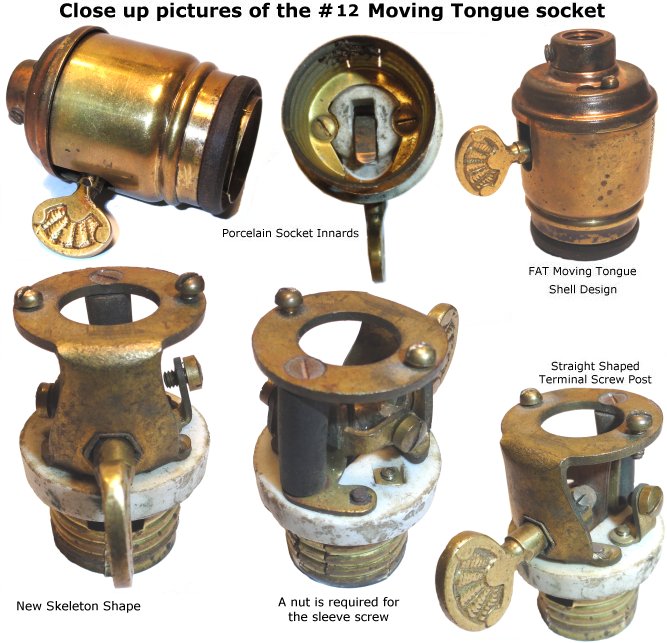
Moving Tongue No. 12 - The Second
PORCELAIN Moving Tongue
|
A
NUT IS NOW REQUIRED TO HOLD THE SLEEVE SCREW
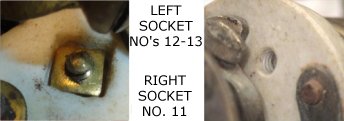 The
no. 11 moving tongue had a threaded hole through the porcelain,
which did not require a nut to be used to hold the sleeve on one
side. Starting with this socket, a molded square hole is provided
to house the square nut. There is more information about the threaded
hole and porcelain molding in general in the moving tongue no. 11
section. Click here to view the area if you
have not yet read it. The
no. 11 moving tongue had a threaded hole through the porcelain,
which did not require a nut to be used to hold the sleeve on one
side. Starting with this socket, a molded square hole is provided
to house the square nut. There is more information about the threaded
hole and porcelain molding in general in the moving tongue no. 11
section. Click here to view the area if you
have not yet read it.
A
NEW SKELETON SHAPE
Starting with the no. 12 moving tongue, a new method of manufacturing
the skeleton takes place. With the new method, the skeleton no longer
requires grinding at the corners to fit the cap.
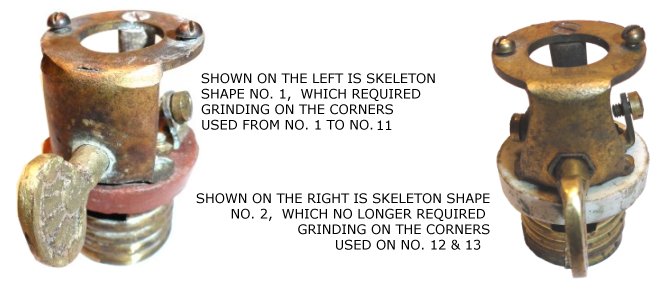
A
TYPE SETTING ERROR ON THE SHELL TAKES PLACE
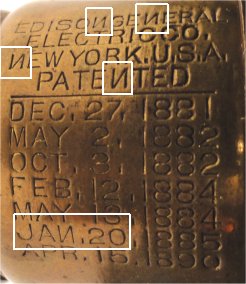
For some reason undocumented at this time, the Edison General Electric
company decided to change the typesetting on their shell once again.
There were not any patent date changes that were needed, but the
font type and size does change. This could suggest that this initial
change was being made to solve a problem that a smaller foot print
would solve. One such flaw that would have been repaired would be
the L in the word "GENERAL" which on many shells would
be partially hidden under the cap rim. Another solved issue would
have been where either the first line or in some cases the last
line would be stamped lightly (in some cases to shallow to read
clearly). This would have been caused by trying to flat stamp the
shell into it's curve or bend. The first and or last lines would
not be as deep. By making the type smaller, the stamping would not
stretch as much to the curve on the shell and would have fixed this
issue.
This moving tongue and the one below which is basically the same
only with a hard rubber key, are the last documented moving tongue
sockets (both of which had the backwards N's).
Moving Tongue No. 13 - The Hard
Rubber Key
|
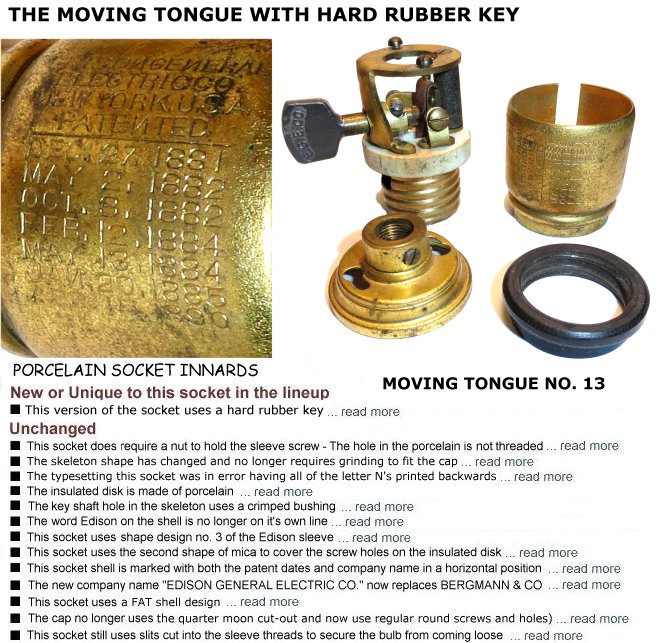
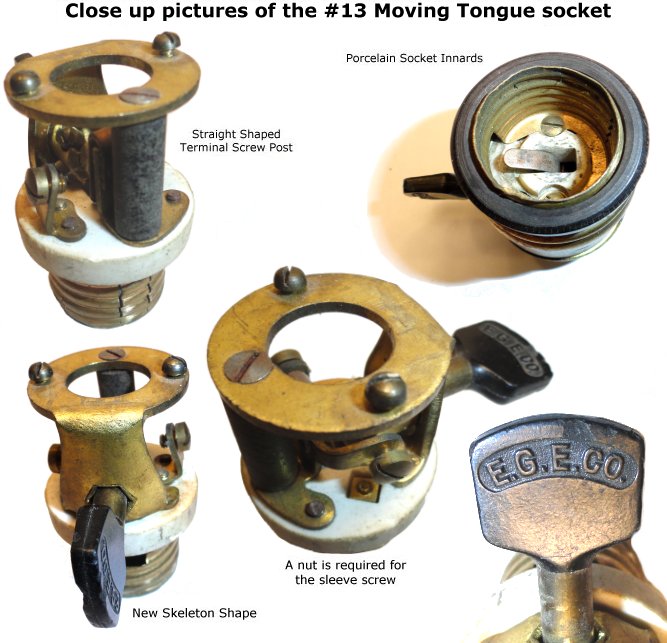
THE HARD RUBBER KEY
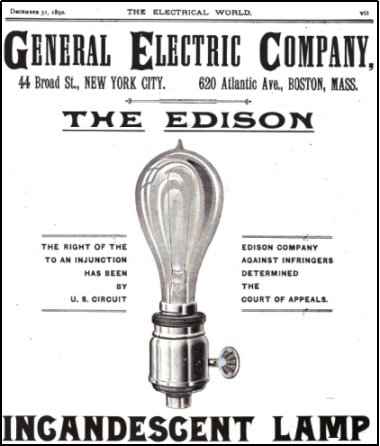 This
moving tongue is virtually the same as no. 11, only with the black
hard rubber key in place of the old Bergmann style brass turn key. This
moving tongue is virtually the same as no. 11, only with the black
hard rubber key in place of the old Bergmann style brass turn key.
There is not much documentation on the hard rubber key, it is possible
that it was sold at the same time as the cast brass key at one time.
It is also possible that the cast brass key was discontinued at
one point and only this hard rubber key was offered. The only documentation
so far is the fact that it was not offered as an option in the Edison
General Electric catalog and price list dated November 1st 1890.
It was also not offered in the September 1st 1891 catalog. General
Electric took over Edison General Electric in mid 1892. In December
of 1892 (as shown below) General Electric pictured the socket in
an ad in the December 31st Electrical World magazine, which still
used a brass key in the illustration. A brass key is also shown
in electrical catalogs, without a mention; order number; part number;
telegraph code or price for a hard rubber key version. The current
catalog availability and those checked so far are: 1891 Gate City
Electric, 1892 Electrical Supply Co., 1893 Pettingell Andrews Co.,
1893 Taylor Goodhue & Ames, 1893 Central Electric Co., And 1895
E.P. Gleason.
Even though it is included as late as 1895 in the E.P. Gleason catalog,
I should mention that G.E. did not sell this socket by the time
of their 1894 catalog. You will also find this socket with the cast
brass key in other catalogs even later in date, but these occurrences
can only be electrical supply dealers having such a large quantity
that they lasted a while. In fact, even though it is shown in the
December 1892 Electrical World magazine, it is also not proven that
G.E. Ever sold or offered the socket, other then simply selling
out the old stock. All of the hard rubber keys are marked E.G.E
Co. And no moving tongue sockets with keys marked G.E. Co. have
turned up to this date.
The 1894 General Electric catalog shows G.E selling their new key
and keyless sockets, but no moving tongue FOR SALE (.)
There is however in the 1894 General Electric catalog an image that
was most likely taken directly out of an older EGE catalog, which
shows the socket in use while selling rosettes.
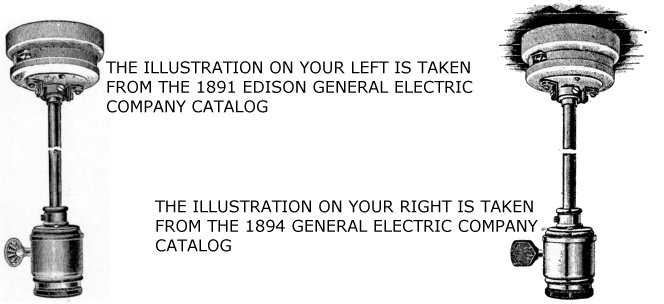
The illustration shown above was only used to sell the ceiling rosette,
the socket shown in the illustration was only to show how the part
worked and was not for sale. Having the socket updated in this illustration,
also helps to add proof that possibly at one time the cast brass
keys stopped being offered. The argument being that there would
have been no other reason to change the illustration.
The Bergmann No. 4 Socket - The
Rotary Switch Socket
|
THIS
BERGMANN SECTION IS STILL BEING WORKED ON - PLEASE CHECK BACK SOON...
Where to go from here?

THE BEGINNING HERE
http://www.antiquesockets.com/bergmann1.html
Or see the new materials
section still under construction...
|