|
HOME
|
Back to the main home page and front menu |
|
Learning
Tools And Research Material
|
|
User Forums Post pictures of your items and ask questions or just learn from reading the posts from others Ad Database View or upload ads from antique magazines Bulb & Socket Bases View images of the most well known bulb and socket bases Patent Utilities Patent Linker Lets You Pull Up Any Patent PDF File Or Link One Directly To Your Web Page Group Patent Dbase Lets You Download The First Page Patent Picture Of Every Patent On A Single Day To View On Quickly Your Local Computer MultiView Search Lets You Search For Patents Using Advanced Methods And Provides Hyper Links To The Patent Office And Google Patents |
|
I have not had much time to get many items in the forsale area below. Please keep checking back as I will start adding more items soon. Items
For Sale |
Switch Material Electrical Code Mica Insulation CP or WATTS Marks Socket Bead/Rib/UNO Catalogs & Ads Patents Pull Chains / Finials |
|
Socket
& Electrical Manufacturer's Items And Their History
|
| GECO
Sockets NEW - This section will allow you to date and learn how to tell one GECO socket from the other. Hubbell This is where this site started from. Since this page was done, there has been much more Hubbell history and information found which will make for a complete redesign of this page and section in the soon future. Hubbell Patents This section has some early patent research on Hubbell. It is mostly complete with only a few missing patents which will be added in when this section is re done into the new format Wheeler Reflector Co. NEW - A history of The Wheeler Reflector Company and tips on how to tell if mirror has been replaced on a shade Other Manufacturers This section is a lot of incomplete work and will be updated shortly. For now it serves to give you some extended information on some companies, but will be a much better tool when it is complete NEC This section is everything you ever wanted to know about the National Electrical Code (NEC) but had no one to ask. Downloads of old NEC's, meetings and much extended information is provided. |
| GECO
Sockets More companies will be added to this list in the near future. We will also be adding a new list of post 1900 sockets and items. Bergmann & Co. Brush Electric Co. Bryant Electric Co. Crown Elect MFG Co. EE&S Holmes & Gale (HG) Perkins Thomson-Houston Westinghouse |
|
Tutorial
And Early Lighting History
|
|
To
read the entire tutorial, you can just click on the first link and
then continue to the next section at the bottom of each page. Or,
you can select links below of interest to you. |
   |
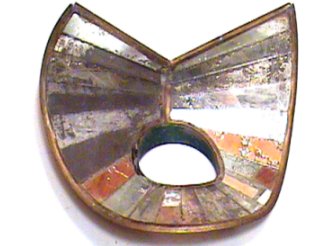
There are basically three things to watch for when authenticating the glass found in smaller Wheeler shades, or other mirrored shades of these types.
The first info I could find was the mention of a patent by the inventor DOMINIQUE DURAND of New York City in 1856. This is likely a hand written document being harder to find (I already downloaded the entire year of patents though), but it is mentioned in Durand's patent No. 123,247 Jan. 30th 1872 This is a good read as Durand is point to another patent (from another inventor) and explaining how it is in error in the makers methods of using shellac, in the place of varnish after the silvering. Durand uses copal varnish (as it stands up to the heat better) and discloses his process of temperatures, mixings, etc. http://patentlink.antiquesockets.com/?123,247
Patent by Henry
Balen Walker So, with the above patent we have the entire process in detail, just should not use the shellac. This patent was reissued by William Augustus Walker on July 18th 1871, after the death of Henry Balen Walker. http://patentlink.antiquesockets.com/?RE4477
Walker had a
method of heating the glass during the silvering process. http://patentlink.antiquesockets.com/?108413 Another invention of a stool that he used in silvering was his patent http://patentlink.antiquesockets.com/?110408 Another patent
from another inventor using copper in 1861 Most times you can see some evidence of this backing, even if the mirror is in really good condition. In these cases though you may need to look REALLY close between the glass pieces (as shown in some pictures below). You can also download a full resolution pdf of most of the images below which will also allow you to zoom in for a closer look. 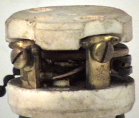 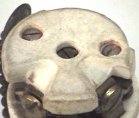 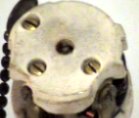    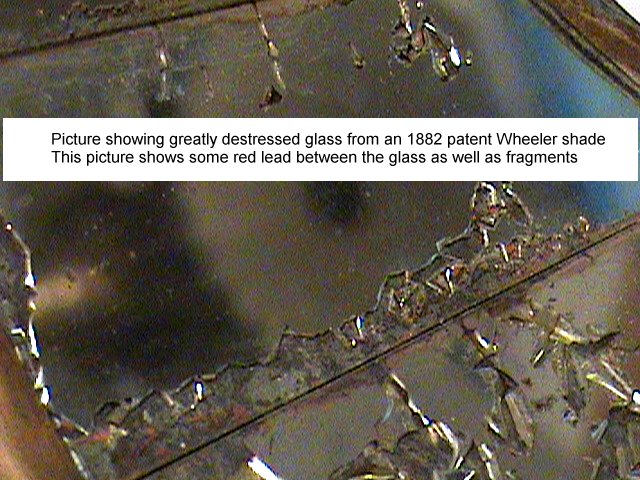 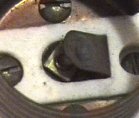 The next thing to watch for is that the lead molding around the shade is smooth and untouched. It is not hard to compare the difference between a shade that never had it's glass replaced and one that has. Even if great care was taken in replacing the glass, there will still be clear evidence that it had been tampered with. .jpg) Wheeler
used soft lead that was smoothed and tooled using a rimming machine
that rolled the lead around the edges to make the "Fellet-Bead". Wheeler
used soft lead that was smoothed and tooled using a rimming machine
that rolled the lead around the edges to make the "Fellet-Bead".
The fellet bead is a diamond shaped leaf which holds the glass in place. The lead was then painted and finished in gold. If the glass ever cracked or broke and was replaced, there would be two things to watch for. First the lead would be crumpled, dented and (or) no longer have the straight smooth factory edges shown below. Second, there would be some paint loss (speckling). This would had been caused when the lead was bent open and the attempting to re smooth it. As you can see from the pictures below, it would be a real task to make the shade perfect again after replacing glass. This type of shade with the soft lead painted rim would NEVER be perfect again after having it's glass replaced(.) .jpg) .jpg) .jpg) Shown above is also the old patent for the diamond shaped bead (Pat. No. 268,063). The new patent no longer required the leaf to be soldered to the inner rim of the shade as those manufactured before 1889. .jpg) All shades do not have heat rings, only the ones that received lots of use. It is common enough to look for though. If there is distress on the glass close to where the bulb or heat would have gathered, be sure that all of the glass matches. It is common where only one or a few pieces of glass were replaced, that the replaced glass would be missing or break the ring pattern. Many times when glass is replaced, it is replaced with glass from another old broken shade. While it might even be of the same type of glass, it would show by not matching completely when it comes to obvious patterns.
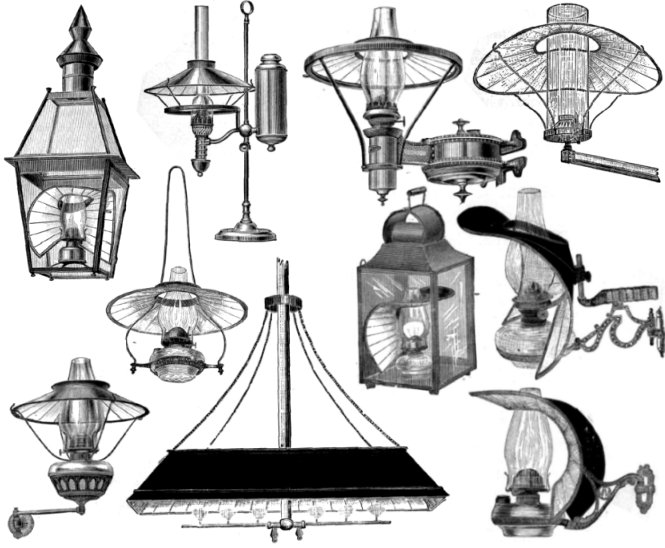
The
earlier Wheeler shades styles (hard to come by) were mostly used
for kerosene and gas.
|
|||||||||||||||||||
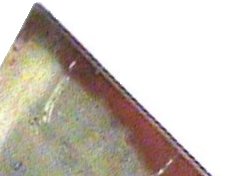 If
you read the patent, you will see that he then goes on to describe
the red backing, that I see on all of my Wheeler glass samples.
If
you read the patent, you will see that he then goes on to describe
the red backing, that I see on all of my Wheeler glass samples.
 George
W. Walker on May 19th 1879
George
W. Walker on May 19th 1879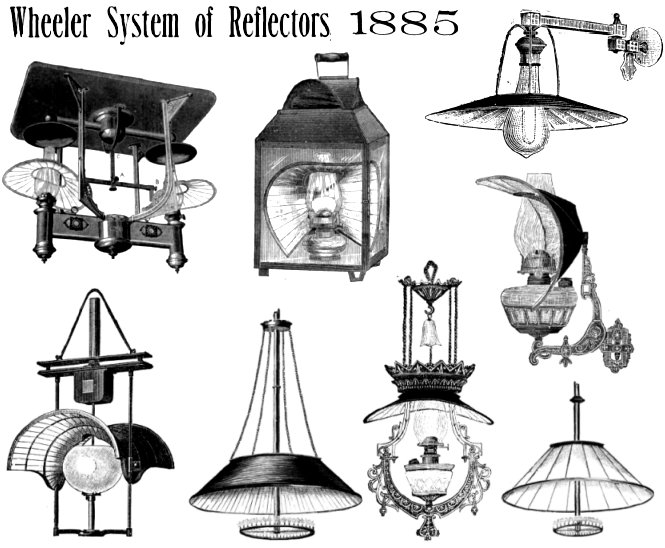

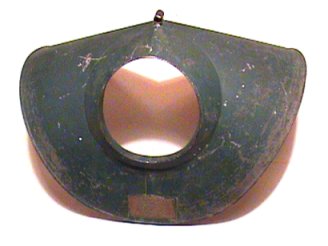
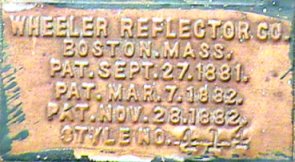
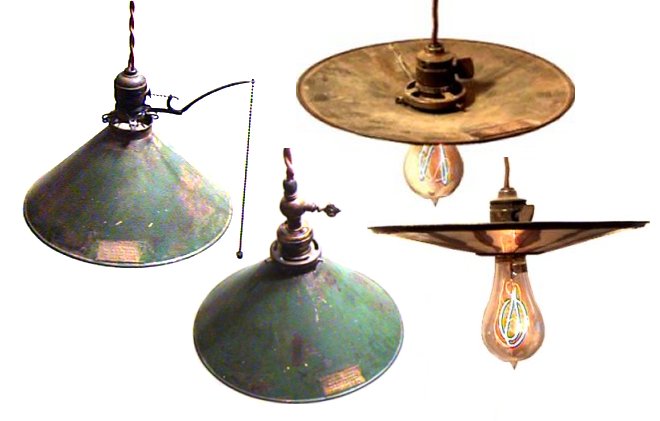
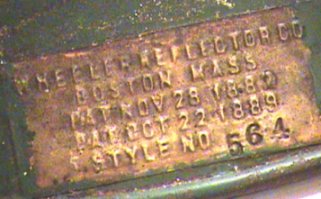 Cone,
inverted and flat shades (made mostly for electric use), will
normally be found with the patent dates of Nov. 28th 1882 (
Cone,
inverted and flat shades (made mostly for electric use), will
normally be found with the patent dates of Nov. 28th 1882 (
� COPYRIGHT ALL RIGHTS RESERVED
Contact
Us - Send Private Email To the Admin
 |