|
The Lighting Time Table
A Walk Through History & A Display Of Rare Antique
Lighting
|
| |
|
FIXTURE
STYLES FROM THE 1900's
|
THIS PAGE WAS
CONTINUED FROM HERE
http://antiquesockets.com/lighting-timetable4.html
|
BENJAMIN - DALE - FEDERAL ELECTRIC CO.
|
I prefer to
call many of these styles "Chicago Lighting" since the
lighting styles were not only manufactured there, but grew, expanded
and became popular all over Chicago and it's suburbs and then all
over the U.S.
 In
fact it is still possible today to find a stack of this type of
old lighting in the corner of an old Chicago barn or basement of
a building from when it was taken down or replaced. In
fact it is still possible today to find a stack of this type of
old lighting in the corner of an old Chicago barn or basement of
a building from when it was taken down or replaced.
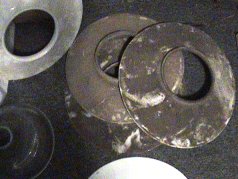
Shown on your right is a pile of three flat 18 3/4" white opal
shades that the owner did not even know were glass (because of the
dirt) even after 40 years of looking at them. The areas that are
showing through with white happened during moving, as these shades
were totally black in color when found.
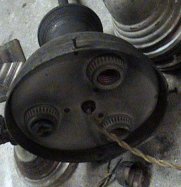 Next to these shades were stacked the original lighting fixtures
to go with them (one shown on your left. (AS AN ADDED BONUS - next
to these fixtures and shades, was also the old pre-1900 industrial
fixtures that these had originally replaced).
Next to these shades were stacked the original lighting fixtures
to go with them (one shown on your left. (AS AN ADDED BONUS - next
to these fixtures and shades, was also the old pre-1900 industrial
fixtures that these had originally replaced).
 Most
times when you find these type of fixtures, they will either be
Benjamin, Dale or Federal Electric Company items. Mostly because
it was mainly these companies that flooded the market with these
types of designs. Most
times when you find these type of fixtures, they will either be
Benjamin, Dale or Federal Electric Company items. Mostly because
it was mainly these companies that flooded the market with these
types of designs.
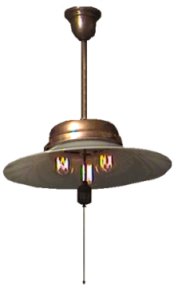
The 1909 Federal Electric fixture shown above, is also shown to
your right after being cleaned and restored.
The Benjamin MFG. Co. Incorporated in 1901. They started in Chicago
with their new line of wireless clusters early in 1902, and by 1905,
they expanded their operation to New York and San Francisco. Benjamin
was the forerunner of this new type of industrial lighting, which
played a big part in causing industrial ARC lighting to become a
thing of the past. ARC street lighting stayed around for a little
over a decade, but stores, professional buildings and factories
began moving towards this simple new type of reflective lighting.
 As
electrical codes changed and buildings needed to update their lighting,
Benjamin was right on top of things with these new easy to install
wireless clusters and fixtures. Benjamin had attracted many jobbers
and contractors and word of mouth traveled fast. By 1905 Benjamin
had many major contracts and supplied their clusters and reflectors
to many major cities. With little competition in these early years
(1902-1909), Benjamin moved forward and made it's dent in lighting
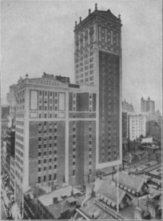
history. An example of success would be a new building (shown on
your left) that was being built in 1905 and was to be the tallest
building in New York at the time (the Railroad & Iron Exchange
Building), in which over 2000 Benjamin clusters were installed.
Other New York contracts by 1905 included the Mercantile Building,
Barclay Building, Times Building, Tabor Building, Trinity Building
and the Hotel Breslin. In other cities: The Henery Siegel Building
in Boston, The Henery Walker Building, The Monks Building and the
John Hancock Building. Benjamin clusters even caught on for railway
cars and depots and were contracted for the St. Louis Transit Company,
Boston Railway, N.Y. Street Railway, Rapid Transit in N.Y, American
Railway in PA, Washington Railway in D.C., West Side Railway in
Chicago, Chicago Union Traction and Los Angeles Railway Co.. These
are a few examples to show you that this was no small venture, Benjamin
was a great success and went on for almost a decade without any
real competition. As
electrical codes changed and buildings needed to update their lighting,
Benjamin was right on top of things with these new easy to install
wireless clusters and fixtures. Benjamin had attracted many jobbers
and contractors and word of mouth traveled fast. By 1905 Benjamin
had many major contracts and supplied their clusters and reflectors
to many major cities. With little competition in these early years
(1902-1909), Benjamin moved forward and made it's dent in lighting
history. An example of success would be a new building (shown on
your left) that was being built in 1905 and was to be the tallest
building in New York at the time (the Railroad & Iron Exchange
Building), in which over 2000 Benjamin clusters were installed.
Other New York contracts by 1905 included the Mercantile Building,
Barclay Building, Times Building, Tabor Building, Trinity Building
and the Hotel Breslin. In other cities: The Henery Siegel Building
in Boston, The Henery Walker Building, The Monks Building and the
John Hancock Building. Benjamin clusters even caught on for railway
cars and depots and were contracted for the St. Louis Transit Company,
Boston Railway, N.Y. Street Railway, Rapid Transit in N.Y, American
Railway in PA, Washington Railway in D.C., West Side Railway in
Chicago, Chicago Union Traction and Los Angeles Railway Co.. These
are a few examples to show you that this was no small venture, Benjamin
was a great success and went on for almost a decade without any
real competition.
Before long the product designs of the lighting clusters and fixtures
grew, as new Benjamin specialty parts were invented. As the more
common lighting market started to grow, Benjamin also moved into
the home lighting market to compete with Hubbell, Bryant and other
electrical specialty manufacturers (but with less success).
By 1908/1909 other manufacturers such as Federal Electric Co. (Chicago)
started making similar designs and began to compete on a large scale.
By this time the lighting "style" was common and it was
not the Benjamin name that people looked for, it was just the simple
lighting style that was purchased.
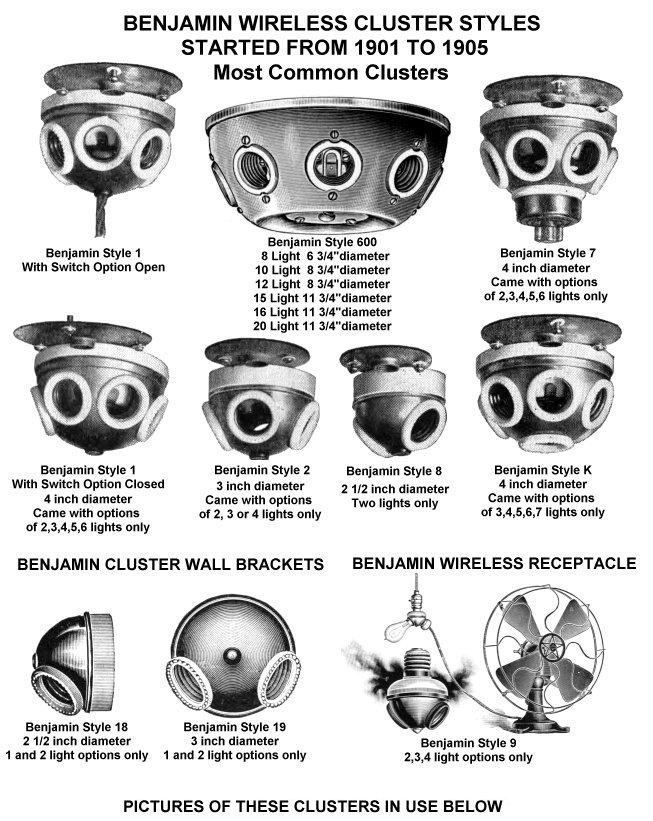
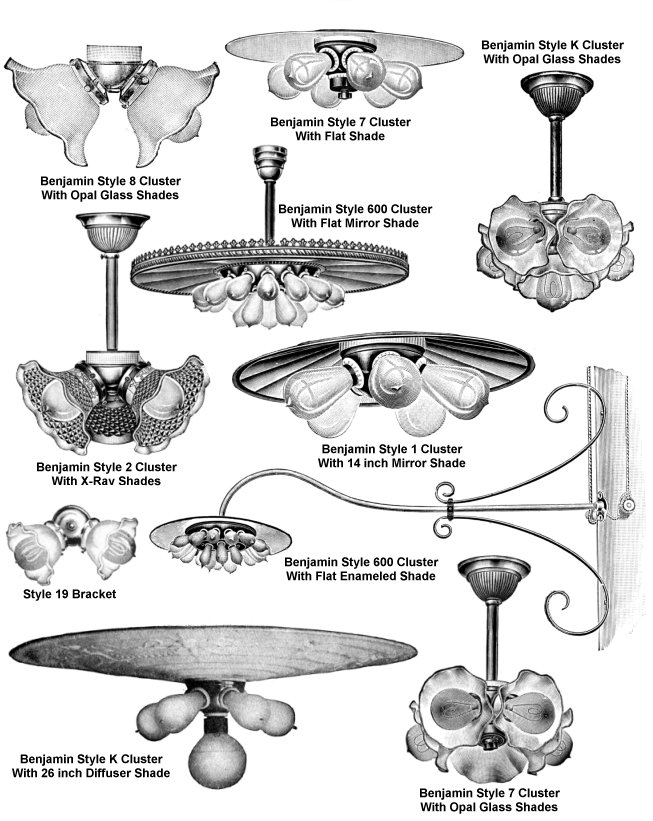
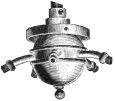 Below
are some pictures from catalogs of some of the wireless cluster
styles. Below
are some pictures from catalogs of some of the wireless cluster
styles.
They are called wireless clusters because only two wires are required
to come down into the cluster. Once these two wires are connected,
all of the sockets work and operate. Keeping in mind that other
clusters of the time needed each socket to be wired separately costing
much more time. Some clusters even required wires to be pushed through
small curved tubes (Dales and others), The Hubbell cluster even
required more work in that the early style of Hubbell socket shell
required threading the pull chains as well. If a worker was installing
a 16 light Dale style separable cluster ball (a six light version
shown on your right) he would not only need to pull 16 wires down
through the tubes, but he would need to also connect 16 costly sockets
and connect the wires to them. Even a fast expert worker would take
much time installing only one of these. For fun lets count the minutes
as if the worker was in a race to get the job done. He cuts 16 wires
to length, (two minutes), he strips both ends of the wires (two
more minutes), he pulls each wire down through the tubes (another
two minutes), he loosens the screws and removes the caps from 16
sockets and pulls out the insides (four minutes), he screws socket
caps on to 16 tubes and then tightens the set screw on each (four
minutes if he did not poke out any cap insulators), he ties the
"wireman's knot" on each wire pair under the cap (four
minutes) he connects each socket to the stripped wires or strips
them at this stage (four minutes) he slides socket shells and insulators
over the insides and secures each with two side screws (most sockets
of this time) (four minutes) he ties all of the wires together and
to the center wires and puts on the bottom cluster ball (4 minutes).
Even though this has taken 30 minutes so far, it is not likely that
anyone would had completed this task in less then 60 minutes per
cluster. While it is true that much of this work would have been
prepared off site, it still needed to be done. 100 clusters would
take over four days for one person if he did not need to sleep.
In contrast the Benjamin cluster would had been completed two minutes
each (this style did not use collars) and 100 clusters taking a
little over three hours to prepare.
 With
Benjamin's new wireless clusters, (a twenty light version shown
on your left) the worker would only need to connect two wires to
the top of the cluster opening which saved time and money on purchasing
sockets, wire and future maintenance. With
Benjamin's new wireless clusters, (a twenty light version shown
on your left) the worker would only need to connect two wires to
the top of the cluster opening which saved time and money on purchasing
sockets, wire and future maintenance.
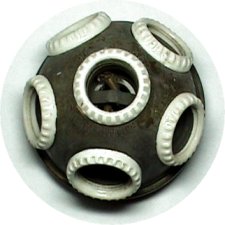 Here
is a close look at a Benjamin Style K 6 Socket Cluster (shown to
your right and below). It would also be good to note that there
are multi socket clusters out there, that are larger socket clusters
with smaller socket caps. These holes in these caps were stamped,
so no real big deal to add the thread attachments and punch more
holes in the cap. I have seen a 7 socket style K with only 4 sockets
in use and a cap with only four holes. A cluster like that could
easily be converted to its original design capacity of 7 sockets. Here
is a close look at a Benjamin Style K 6 Socket Cluster (shown to
your right and below). It would also be good to note that there
are multi socket clusters out there, that are larger socket clusters
with smaller socket caps. These holes in these caps were stamped,
so no real big deal to add the thread attachments and punch more
holes in the cap. I have seen a 7 socket style K with only 4 sockets
in use and a cap with only four holes. A cluster like that could
easily be converted to its original design capacity of 7 sockets.
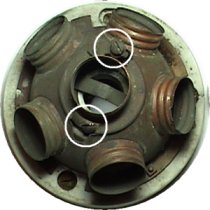
In the picture shown on your left, I have put white circles where
the lead in wires would attach.
The two fixture wires would come up through the bottom back of the
cluster and attach one to each screw. After being tightened, the
cap would be replaced and the porcelain collars screwed over the
Edison threads. It was these collars that held the cluster together
or the cap in place.
All Benjamin clusters started out and were "ceiling form"
clusters, meaning that each cluster had holes in the bottom of the
porcelain and could be directly screwed into a ceiling using standard
wood screws.
 It
was the after market parts in the early days that made the cluster
able to be used as a Cluster Pendant Unit. It
was the after market parts in the early days that made the cluster
able to be used as a Cluster Pendant Unit.
Since there were different size clusters, the flanges and flange
part numbers were different for each style cluster.
The point here being, that you will frequently come across Benjamin
clusters that are "ceiling form", meaning that there is
no flange back to attach it to a fixture. However, this does not
mean that it can not be used with a fixture. You only need to find
the correct size back for it.
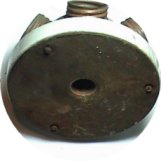
The Benjamin cluster shown on your right has a tapped 3/8 inch flange
back plate attached.
It is also note worthy that many times you will find these back
plates using reducers. Reducers were sometimes used to adapt the
plate to a smaller size, which most times can be easily removed
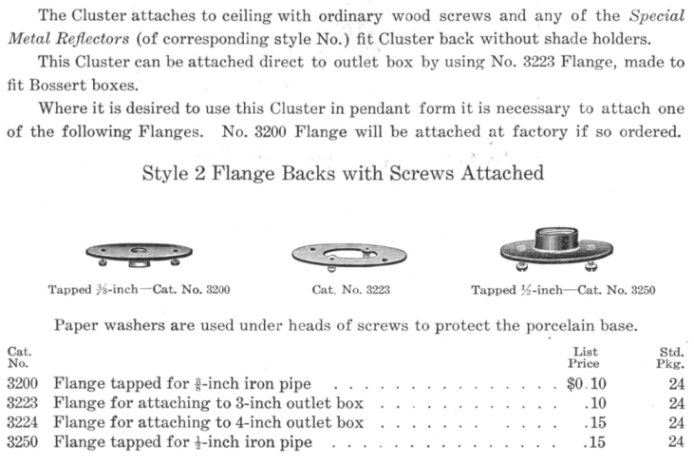
(with some WD40) if needed. Shown below is a capture from the 1905
Benjamin catalog that explains what I am talking about, which also
shows the part numbers and pictures of pack plates for a Style 2
Benjamin Cluster.
 It is not hard to see why Benjamin was such a success with this
new lighting concept. I am personally surprised that there was not
as much direct competition in the early days. Benjamin was smart
in the way that they continued to quickly invent new items to deal
with most any application that would be needed. This made them a
kind of one stop shop for jobbers and secured their clients for
decades to come.
It is not hard to see why Benjamin was such a success with this
new lighting concept. I am personally surprised that there was not
as much direct competition in the early days. Benjamin was smart
in the way that they continued to quickly invent new items to deal
with most any application that would be needed. This made them a
kind of one stop shop for jobbers and secured their clients for
decades to come.
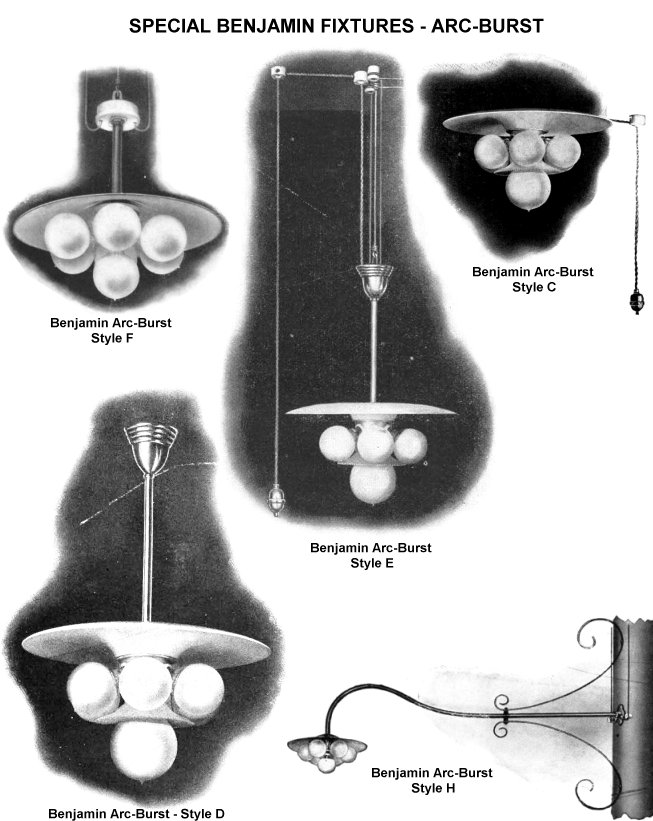
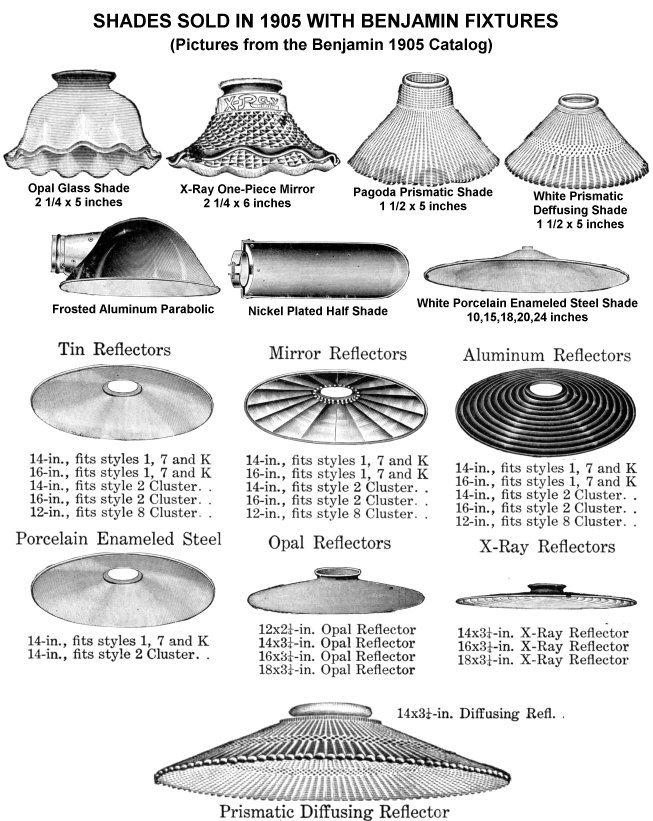
.
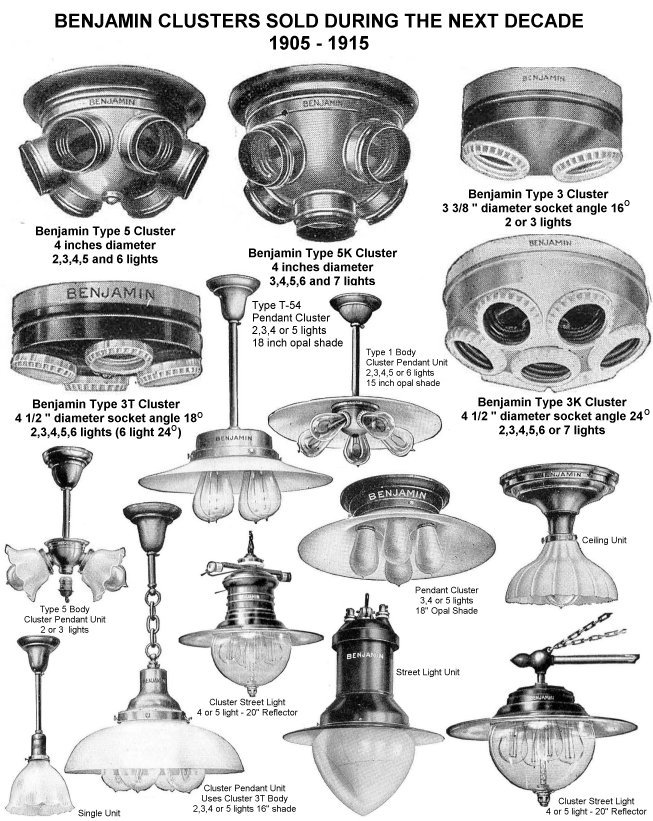
BENJAMIN - THE NEXT DECADE
Between 1905 and 1915 many new clusters, fixtures and inventive
parts came out (some of which are shown below).
Benjamin made a wise move and did not fall into the mistake that
I have seen so many other companies make.
During this time new clusters were developed, BUT they did not discontinue
ANY of the already successful cluster styles. They continued making
the older styles while adding and mixing the new lines into their
existing inventory.
 The
only difference in the older clusters shown above is a small name
change in "STYLE" numbers are now changed to "TYPE"
numbers and the "Clusters" are now called "Cluster
Bodies". For example a cluster already shown above called "Benjamin
Style 2 Cluster" is now called "Benjamin Type 2 Cluster".
The porcelain collars that screw on to the socket threads have changed
some too, but that is another topic since these have changed many
times through the years. I may research this later and provide a
time line for different style porcelain collars. Also noted is that
many of the new clusters invented no longer used collars. Also many
of the insides of these new type clusters are no longer made with
porcelain. These are now made of different materials of hard rubber,
Bakelite and other synthetics (note that the older styles were still
made with porcelain). The
only difference in the older clusters shown above is a small name
change in "STYLE" numbers are now changed to "TYPE"
numbers and the "Clusters" are now called "Cluster
Bodies". For example a cluster already shown above called "Benjamin
Style 2 Cluster" is now called "Benjamin Type 2 Cluster".
The porcelain collars that screw on to the socket threads have changed
some too, but that is another topic since these have changed many
times through the years. I may research this later and provide a
time line for different style porcelain collars. Also noted is that
many of the new clusters invented no longer used collars. Also many
of the insides of these new type clusters are no longer made with
porcelain. These are now made of different materials of hard rubber,
Bakelite and other synthetics (note that the older styles were still
made with porcelain).
Only the new clusters and a few of the many new lighting fixtures
are shown below. There are far too many new items to list here.
For a more complete list you can purchase digital copies of the
Benjamin catalogs from this site.
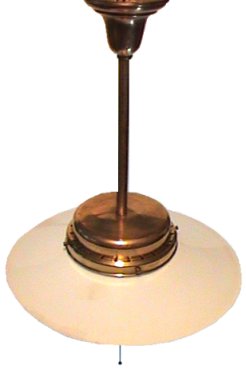
The most popular fixtures of the time were those using the large
18 inch flat opal shades like the fixture shown above and to your
left.
This lighting style caught on and was manufactured and sold by other
companies as well.
 It
also became the industrial common design for lighting large spaces.
There are many in-use pictures from the period also of these designs
in our picture database. It
also became the industrial common design for lighting large spaces.
There are many in-use pictures from the period also of these designs
in our picture database.
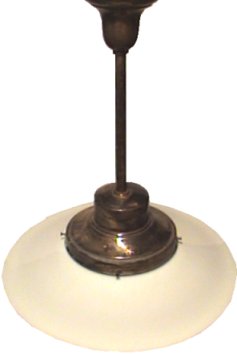
The fixture shown here is an example of a Benjamin three socket
pendant cluster type T53. It came with options of 2,3,4 or 5 lights
of which all versions came with an 18 inch flat opal reflector.
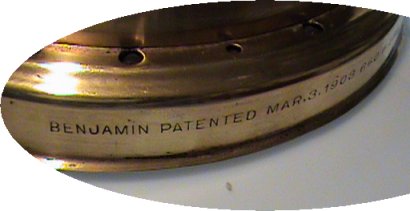
Another thing to take note of is that the "Pendant Clusters"
are normally marked or stamped Benjamin, while the "Cluster
Pendant Units" in most cases are not. This could be because
the cluster itself is already marked or because Benjamin did not
manufacture all of the fixture parts that they sold. In other words,
the instance of a fixture being used together with a standard cluster
body; the cluster is already marked (as all clusters were). But
in the case of a "Pendant Cluster", it has a built in
cluster (the fixture being the cluster) and the fixture itself is
marked as shown above.
You will notice the close design between this cluster and the style
of the 1909 Federal Electric cluster pendant shown above at the
top of this Benjamin section on the web page.
This fixture is also shown below in the catalog pictures (the four
socket version T-54). Benjamin had many designs of clusters for
different uses. For example Industrial Clusters, Special Units,
Wireless Cluster Units, Pendant Clusters, Cluster Pendant Units,
Ceiling Units, Single Units, Waterproof Units, Cluster Street Lights,
Street Hoods & Clusters, Single Unit Street Lights, etc.
 Each
of these go together with the type of cluster being used. For example:
"Cluster Pendant Units" are those that use a standard
cluster fit into a fixture body (shown below), while "Pendant
Clusters" are fixtures like the one shown above where the cluster
is part of the fixture and signed Benjamin. Each
of these go together with the type of cluster being used. For example:
"Cluster Pendant Units" are those that use a standard
cluster fit into a fixture body (shown below), while "Pendant
Clusters" are fixtures like the one shown above where the cluster
is part of the fixture and signed Benjamin.
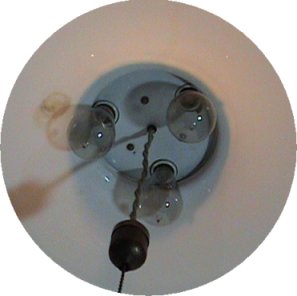
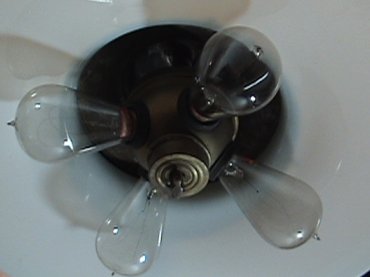
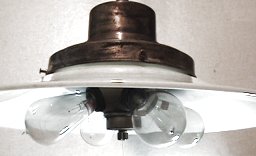 In
this example, we have a fixture with a Benjamin Style 7 (four socket
cluster with a switch). The fixture itself is not signed, but the
cluster is. In
this example, we have a fixture with a Benjamin Style 7 (four socket
cluster with a switch). The fixture itself is not signed, but the
cluster is.
These fixtures with this hood style shown here were sold by Benjamin
in their catalogs as a chain pendant and as shown here a pendant
fixture. There were many different types of fixture parts that Benjamin
used through the years. Sometimes it can be hard to tell if it was
an item that Benjamin put together and listed in their catalog,
or if it was something that a jobber put together from different
fixture suppliers, using a Benjamin cluster.
Through the many years of Benjamin catalogs, it would use too much
space to list all of the different fixture parts. If you plan on
being a purest, you will need to purchase digital copies of the
Benjamin catalogs from this site, or start collecting catalogs yourself
and learning all of the different styles.
 Another
note though is that Benjamin did not directly manufacture all of
the fixture parts that were sold in their catalogs. Another
note though is that Benjamin did not directly manufacture all of
the fixture parts that were sold in their catalogs.
It was common practice for manufacturers to purchase items at a
discount from other specialty manufacturers.
The largest of these that I am aware of was the Faries Manufacturing
Company. I will soon do a page on Faries because when done it will
surely blow the mind of anyone that is familiar with different fixture
styles. It is an awesome thing to see fixtures being sold in raw
form. Meaning before the holes were punched and drilled, totally
unfinished pieces waiting for the jobber or manufacturer to work
their magic. This is what you would see with Faries as they sold
thousands of turned, stamped and cast items, unfinished and hot
off the press.
It would be a task in itself to identify every part, inventor and
manufacturer. Some items were licensed and allowed to be made by
one manufacturer when it belonged to yet another. Then in other
cases it was not licensed, but sold at a discount to the other manufacturer.
So items can be identified as being owned by one manufacturer, sold
by another, but that does not mean that they manufactured it. Then
another can of worms; Patents are another issue. After a patent
had expired other manufacturers could consider the item open game
to manufacturer and sell.
BENJAMIN - OTHER PARTS - SHADE HOLDERS - WIRE
GUARDS
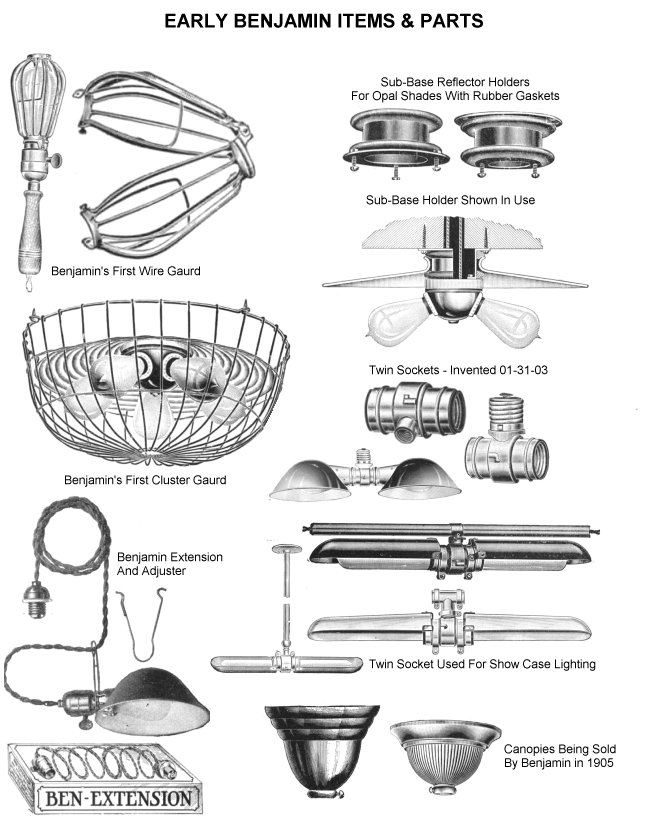
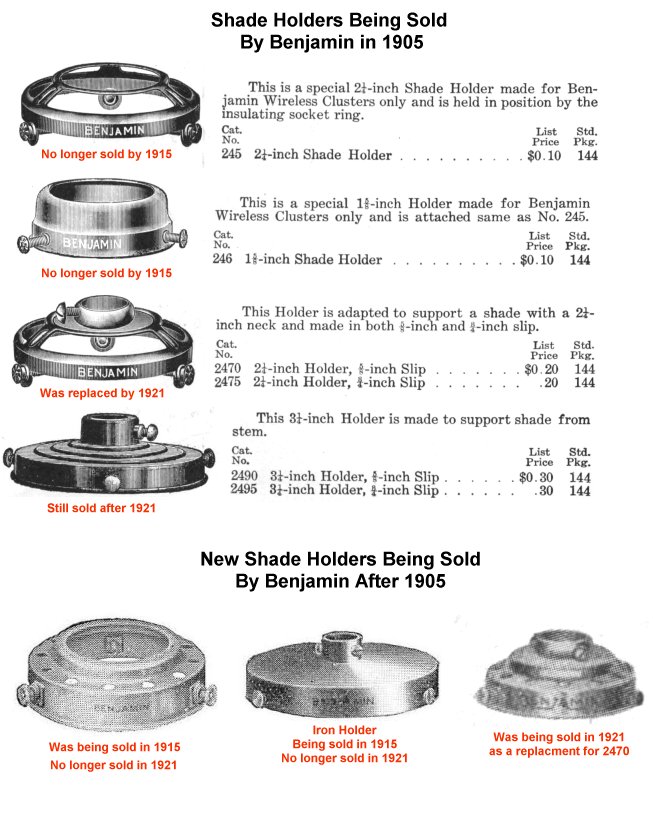
After 1905 there were MANY other wire guards, baskets, work lights,
industrial fixtures, sockets, lamp clusters, etc., etc., the list
really goes on and on and on. Sadly far too much to list here, so
if you want to learn more about Benjamin products you will need
to purchase our digital Benjamin catalogs.
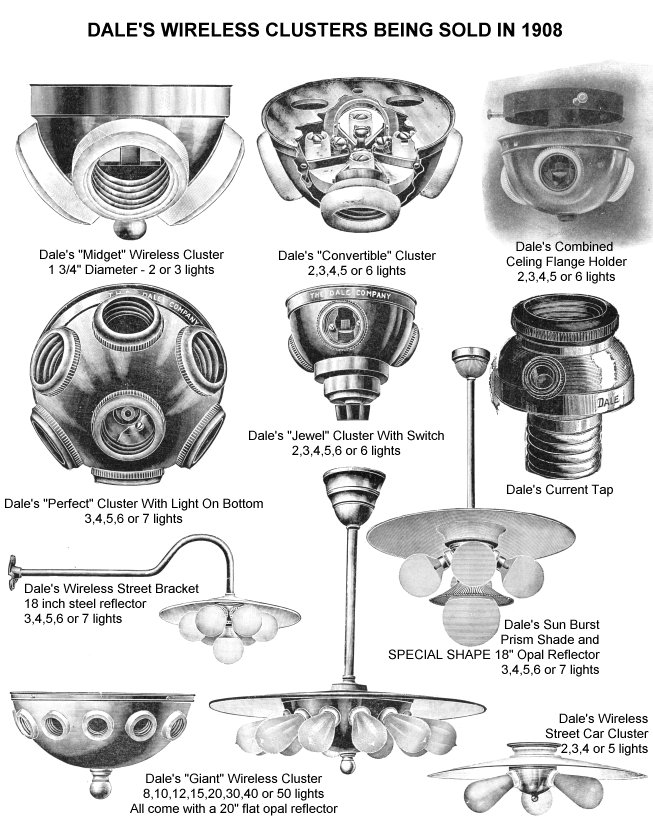
ALSO, this page grew too much for me to add additional information
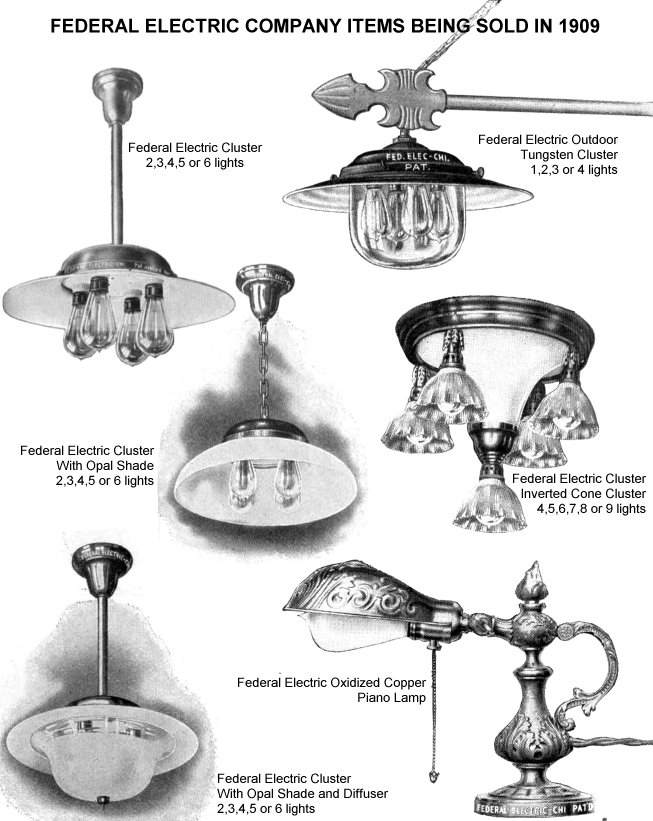
about Dale clusters and the Chicago Federal Electric Company fixtures.
So, added below are some quick captures showing some Dale clusters
from 1908 and some Federal Electric fixtures from 1909.
|
ELECTRICAL
SPECIALTY MANUFACTURERS - UNDER CONSTRUCTION
|
This
next section of the lighting timetable is under construction and
will be linked here when complete.
Please check back later.
Latest
New Page Finished was on Oct. 26th 1008
Last updated on Nov. 6th 2008: GECO
Sockets
The
history of G.E. Co. sockets, dating them and how to tell one from
the other
|