|
G.E. Co. Fatboy Sockets
The History Of G.E. Co. Fatboy Sockets,
Dating Them
And How To Tell one From The Other
|
|
There are some interesting facts concerning G.E.Co. sockets,
as well as some misconceptions that should be cleared up.
Firstly, the misconception that all G.E.Co. sockets should
have mica under the center contact. I have seen more then
once where a well meaning lamp restoration job added mica
to the socket, when it in fact was a version of the socket
that would not had come with mica. Also, I have seen where
people that are buying or inspecting a lamp, often times look
into the socket to see if it has the mica insulator. If it
does, it is deemed as an early lamp socket and all looks fine.
However if it is missing mica, then the lamp is either seen
as something less desirable, or viewed as something that is
not 'correct'.
The first GECO Fatboy socket was introduced in 1895 and DID
NOT contain mica.
The truth is, that mica was not used on G.E. 'Fat Boy' sockets
until the early 1900's. Starting in about 1910 mica slowly
began to be removed from sockets by manufacturers including
General Electric. By 1913 most G.E. sockets no longer contained
mica. (however, 'old stock' mica sockets were still sold for
several years after by electrical supply houses).
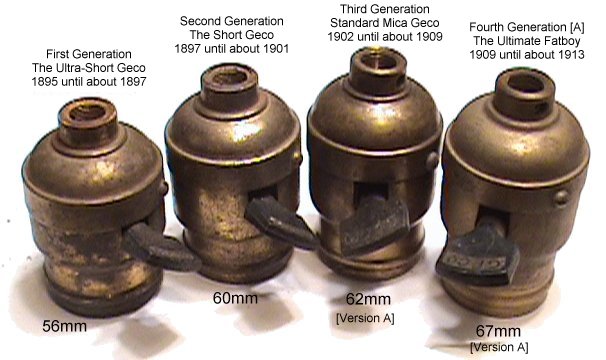
There were many changes in the GECO socket through the years,
but the most important years for telling the difference in
early G.E.Co. sockets, were those that were offered in the
years 1895, 1897, 1902 and 1909.
The 1902 socket is the most common "mica socket"
seen today. Starting in about 1909, the ultimate fatboy came
out and measured 67mm. There were many different versions
of the ultimate fatboy which I will cover in brief at the
bottom of this page, but the main difference was that mica
was no longer used (by 1913/1914) and a quick catch was used
on the cap and shell along side the screws (other versions
with quick catches only (no screws) also came out covered
at the end
of this page).
There
are some common terms among collectors, when dealing with
older G.E.Co sockets that you should be aware of.
For example, the terms "sausage-shaped logo", "sharp-sausage",
"squared-sausage" and large and small fonts (when
speaking of the lettering on the turn keys).
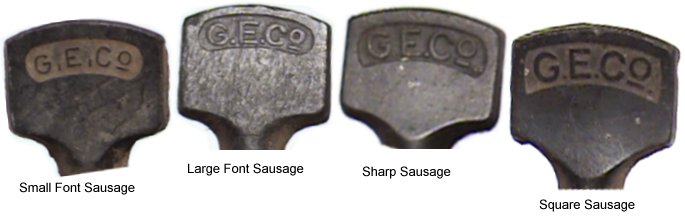
The "Sausage" was used on First Generation and Second
Generation (version A) GECO sockets. The new "Sharp Sausage"
began to be seen on the Second Generation Version B and Third
Generation standard mica sockets. The "Square Sausage"
is found on Fourth Generation (version A) ultimate fatboy
sockets. However always keep in mind that there were transition
periods where a year or two before or after a major change
took place, may have used old or new styles on some sockets.
Always take the entire socket into account when dating it.
Compare each section on this page to your socket along with
the dating provided to see where your socket falls into the
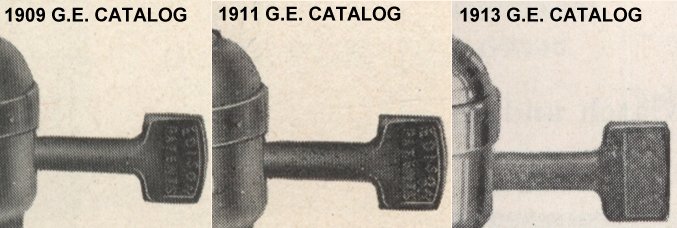
dating line. By the time that the G.E. "1913-1914"
catalog was released, most all sockets (fourth generation
version b) had changed from the sausage keys to the new GE
logo key shown below on your right.
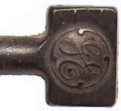 The
above is all dealing with the turn key sockets in which most
earlier paddles used a sausage-shaped indent with the "GECo"
trademark embossed inside the sausage in either a large or
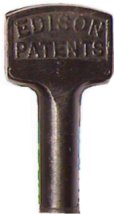
small font size (larger font most common). There is one exception
to the rule which was the GECO long key sockets. These long
keys used the trademark word "EDISON PATENTS" embossed
on the key. This key however was changed in 1913/1914 with
the other G.E. sockets to a GE circular logo (as shown on
your right). The
above is all dealing with the turn key sockets in which most
earlier paddles used a sausage-shaped indent with the "GECo"
trademark embossed inside the sausage in either a large or
small font size (larger font most common). There is one exception
to the rule which was the GECO long key sockets. These long
keys used the trademark word "EDISON PATENTS" embossed
on the key. This key however was changed in 1913/1914 with
the other G.E. sockets to a GE circular logo (as shown on
your right).
You will also notice that some GECo sockets have letters or
numbers (sometimes a combination of both a letter and number)
embedded into the porcelain tops of the sockets. There is
no significance to these (that we can make heads or tails
out of for dating). While with some manufacturers, this is
possible. However, these GECo sockets do not make any sense.
Collectors have grouped together disclosing their letters,
marks, and differences in sockets going down a check list.
It seems that G.E. simply went A-Z, 1-9, A1, A2, etc... until
the next major socket generation, and then started all over
again with A-Z. This makes these 'G.E. Codes' of no real use
to a collector. Unless you want to collect hundreds of different
sockets just to have one of each letter, there is no real
reason for them(.)
The term "Ultra Short" is speaking of a version
of the early 1895 GE.Co. socket that was slightly shorter
then the Dec. 1897 version which today is simply termed as
a "Short GECO". The shells on most of these ultra
shorts are also marked Edison Patents, however there are some
early unmarked shells (mostly keyless or marine sockets).
Also, these two sockets (1895 and 1897) are shorter then the
standard fat boy GECO sockets from the 1900's to the 1920's.
Over the
years, the fatboy grew in length. Each increase was fairly
small, so it is most convenient measure in millimeters. When
measurements we measure including the insulator or Edison
threads that may be sticking out of the bottom of the socket.
This can cause slight variances for example our measurements
on different ultra short sockets (using a digital caliper)
might be 56.05, 56.48, 55.57, 56.65, 55.41, 55.61, 55.90,
55.77, etc.. So, it would be safe to say that GECo's measuring
under 57mm would be an ultra short socket, however we will
use the average and call it 56mm.
Note that these sockets are always shown in G.E. catalogs
as Cat. No. 9386 (for the turn key sockets)
FIRST GENERATION [A] (Ultra Short with narrow contact
stem) 1895 To About 1897 - 56mm
Round center contacts, no mica, round cap screw holes in porcelain
and regular sausage keys
Sockets described as above measuring under 57mm would be an
ultra short socket
FIRST
GENERATION [B] (Ultra Short with wide contact stem) 1896
OR Jan. 1897 To Late 1897 - 56mm
Everything as shown above only the center contact stem is
much more narrow.
It is unknown at which time this change was made, but the
wider contact was the later change since the narrow contact
was shown in 1895. The problem is that the Jan. 1897 G.E.
bulletin used the same illustration for the socket insides
as the 1895 ad (G.E. did not go to the expense of making a
new drawing). However, by the time that the Dec. 1897 catalog
was released, the socket was now shown as a "Second Generation"
socket. So, even though we do not know exactly when the wide
contact came out, it is newer then the 1895 narrow version.
It is likely that this wide contact (since it no longer existed
by Dec. 1897) can be called an 1897 version, while those with
narrow stems can be called a pre 1897 socket, or simply a
version A if you are a purest when it comes to dating.
Sockets described as above measuring under 57mm would be an
ultra short socket as in version [A].
SECOND
GENERATION [A] (Regular Short) 1897 To About 1901 - 60mm
Square center contact, no mica, rectangle cap screw holes
in porcelain, small cap and regular sausage key (some early
sockets have round holes in the porcelain). Keeping in mind
that this was the first socket to offer the option of a full
sleeved insulator, sockets that still used the small half
inch insulator will measure almost 2mm smaller then those
using the larger full sleeve insulator.
Sockets described as above measuring over 57.5mm but under
61mm would be the regular Short Geco.
SECOND
GENERATION [B] (Regular Short with large cap) About 1901
To About 1904 - 62mm
Short as above but with larger cap, sharp sausage key, mica
insulator and a new rectangle center contact with a dot indent
on it. (some early versions do not have mica but the key has
already changed to the sharp sausage)
Sockets described as above measuring over 62mm but under 63mm
are second generation [B] sockets.
THIRD
GENERATION [A] (Standard Geco Mica Socket) 1904 To About
1907 - 62mm
These sockets are all insulated under the center contact with
mica, the center contact is the rectangle with a dot indent
on it, the key uses the sharp sausage, the large cap which
is now always fiber insulated. This is the version being sold
in the 1904 G.E. catalog.
Sockets described as above measuring over 61mm but under 62mm
are third generation version A sockets.
THIRD
GENERATION [B] (Standard Geco Mica Socket) 1907 To About
1909 - 63mm
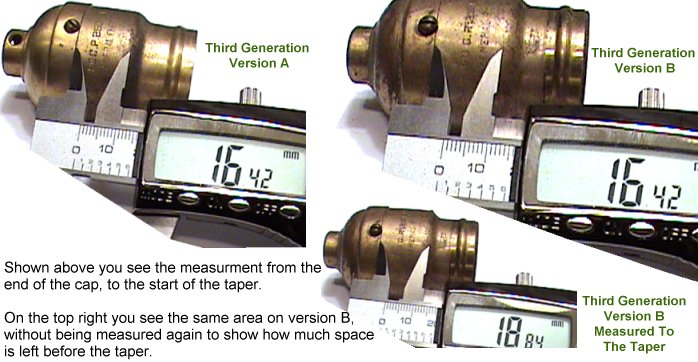
These socket shells have a different taper from those above
causing more space between the taper and the shade holder
rib. Also in virtually all shells there is about a .5mm more
space between the rib and the end of the shell tube where
the shade holder would fit. This is the version being sold
in the 1907 G.E catalog. Also note that a new socket (catalog
no. 1317) shows up in this 1907 catalog (next to our socket),
only with three bayonet joints. The 1909 G.E. catalog no longer
shows no. 1317, but instead now shows our 9386 socket as the
three bayonet version.
Sockets described as above measuring over 63mm but under 64mm
are third generation version B sockets.
FOURTH
GENERATION [A] (Ultimate Fatboy) - 1909 To About 1913
- 67mm
As stated above, our 9386 type socket now changes and uses
three bayonet joints on the shell. This is shown in the 1909
catalog along with the catch that is now clearly shown on
the shell cap. While another picture in the catalog only shows
two bayonet joints, every socket that I have seen so far with
the catch on the cap, has three bayonet joints on the shell.
It is clear from the new type (cat. no.1317) shown in the
1907 catalog, that this new 9386 has now taken it's place.
The key has also not changed to the squared sausage.
Sockets described as above measuring over 66mm but under 67mm
are fourth generation version A sockets.
FOURTH
GENERATION [B] (Ultimate Fatboy With Catches) - 1913 And
On... - 68mm
As seen now in the 1913/14 G.E. catalog, the turn key has
now changed to the G.E. logo, the socket has become longer
and mica is no longer used as an insulator. Shortly after
this catalog, all of the sockets also loose the rib for the
shade holder and start using UNO threads. This is documented
in a 1917 central electric company catalog, but trusted to
have taken place well over a year earlier.
Sockets
described as above measuring over 67mm but under 69mm are
fourth generation version B sockets.
|
THE
FIRST GENERATION
G.E.Co Fat Boy Socket - 1895 To 1897 - The
Ultra-Short
|
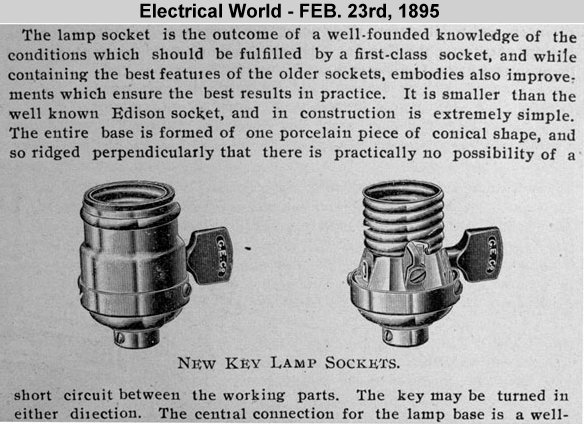
 The
oldest of the four major types of GECo's is the 1895 socket which
was first announced in the Electrical World magazine February 23rd
1895 as shown above. The
oldest of the four major types of GECo's is the 1895 socket which
was first announced in the Electrical World magazine February 23rd
1895 as shown above.
The socket key was shown with a sausage shaped indent using (what
looks like to me), the small sharp font with the G.E.Co. Trademark
embossed inside. Most of the early GECo sockets used the less sharp
font.
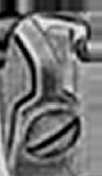
A close look at the introduction (enlarged on your right) will also
show that the center contact used a more narrow stem which later
became thicker (talked about below in the version "B"
section).
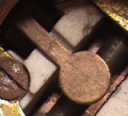 The
First Generation Version A GECO socket did not use mica under the
center contact, and it had a round tongue. The
First Generation Version A GECO socket did not use mica under the
center contact, and it had a round tongue.
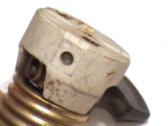
The First Generation Version A GECO socket had round holes in the
porcelain for the cap screws.
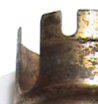
The First Generation Version A GECO socket did not use a bayonet
shell attachment method
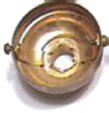
The First Generation Version A GECO socket did not use an insulator
in the cap
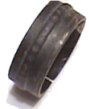
The First Generation Version A GECO socket only had a small round
insulator that fit into the RIB at the bottom of the socket tube.
The color can be different (example brown or black) has nothing
to do with dating.
(Note that in 1897 this socket was sold with an "optional"
full socket liner)
DIFFERENCES
BETWEEN THE GECO FIRST GENERATION VERSIONS (A & B)
The first Geco fatboy socket was released in 1895 as was seen in
the Electrical World magazine of Feb. 23rd 1895. This announcement
showed a picture of the socket as well as the insides. It without
a doubt shows a narrow center contact stem.
On January 11,1897 G.E. released a new bulletin. While the picture
on the first page only shows the same exact illustration as was
seen in 1895 (no help here), the second page does show the entire
new socket line up for the start of the year. In this line up, new
pictures are shown of the First Generation G.E. socket. While there
are no pictures of the inside of the socket, at least it does show
us that in Jan. 1897, G.E was still offering the "First Generation"
socket.
This is important because by December 6th, 1897 a new catalog which
contained their new items was released, and it now offered the Second
Generation Geco socket. Other new items included Bryant and Hubbell
sockets among others. The Second Generation GECo socket was now
offered with a full fibre lining for five cents more, but since
it was not yet required by the National Electrical Code (NEC), it
was only an option that you could add on to the socket.
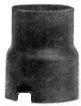 Most
of the first generation version A sockets found today, simply have
the fibre ring insulator (shown two pictures above). However, since
this documented change did take place in Jan. of 1897, the First
Generation GECo sockets can be found with the full fibre lining.
Take note that the first lining (as shown on your right) did not
cover the bayonet holes. The first version of the insulator was
shorter then the later common insulator that lined the shell all
the way up to the bayonet joints and screw holes. The G.E. Bulletin
called the fibre lining "A recent Improvement" It also
stated, "This improvement receives the fullest approval of
fire underwriters (NEC) and is strongly recommended by the General
Electric Company". The next NEC was not due to come out until
1899, at which time it then included the full liner as a requirement
for all sockets. Most
of the first generation version A sockets found today, simply have
the fibre ring insulator (shown two pictures above). However, since
this documented change did take place in Jan. of 1897, the First
Generation GECo sockets can be found with the full fibre lining.
Take note that the first lining (as shown on your right) did not
cover the bayonet holes. The first version of the insulator was
shorter then the later common insulator that lined the shell all
the way up to the bayonet joints and screw holes. The G.E. Bulletin
called the fibre lining "A recent Improvement" It also
stated, "This improvement receives the fullest approval of
fire underwriters (NEC) and is strongly recommended by the General
Electric Company". The next NEC was not due to come out until
1899, at which time it then included the full liner as a requirement
for all sockets.
At some point between 1895 and Dec. 1897, G.E. changed the thickness
of the center contact. It is likely (but not proven) that this change
also took place with the new changes and items in Jan. of 1897.
The narrow stem is termed as the first generation version A "ultra
short" and the thicker stem the first generation version B
"ultra short".
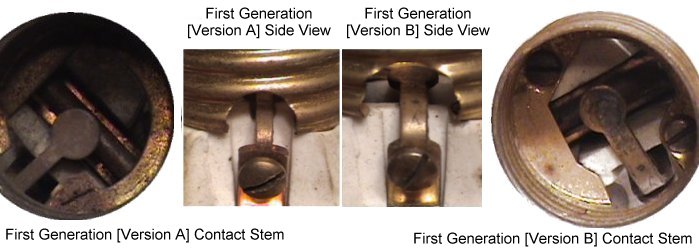
To sum things up, this first generation ultra short socket is a
G.E.CO. socket from 1895 until about December of 1897 that is 56mm
in length. It does not use mica, has round holes in the porcelain
for the cap screws, has a round center contact and uses slits (not
a bayonet) for the shell cap attachment method.
The thick contact stem is a newer socket made sometime before December
of 1897 and is called the first generation version B "ultra
short" socket.
(more facts
and patent information about the first 1895 socket here)
THE
SECOND GENERATION
GECo Socket - 1897 To About 1904 - The
Short GECo
|
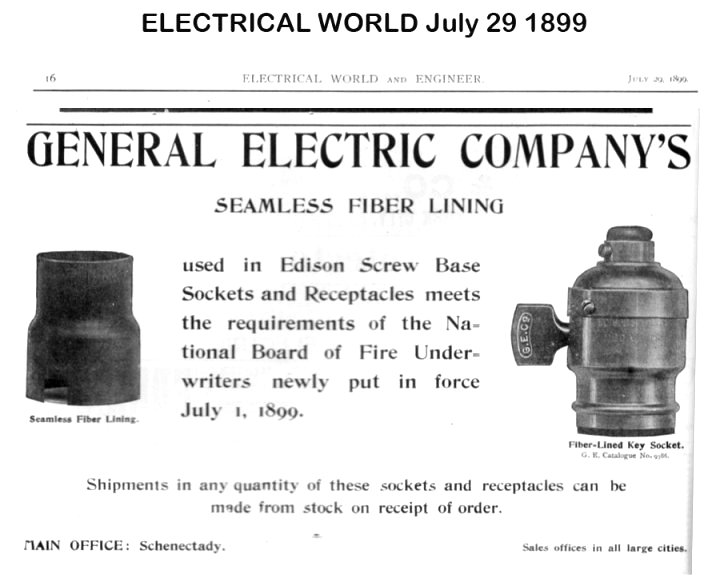
This is a fun socket to research...
Even though G.E. already had the full lining as an option to the
first generation socket early in Jan. 1897, the shell design changed
(likely to better accommodate the lining) by Dec. of 1897.
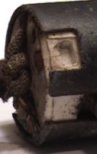 This
shell design was shown
by a new illustration in the Dec. 1897 G.E. catalog and became the
Second Generation G.E. socket. After the electrical code changed
in 1899, the lining became a requirement for all sockets, and the
ad shown above was placed in the July 29, 1899 Electrical World
magazine which provides us with a nicely dated illustration of both
the socket and liner. This is the first known illustration that
shows the early liner, which is important for dating because the
ad shows a shorter liner then what was used in later G.E. sockets.
It is not yet known exactly when the liner changed. By using examples
of found sockets, it was likely between 1900 and 1902 that G.E.
started using the new liner which covered the entire shell up to
the bayonet joints. This
shell design was shown
by a new illustration in the Dec. 1897 G.E. catalog and became the
Second Generation G.E. socket. After the electrical code changed
in 1899, the lining became a requirement for all sockets, and the
ad shown above was placed in the July 29, 1899 Electrical World
magazine which provides us with a nicely dated illustration of both
the socket and liner. This is the first known illustration that
shows the early liner, which is important for dating because the
ad shows a shorter liner then what was used in later G.E. sockets.
It is not yet known exactly when the liner changed. By using examples
of found sockets, it was likely between 1900 and 1902 that G.E.
started using the new liner which covered the entire shell up to
the bayonet joints.
It is an easy thing to identify the Second Generation version A
socket, because both the socket shell and center contact changed.
It can become a little confusing as you get closer to 1903, as the
shell caps, center contacts and the turn key sausage shape began
to change. Also the appearance of the mica insulator, as well as
cap insulators thrown into this mix.
Though from 1897 until 1899 mica was not used under the center contact.
It is clear from examples that mica started being used on these
sockets prior to 1903. Second Generation version A sockets can be
found with smaller socket caps which means that mica started being
used before the cap insulator.
From my test bed of GECo sockets, it is easy to see the progression.
ALL of my Second Generation socket shells with the small caps, have
no cap insulators.
ALL of my Second Generation socket shells with large caps have the
cap insulator.
One Second Generation socket shell was found using a small cap,
no insulator but with mica.
Three Second Generation socket shells with large caps have mica
and the cap insulator as well as the Second Generation B center
contact and the new sharp sausage key.
So, you can see from this that there are a few different transition
periods taking place all in the same shell. Some before 1903, some
at 1903 and others after 1903.
Please take the above information into thought as you learn about
the Second Generation socket below.
The Second Generation socket shell has a sharper edge or shoulder
then the First Generation version
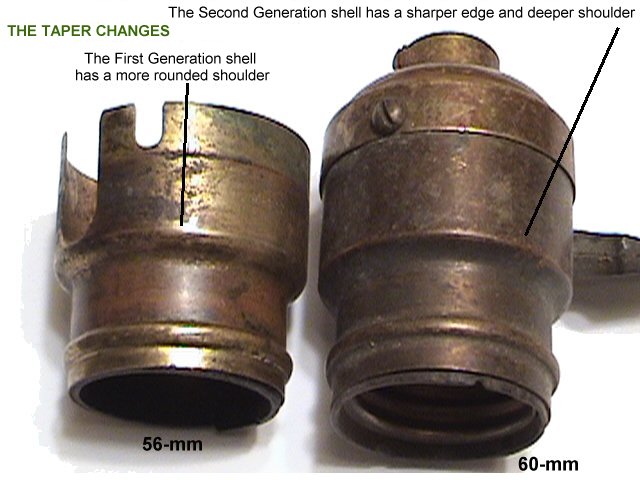
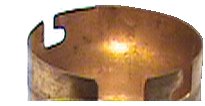
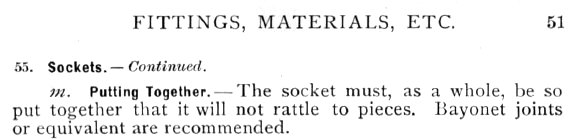
The Second Generation socket shell now also uses a bayonet to hold
the cap in place. The bayonet was also recommended by the National
Electrical Code in 1899 as shown below.
It should also be noted that since we do have early Second Generation
sockets with round holes in the porcelain, but do not have a socket
that used the first short insulated sleeve, that there also may
be early First Generation sockets that do not use bayonets.
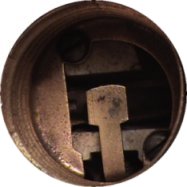
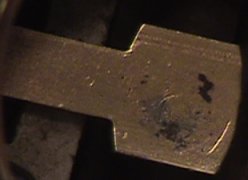
The Second Generation socket still does not use mica and the center
contact changes to a smooth square tongue as shown on the left and
to your right.
NOTE that this Second Generation socket was during a transition
period in which on early sockets, the square contact was used together
with round holes in the porcelain (not the rectangle as shown below).
This tells us that the contact was the first to change in our dating
timeline.
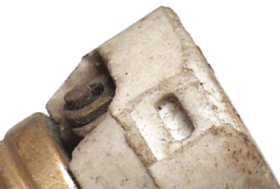
The Second Generation socket started using a rectangle hole in the
porcelain for the cap screws.
NOTE that this Second Generation socket was during a transition
period and that these type sockets can be found with round holes
in the porcelain as explained above.
EARLY Second Generation sockets still use round holes
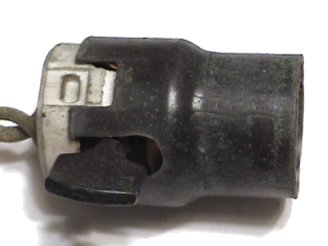
The Second Generation Socket comes with a fully insulated one piece
liner.
As
explained above, real early versions of this liner did not cover
the holes in the porcelain.
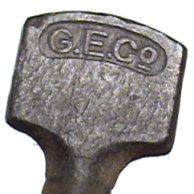
The Second Generation turn key still uses the old style sausage
key with the GECo trademark.
DIFFERENCES
BETWEEN THE GECO SECOND GENERATION VERSIONS (A & B)
Some of the
dating can get a bit confusing between the Second Generation and
Third Generation sockets as well as the sizes. This is mainly because
of the cap size. On Second Generation B Geco sockets, the cap size
changes which adds some size to the overall socket and comes really
close to the Third Generation socket size, but the Third Generation
socket has its own shell and traits.
A Second Generation B uses the large cap
Out of my entire test bed, I do not have one socket with the new
rounded shell design (Third Generation Geco), that comes with the
smaller cap. On the other hand, I do have several GECo sockets that
use the Second Generation sharp shell with the new larger cap design.
It evident that the new cap preceded the Third Generation Geco socket
(also the Third Generation socket is only ever pictured using the
large cap).
The First Generation shells did not come with lined caps. In 1897
G.E. introduced the shell lining, but it was only an option that
cost five cents more. Customers that wanted to spend more money
to be safe, selected the option. In 1899 the new National
Electrical Code made the lining of the socket shell a requirement,
BUT NOT FOR THE CAP. The only mention of the cap was that there
were to be no sharp edges, it was interrupted that the insulation
on the wire itself would provide the insulation needed with the
tying of the wiremans knot above the bare wire connections which
were insulated with the new lining.
This section changed in the July, 1904 National Electrical Code
as shown below
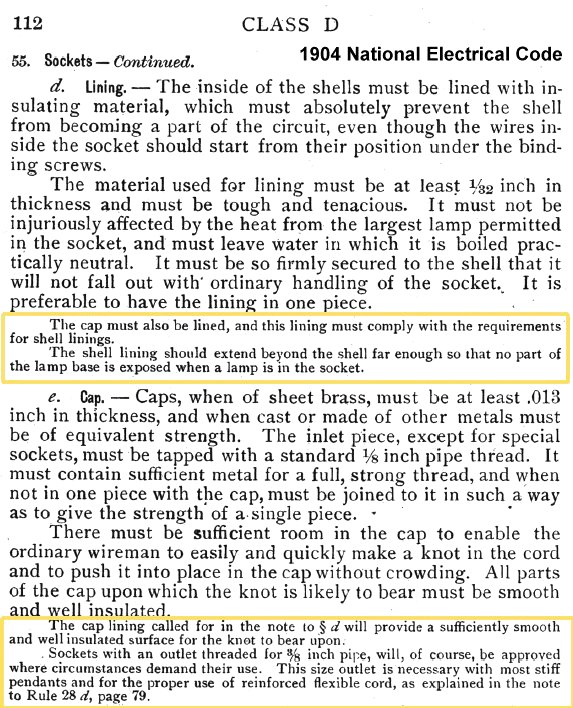
 The
exact date that G.E. offered the new cap design is not known, there
is no evidence at this time other then the electrical code of 1904
and the 1904 G.E. catalog as to actual cap dating. G.E. offered
an insulated lining in 1897 even though it did not actually become
a rule until the next NEC came out in 1899. So it is feasible that
G.E. could had offered the lined cap a year or even two before it
became an actual code rule. If it was an early cap design, I would
figure it to be sometime by late 1902. Also on another note G.E.
released their 1904 catalog which normally went along with new or
pending changes to the NEC. The
exact date that G.E. offered the new cap design is not known, there
is no evidence at this time other then the electrical code of 1904
and the 1904 G.E. catalog as to actual cap dating. G.E. offered
an insulated lining in 1897 even though it did not actually become
a rule until the next NEC came out in 1899. So it is feasible that
G.E. could had offered the lined cap a year or even two before it
became an actual code rule. If it was an early cap design, I would
figure it to be sometime by late 1902. Also on another note G.E.
released their 1904 catalog which normally went along with new or
pending changes to the NEC.
Keeping in mind that this was not like the code change from 1897
to 1899, where only the lining was changed. This was an undertaking
of a total new design of the socket shell and cap.
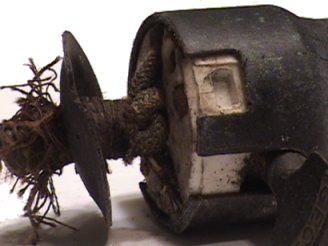
It is evident that the cap needed to be redesigned to fit both the
new liner and the wireman's knot as explained below.
"There must be SUFFICIENT ROOM in the cap to enable the ordinary
wireman to EASILY AND QUICKLY make a knot in the cord and push it
into place in the cap WITHOUT CROWDING".
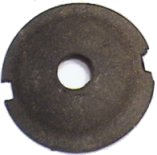
Now with the added rigid hard fibre cap liner, the small cap would
not had provided the room needed to meet the spirit of the new code.
Seen below is the new cap compared to the older cap.
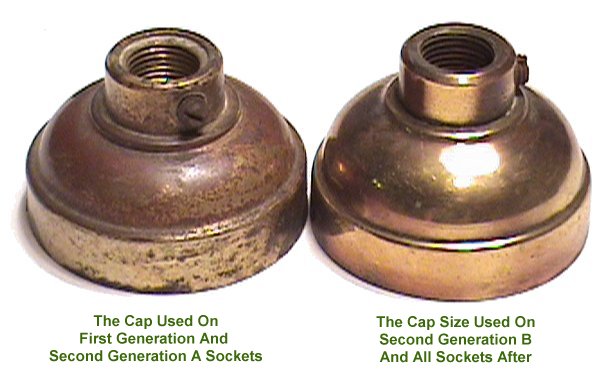
It is not hard to notice the change in these cap sizes. The new
cap is more of a bulbous shape which is much higher then the older
cap design. There is no doubt as to the timing and reason for this
change. It was most definitely the new code change that created
this need, as explained above.
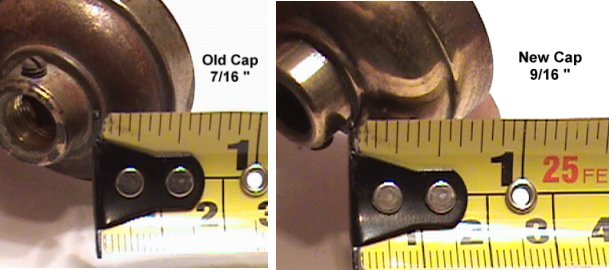
The actual measurements in millimeters of two random sockets were
25.21mm on the old cap and 27.43 on the new.
Keeping in
mind that at this time, the first documented arrival of the Third
Generation socket was in the April, 1904 G.E. catalog. Someone could
assume that old Second Generation shells would had been left over
that now needed the cap lined to conform with the new Electrical
Code. To properly line the old shell, the new cap would had been
added to the older shell. But, taking other transitions of the Second
Generation B socket into consideration, there would be other more
obvious items that would not fit into the dating timetable to still
make sense.
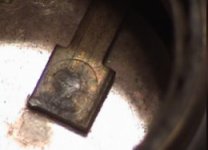 Most
Second Generation B sockets use mica Most
Second Generation B sockets use mica
Most Second Generation B sockets use mica under the center contact
as an insulator. If there is no mica, the center contact likely
is also missing the center contact indent, which was also a transition
that took place with the B version first before appearing in the
Third Generation socket.
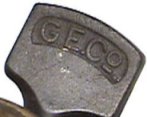 Second
Generation B sockets use the sharp sausage keys Second
Generation B sockets use the sharp sausage keys
Second Generation B sockets use the sharp sausage keys.
The sharp sausage was a change shown in the 1904 G.E. catalog.
This change is also another transition that took place first on
this socket and then appeared in the Third Generation socket.
So, if we take the following into account; First the use of mica
which started being used by most other manufacturers on sockets
starting about 1901; Then the migration of the center contact and
sharp sausage key; And now that fact that the Third Generation socket
is shown complete in the 1904 G.E. Catalog, we have no choice but
to date this B version as starting after 1901 (versions without
mica dating to 1900) and sometime before 1904.
THE
THIRD GENERATION
G.E.Co Fat Boy Socket - 1903 To 1907 - The
Mica GECo Socket
|
This Third Generation
socket is the most common of the GECo sockets.
Though the Second Generation shell shown above can be found with
mica and the larger cap, The Third Generation sockets shown below
were the new shell design and what is commonly known as the GECo
mica socket.
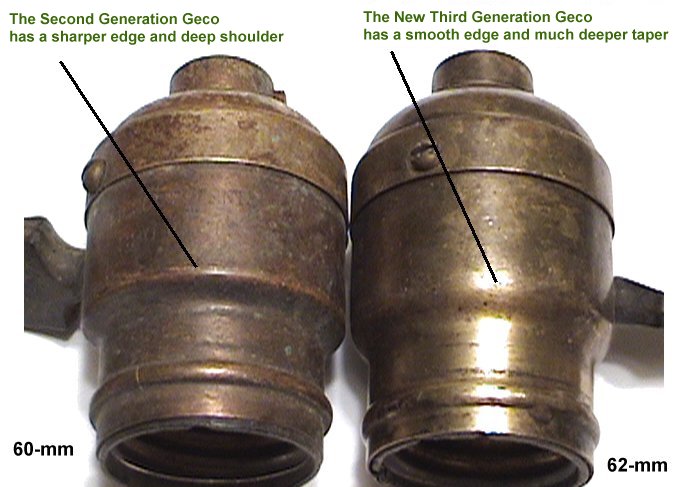
The Third Generation socket uses the same rectangle hole in the
porcelain for the cap screws as the Second Generation socket
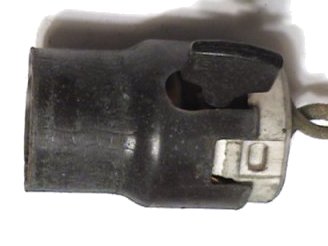
This Third Generation Geco comes with a fully insulated one piece
liner and cap insulator
The
Third Generation socket shell always uses a bayonet to hold the
cap
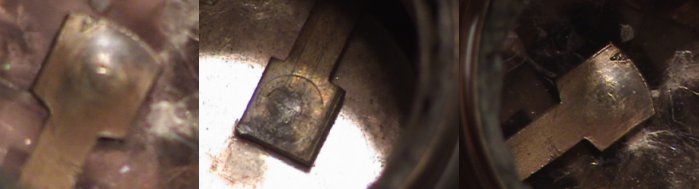
The 1903 socket always uses mica under the center contact. The center
contact always uses a tongue with a indented circle to make better
bulb contact. This raised circular indent can easily be felt with
your finger if the contact is too dirty to see it.
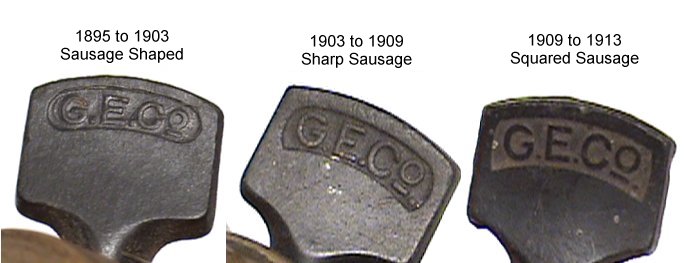
The third Generation turn key changes the sausage indent to a new
squared design as shown in the center picture below. To avoid confusion,
I have also added a third picture of the 1909 change (third picture
below) in which the sausage indent is completely lost in the newer
squared design.
Take note that the square sausage does turn up for the first time
(but on only one socket picture) in the 1907 G.E. catalog. However
out of all of my examples, none of my Third Generation sockets use
the squared design. It is evident that this was a transition period
(1907 to 1909) for the squared design, but my only socket examples
using the squared design are Fourth Generation Sockets.
DIFFERENCES BETWEEN THE GECO THIRD GENERATION VERSIONS (A &
B)
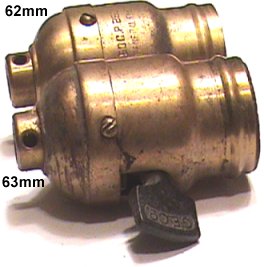 The
Third Generation B socket shell has a different taper from the A
version that was shown above. This taper causes more space between
the taper and the shade holder RIB. The
Third Generation B socket shell has a different taper from the A
version that was shown above. This taper causes more space between
the taper and the shade holder RIB.
Also on most shells there is about .5mm more space between the rib
and the end of the shell tube, where the shade holder would fit.
This B version was the one being sold in the 1907 G.E catalog.
Also note that a new socket (catalog no. 1317) shows up in the 1907
catalog (next to our socket), only with three bayonet joints.
The 1909 G.E. catalog no longer shows no. 1317, but instead now
shows our 9386 socket as the three bayonet version which then becomes
the Fourth Generation socket.
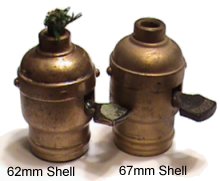
The only real difference between the Third Generation version A
& B are the sizes.
I have given some sample sizes below to give you a good idea of
what to look for seeing that measurements can be slightly different
depending on insulators.
Measurements of some random Third Generation A 62mm sockets:
61.56,
61.28, 61.51, 61.83, 61.98
Measurements of some random Third Generation B 63mm sockets:
63.37, 64.0, 63.21, 63.06
So
you can see that it would be safe to say that a Third Generation
Version A socket would be over 61mm but under 62mm. The Third Generation
Version B socket would be 63mm to 64mm
THE
FOURTH GENERATION G.E.Co Fat Boy - 1909 To About 1912 - The
Last Mica GECo Socket
|
This
is the last socket change before loosing the mica insulator, and
should be termed as the ultimate GECo.
The ultimate GECO stage is where it reaches its maximum size. It
is also the last GECo significant to most collectors.
Mica started being removed from sockets somewhere between 1910 to
1912. It was also not long after this that UNO threads started being
added to sockets of all makers. Collecting interest and socket history
becomes much less desirable during this time as many more were manufactured
and the sockets become much more common.
 THIS
NEW DESIGN PRIOR TO 1909 THIS
NEW DESIGN PRIOR TO 1909
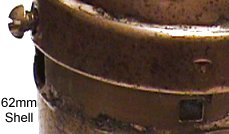 While
we date these new sockets to 1909, it should be noted that prior
to 1909 and the change in size to the new shell of 67mm, this design
was used on the 62mm shells. This was likely done between 1907 and
1909, but there is no precise evidence of this dating period as
fact. While
we date these new sockets to 1909, it should be noted that prior
to 1909 and the change in size to the new shell of 67mm, this design
was used on the 62mm shells. This was likely done between 1907 and
1909, but there is no precise evidence of this dating period as
fact.
(now proved see the update below)
However, these 62mm sockets with the new design are also found with
the sharp-sausage turn key design (1903-1909). We can only say for
sure that the change took place sometime before 1909 because at
that time the G.E. catalog was using the new shells with the new
turn key design where the sausage is completely lost to the new
squared designs.
UPDATE: A GREAT Thank You! - goes to A. Allerhand for providing
the 1904 and 1907 G.E. catalogs.
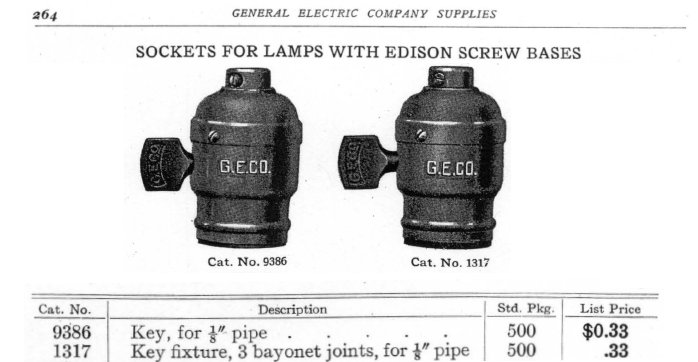
As shown below in the 1907 G.E catalog, there is a new arrival (catalog
no. 1317) that was not in the 1904 catalog.
Catalog number 1317 is our socket mystery shown above. A 62mm shell,
with the catch and extra bayonet joint!
The funny thing and new revelation is that later in the 1909 G.E.
catalog, the "1317" socket now becomes our "9386"
socket and there is no more mention ever of a catalog number 1317
ever existing.
For those not paying too much attention, it is the G.E. catalog
number 9386 that we have been following all of this time through
all of it's different generations and versions.
These new sockets are easy to spot simply be the new caps.
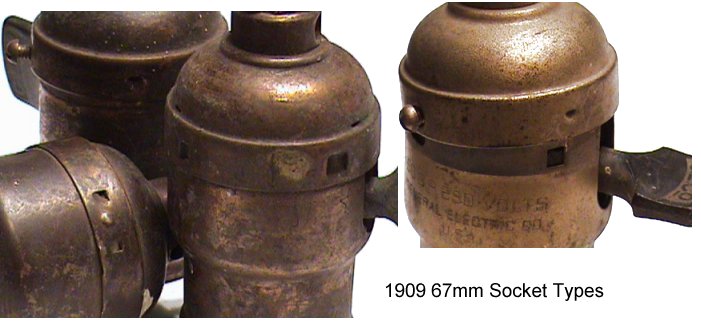
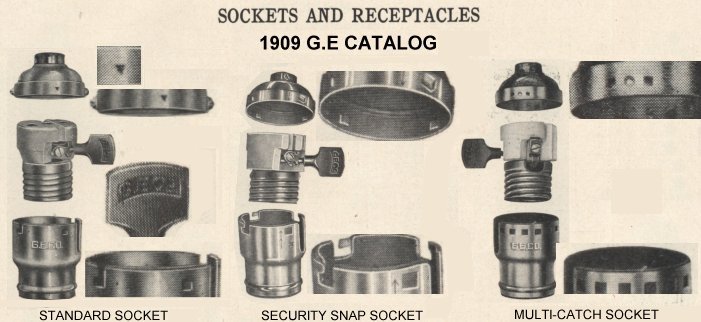
So to summarize this section, the Fourth Generation A socket is
one that is from 66mm to 67mm in size, which uses the side cap catch.
This catch can be seen by a little dent on the outside of the cap.
Under the cap is a small square hole for the catch to snap into.
All "9386" style sockets that I have seen so far always
use a third bayonet for the back catch and the square hole for the
front catch.
The squared sausage key is used and mica is under the center contact
on all Fourth Generation A versions.
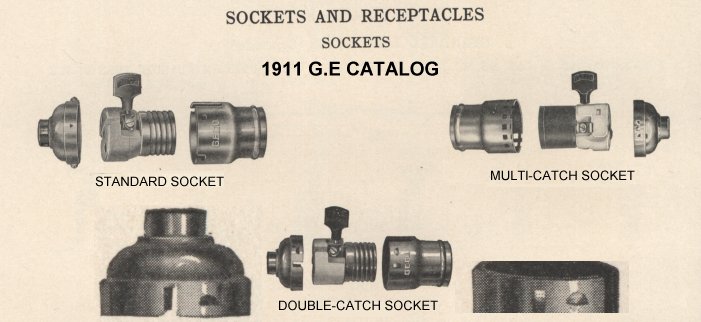
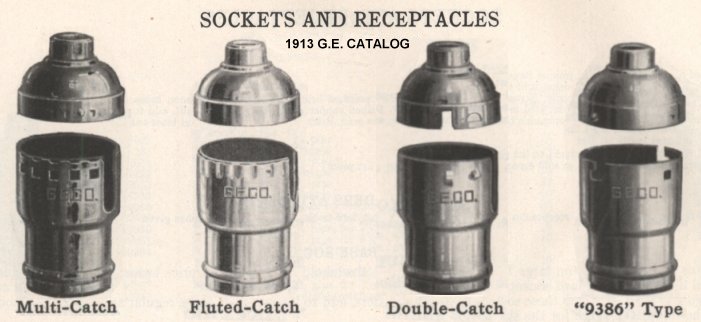
The Fourth Generation version B socket arrives with the 1913/1914
G.E catalog below
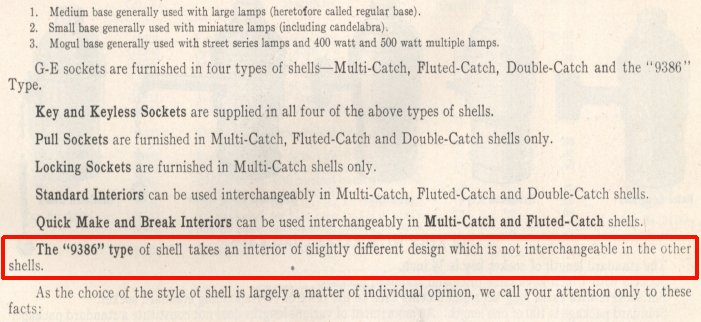
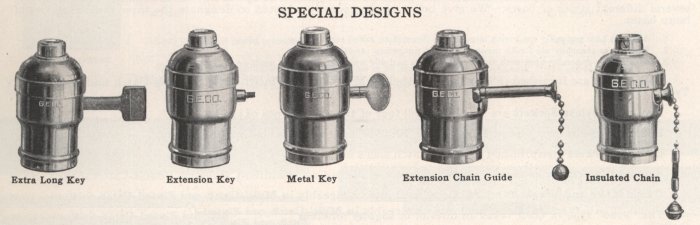
THE GECO FOURTH GENERATION VERSION B AND AFTER....
Many things changed with the coming of the G.E. 1913/1914 catalog.
Shells are now 68mm in size, socket keys no longer use the sausage
logos, mica is no longer used, the center contact changes to the
new design (shown below).
I will not go much farther then this catalog and point, as within
another year the only change to these sockets worth bringing up
is the UNO threading on the socket tubes (which replaced the shade
holder RIB).
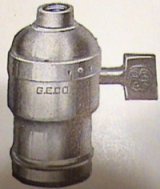
Note
worthy is that the keys changed once again in the 1913 catalog.
Only a few pictures in the catalog had not yet been updated, and
the socket for long keys in the 1913 catalog had been drastically
blanked out as shown in the catalog pictures below.
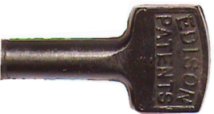
The long key socket option was the only key through the years that
did not change with the GECO trademark changes. It remained the
same "EDISON PATENTS" stamped on the key since it was
offered until now.
Comparing the catalog pictures below, it is clear that a new drawing
of the socket had not yet been completed in time for the printing
of the new catalog, so they simply blanked out the wording "EDISON
PATENTS".
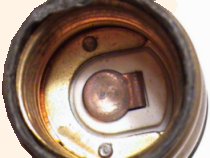
By 1913 the sockets now had a new center contact, and the mica under
the center contact was no longer used.
Now that you have got this far:
The
Simple GECO Quiz
|
OTHER
G.E.Co SOCKETS OF INTEREST
|
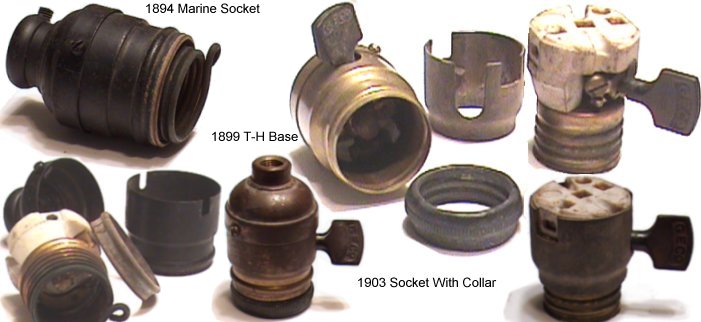
 Keeping
in mind that we I have covered mostly only the basic GECO socket,
there were still other G.E. sockets of different types and configurations.
The Marine socket stayed the same for many years having different
electrical codes for Marine, it did not require as many changes.
The marine socket shell only measures 44mm from the socket cap to
the bottom of the shell. The complete socket put together from the
top of the cap to the bottom spring measures 51mm much shorter then
the ultra short GECO. Keeping
in mind that we I have covered mostly only the basic GECO socket,
there were still other G.E. sockets of different types and configurations.
The Marine socket stayed the same for many years having different
electrical codes for Marine, it did not require as many changes.
The marine socket shell only measures 44mm from the socket cap to
the bottom of the shell. The complete socket put together from the
top of the cap to the bottom spring measures 51mm much shorter then
the ultra short GECO.
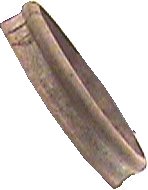
The fibre insulator (shown on your right) for the Marine shell is
of a different shape and style from the standard GECO insulator
rings.
Other type sockets also used different shaped insulators, such as
the sockets sold for use with collars (G.E. gave the choice of porcelain
or hard rubber on these socket collars).
The collar sleeve is more well known because the socket was used
widely for Tiffany lamps.
GENERAL
ELECTRIC COMPANY HISTORY AND OLDER SOCKETS
|
This
page has covered the GECO Fatboy socket in great detail, however,
there were other "G.E." sockets before the fatboy and
some other style G.E. sockets sold at the same time as the fatboy.
The time table for G.E. started in 1892 when the company was formed.
Prior to 1892, Edison had merged all of his electrical companies
together in 1889 to one company named the "Edison General Electric
Company". Along with this large merger came the possibility
of a loss of control. Without his knowledge at the time, another
merger took place in which the "General Electric Company"
was formed in 1892. G.E. now owned all of Edison's lighting and
electrical patents as well as rights to his name. (see the section
below called "General
Electric Company History" for more detail)
Most of the sockets offered just prior to the fatboy sockets were
a progression of the Edison-Bergmann socket line, which were sold
by Edison's earlier company called the "Edison General Electric
Company". The first real "G.E." socket was the one
shown below in both key and keyless versions.
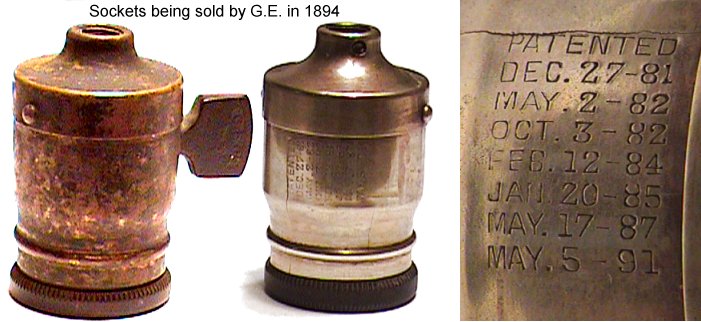
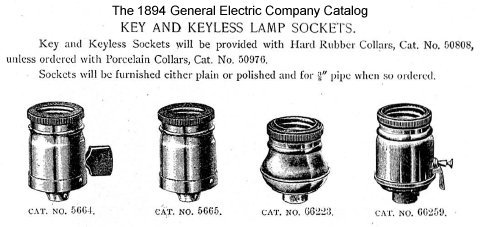
These two sockets (above) are shown in the 1894 General Electric
Catalog (shown on the right). The other two sockets shown in the
catalog are the acorn socket, (which was a progression of the Edison-Bergmann
invention) and the Push-Pull socket (which was also an Edison-Bergmann
design). I will cover these two Bergmann designs at the bottom of
this section.
This new G.E. design was the first G.E. socket and the first socket
to ever display the GECO trademark sausage like key logo. This logo
used the sausage, but the sausage was much 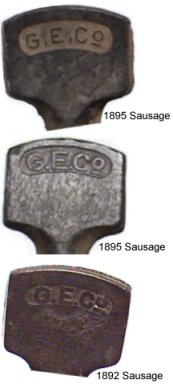 smaller
and the font crowded the inside to the point that it filled it entirely.
It is not hard to see the difference when comparing the 1894 sausage
to the 1895 versions that were used on the fatboy sockets as shown
on your right. smaller
and the font crowded the inside to the point that it filled it entirely.
It is not hard to see the difference when comparing the 1894 sausage
to the 1895 versions that were used on the fatboy sockets as shown
on your right.
Another difference in this early socket is that it used a collar
at the bottom of the socket tube like the early Edison-Bergmann
sockets had.
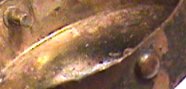
The cap did not have screws through the sides, it had posts that
were permanently attached.
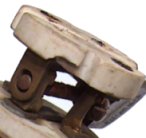
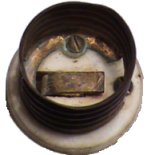
The posts would fit into a groove on the porcelain.
When the cap was twisted, the posts would fit snugly under a porcelain
cut-out and hold the socket in place when the collar was screwed
on tightly.
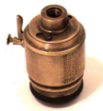 The
center contact shown above on your right, was the one used on this
socket, but later updated (likely late 1894 or early 1895) to a
new center contact which matched the first G.E. (porcelain gut)
acorn socket. The Edison threads also used the two
slits which was an 1890 patent not found on this shell. The
slits patent was applied for in 1889 and was an Edison invention
that was used to help hold the light bulb in place. The
center contact shown above on your right, was the one used on this
socket, but later updated (likely late 1894 or early 1895) to a
new center contact which matched the first G.E. (porcelain gut)
acorn socket. The Edison threads also used the two
slits which was an 1890 patent not found on this shell. The
slits patent was applied for in 1889 and was an Edison invention
that was used to help hold the light bulb in place.  In
1892 G.E was selling all EGE (Edison General Electric) items (like
the items shown on your right) with either the new General Electric
name or Thomson-Houston patents marked on the shells. Older Bergmann
and EGE items, were signed showing either the Bergmann & Co.
or Edison General Electric Co. name on the shell (not acorn sockets
which always remained unmarked until after 1899, when it became
an N.E.C. rule that all socket shells must be marked with a name
or trademark). In
1892 G.E was selling all EGE (Edison General Electric) items (like
the items shown on your right) with either the new General Electric
name or Thomson-Houston patents marked on the shells. Older Bergmann
and EGE items, were signed showing either the Bergmann & Co.
or Edison General Electric Co. name on the shell (not acorn sockets
which always remained unmarked until after 1899, when it became
an N.E.C. rule that all socket shells must be marked with a name
or trademark).
 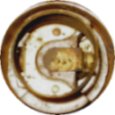 Fibre
as a rule stopped being used on the insides of sockets by 1890,
and by 1891 most all sockets were now using porcelain insides. The
unmarked acorn shown on your left could had been a late EGE socket
(1891) or an early G.E. acorn (1892) as it uses porcelain insides
with an unknown center contact for EGE (as shown on your right.
The same center contact with slightly different porcelain was used
by G.E. later in their first true acorn design of their own. Fibre
as a rule stopped being used on the insides of sockets by 1890,
and by 1891 most all sockets were now using porcelain insides. The
unmarked acorn shown on your left could had been a late EGE socket
(1891) or an early G.E. acorn (1892) as it uses porcelain insides
with an unknown center contact for EGE (as shown on your right.
The same center contact with slightly different porcelain was used
by G.E. later in their first true acorn design of their own.
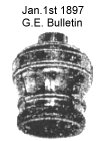
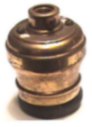 By
1897 G.E. was no longer offering the push socket, and the new G.E.
style acorn became a true unique G.E. design with a new shell and
insides. On Jan. 11th 1897 G.E. released Bulletin No. 4089 which
announced the new G.E. socket line. The picture shown on your left
is the new acorn socket shown in the bulletin. You will notice that
it now uses a standard looking cap as also the real acorn which
is shown in the picture on your right. By
1897 G.E. was no longer offering the push socket, and the new G.E.
style acorn became a true unique G.E. design with a new shell and
insides. On Jan. 11th 1897 G.E. released Bulletin No. 4089 which
announced the new G.E. socket line. The picture shown on your left
is the new acorn socket shown in the bulletin. You will notice that
it now uses a standard looking cap as also the real acorn which
is shown in the picture on your right. 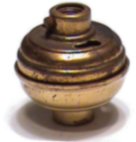 The
size of the new acorn was also now much smaller in that the new
cap would actually fit inside one of the older acorn caps if you
were to lay it inside as shown on your right below. The
size of the new acorn was also now much smaller in that the new
cap would actually fit inside one of the older acorn caps if you
were to lay it inside as shown on your right below.
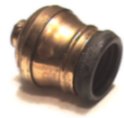
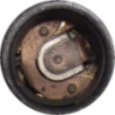 As
you can see from the picture on your right, the porcelain and center
contact was close to the design of the 1891 acorn that was shown
above. As
you can see from the picture on your right, the porcelain and center
contact was close to the design of the 1891 acorn that was shown
above.
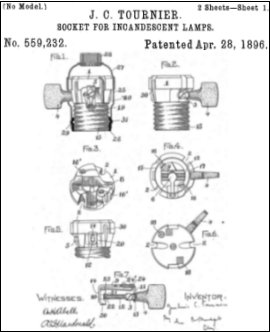
The Tournier GECO Fatboy Patent
 At
the same time in 1897 that these sockets were released, the bulletin
also announced the 1895
GECO fatboy socket (since the bulletin showed the complete G.E.
line up of sockets together for the first time). At
the same time in 1897 that these sockets were released, the bulletin
also announced the 1895
GECO fatboy socket (since the bulletin showed the complete G.E.
line up of sockets together for the first time).
It is also note worthy that the "fatboy style" that virtually
every manufacturer started using (even to this day), was a unique
invention of G.E. as shown with every detail intact in their patent.
(today commonly known as the "TOURNIER" fatboy patent).
The patent (No.
559232) states that it was applied for on March 25th, 1896 and
approved April 18th 1896 which is less then 30 days for approval.
I have never seen any other patent approved so fast. Most patents
take one year from the date of application, but I have seen some
approved a few months before the end of a year in rare cases. This
patent date I believe to be in error by the patent office, possibly
because Tournier signed it with the wrong date and it went un noticed.
It is also possible that there was an earlier filing date, but because
of some kind of error at the patent office, (maybe a lost application)
G.E. was allowed to make a new application and then it was quickly
passed through.
Remember, the socket was first announced in the Electrical World
magazine on February 23rd 1895, it would hardly make sense that
they (after announcing it) are one year later filing for a patent
for it. It would make much more sense that since it was announced
in February of 1895, that they applied for patent in early February.
Then one year later, (February of 1896) had not heard anything and
put in an inquiry and had to re date their application March 25th,
1896 which is about the time that it would had taken to investigate
things. Well, these are only my thoughts on the issue, and should
not be taken as fact. But, if you have researched patents yourself,
you already know that patents are never approved in less then 30
days like this one claims it was. Also a company such as G.E. would
never announce a socket and then apply for patent for it a year
later.
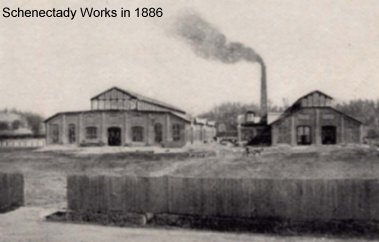
General
Electric Company History
 Most
people when they think of General Electric, think of Edison. Most
people when they think of General Electric, think of Edison.
While it is true that Edison was the father of incandescent lighting,
the truth is that Edison himself did not have much if anything to
do with the General Electric Company at all. In fact by the time
that Edison's companies merged into the General Electric Company,
he did not even know that it had happened until after it had taken
place.
For years
before the merger that created 'The General Electric Giant', Edison
had been merging his companies and buying other electric companies.
At the same time, two other companies namely Westinghouse
and Thomson-Houston
had also been buying up and merging their own companies. Up until
the Edison General Electric merger in 1889, Edison had merged: the
Edison Shafting Co. and Edison Tube Co. into Edison Machine Works;
(about 1883) then about 1886 the Edison Machine Works, Bergmann
& Co. and the Edison Lamp Co. into the Edison United MFG Co.;
In 1889 he then merged the Edison United MFG. Co., Edison Electric
Light Co., Canadian Edison MFG. Co., Edison Co. For Isolated Lighting,
as well as two other companies that he had bought (Sprague Electric
Railway & Motor Co. and Leonard & Izard Co.) into The Edison
General Electric Company. These mergers had made the Edison General
Electric Company a powerful and strong company by 1889.
Important to note is that during the same time that Edison had been
merging and buying his companies, Thomson-Houston (president Charles
Coffin a former shoe manufacturer with a unique and shrewd business
outlook) was rapidly buying out competitors (or controlling interests
in those companies) that had a foothold in the area of patents or
production. It gets a bit more complicated, but just so that you
understand how powerful they had become: The Thomson-Houston Electric
Company was formed in 1883 from the merger of the Elihu Thomson's
American Electric Company and the interests of Edwin Houston. In
about 1884 they bought out the Consolidated electric Light Co. which
had already owned the Eastern Electric MFG. Co., Sawyer-Man was
bought but then sold to Westinghouse. For several years they continued
buying and merging. By about 1890 they owned Elecro-Dyanmic Light
Co., Van Depoele Electric MFG. Co., Fort Wayne Electric Light Co.,
Brush Electric Co. (which was created from a merger with the Telegraph
Supply Co.), The Bentley-Knight Electric Railway Co., Schuyler Electric
Co., Excelsior Electric Co., as well as the Thomson-Houston International
Electrical Company.
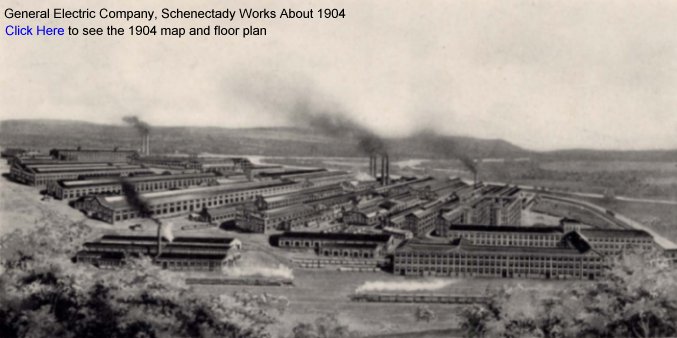
By 1891 Thomson-Houston was already worth 10 million which was greater
then the Edison companies. After the merger was complete in 1892,
The new "General Electric Company" had a capitol stock
of 35,000,000 which was distributed to the shareholders of the old
Edison General Electric Company, as well as Thomson-Houston and
others in exchange for their holdings. The Thomson-Houston side
of the ownership was much greater then the side of the Edison interests,
so control was on the Thomson-Houston side and Coffin took his place
as the first president of General Electric which was now the largest
Electric Company in the world.
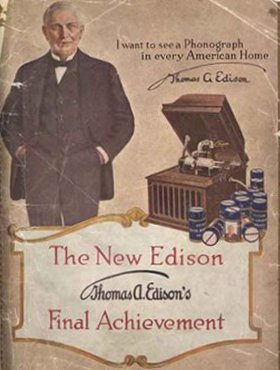 Edison
went on to other things as he still had many other inventions and
companies, but the General Electric Company now owned the rights
over the "Edison" name. Edison
went on to other things as he still had many other inventions and
companies, but the General Electric Company now owned the rights
over the "Edison" name.
This is why Edison can be assumed and attributed to G.E. and their
inventions even after 1892, but the truth is that Edison had little
or nothing to do with lighting inventions after 1892.
Just some of his other inventions:
1891 Invented and patented the motion picture camera
1891-1900 Developed his great iron ore enterprise
1900 - 1910 Invented alkaline storage battery - A commercial success
1900 -1909 Established his once famous Portland Cement Co.
1907, He introduced the first concrete mold for making one-piece
houses
1902-1903 Worked on improving the Edison Primary Battery
1905 Introduced a revolutionary new type of dictating machine
1907 Introduced the Universal Electric Motor
1910-1914 Worked on - and much improved - the disc phonograph
1912 Introduced the Kinetophone or talking motion picture
1913 Introduced an automatic correction device for the dictating
machine
1914 Invented the Telescribe, combining the telephone and the dictating
phonograph (the recording of both sides of a telephone conversation)
For more information about Edison's inventions and other companies,
see http://inventors.about.com/library/inventors/bledison.htm
Edison
Patents: 147
patents for batteries, 49
patents for cement, 424
patents for electric light and power, 53
patents for mining and milling, 9
patents for motion pictures, 186
patents for telegraphy and telephone, 199
patents for phonograph and sound recording, 50
miscellany patents.
For older sockets and information, see items such as Bergmann and
Edison General Electric which are basically REAL "Edison"
sockets and items that predate the "General Electric Company"
items.
If you would like to learn about other makers sockets such as Bergmann,
Brush, Bryant,
Crown, EE&S,
Holmes & Gale,
Perkins,
Thomson-Houston
and Westinghouse,
you can click on the the provided links.
Also more about Edison and Bergmann History and items HERE...
|