|
HOME
|
Back to the main home page and front menu |
|
Learning
Tools And Research Material
|
|
User Forums Post pictures of your items and ask questions or just learn from reading the posts from others Ad Database View or upload ads from antique magazines Bulb & Socket Bases View images of the most well known bulb and socket bases Patent Utilities Patent Linker Lets You Pull Up Any Patent PDF File Or Link One Directly To Your Web Page Group Patent Dbase Lets You Download The First Page Patent Picture Of Every Patent On A Single Day To View On Quickly Your Local Computer MultiView Search Lets You Search For Patents Using Advanced Methods And Provides Hyper Links To The Patent Office And Google Patents |
|
I have not had much time to get many items in the forsale area below. Please keep checking back as I will start adding more items soon. Items
For Sale |
Switch Material Electrical Code Mica Insulation CP or WATTS Marks Socket Bead/Rib/UNO Catalogs & Ads Patents Pull Chains / Finials |
|
Socket
& Electrical Manufacturer's Items And Their History
|
| GECO
Sockets NEW - This section will allow you to date and learn how to tell one GECO socket from the other. Hubbell This is where this site started from. Since this page was done, there has been much more Hubbell history and information found which will make for a complete redesign of this page and section in the soon future. Hubbell Patents This section has some early patent research on Hubbell. It is mostly complete with only a few missing patents which will be added in when this section is re done into the new format Wheeler Reflector Co. NEW - A history of The Wheeler Reflector Company and tips on how to tell if mirror has been replaced on a shade Other Manufacturers This section is a lot of incomplete work and will be updated shortly. For now it serves to give you some extended information on some companies, but will be a much better tool when it is complete NEC This section is everything you ever wanted to know about the National Electrical Code (NEC) but had no one to ask. Downloads of old NEC's, meetings and much extended information is provided. |
| GECO
Sockets More companies will be added to this list in the near future. We will also be adding a new list of post 1900 sockets and items. Bergmann & Co. Brush Electric Co. Bryant Electric Co. Crown Elect MFG Co. EE&S Holmes & Gale (HG) Perkins Thomson-Houston Westinghouse |
|
Tutorial
And Early Lighting History
|
|
To
read the entire tutorial, you can just click on the first link and
then continue to the next section at the bottom of each page. Or,
you can select links below of interest to you. |
   |
 Hubbell
Sockets Hubbell
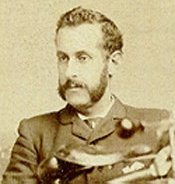
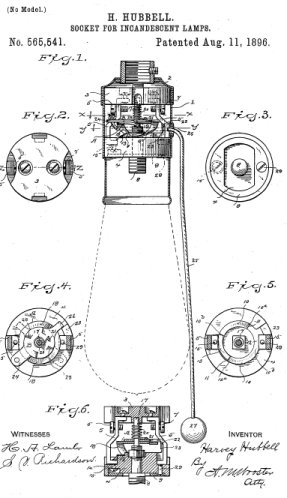
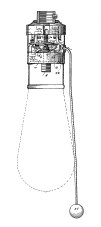
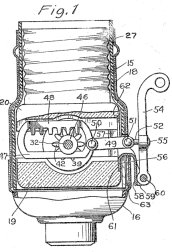
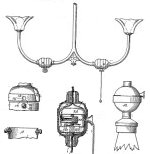
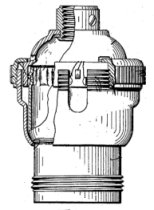
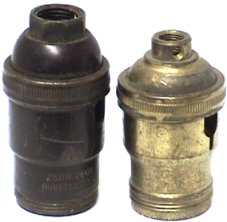
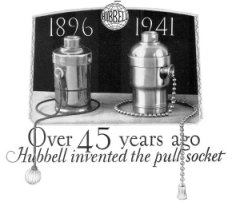
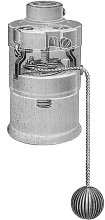
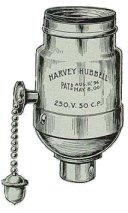
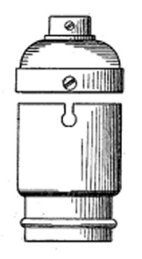
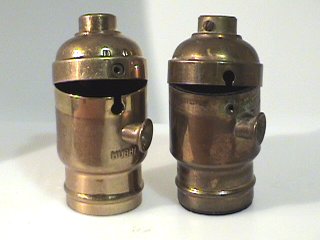
SocketsHarvey Hubbell II, was the first to patent a pull chain style socket. A drawing from the socket patent August 11th of 1896 patent number 565541 which is shown to your right with the old standard one piece shell. This socket came with an internal pulley switch operated by a silk tuna line pull cord that came with a ball at the end. Some time after Jan 28th 1901 the Company was known as THE HUBBELL - GRIER ELECT. CO. Sockets made in 1901 were marked with this Company name. The Hubbell-Grier Elect Company name was also used in the first product catalogue in 1901. As shown in the pictures below, sockets are called "H-G Pull Sockets". 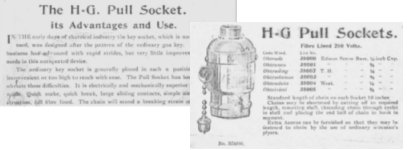 It is unknown if Grier was a business partner in the early years, but by Sept 4th 1901 no more mention of Grier is made and sockets are simply marked "Harvey Hubbell". More about this topic... Harvey Hubbell incorporated in the State of Connecticut in the year 1905 under the name "Harvey Hubbell INC.". |
A full history of the Hubbell Company from 1888 to date can be seen on their web site at: http://www.hubbell.com/history.htm |
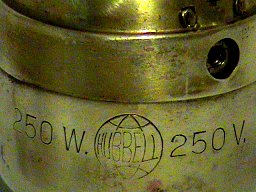
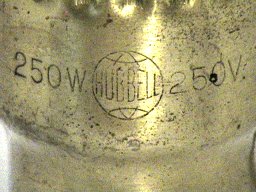
 In
the same year, the Company registered a trademark. They selected the
'globe logo' that had been used by Harvey Hubbell on his business
stationary as early as 1901. This trademark (a sphere with meridian
lines and the name "HUBBELL" centered within) is frequently
seen on sockets that came out after 1909 and are also the most common
found today. The mark on these sockets is sometimes referred to as
"the globe logo". In
the same year, the Company registered a trademark. They selected the
'globe logo' that had been used by Harvey Hubbell on his business
stationary as early as 1901. This trademark (a sphere with meridian
lines and the name "HUBBELL" centered within) is frequently
seen on sockets that came out after 1909 and are also the most common
found today. The mark on these sockets is sometimes referred to as
"the globe logo". Harvey Hubbell always had new ideas and solutions to problems that existed with other manufacturer's designs. He was one to see an unnecessary problem with something and take it upon himself to design his own invention that fixed the problems. Between 1896 and 1909 he was granted 45 patents on a wide variety of electrical products. We have archived over 100 Hubbell patents for you at this link. |
Some possible known pull chain switch and shell configurations are shown below.
The research test bed of shells and switches has been selected from over one hundred different examples obtained from at least 80 different sources. The rarity is based on a scale of 1 to 10 (10 being the most rare)
| PATENT DATE(S) | Description of pull chain socket models and patent dates | RARITY | ||||
| First
model with or without patent date on the shell. This is the earliest and extremely rare Hubbell pull socket. This model was patented August 11 1896 shown to your left. It had a tuna line silk cord which was known for breakage. This was replaced with a chain In 1900 with a new socket design that had a wider shell. This new socket type was also insulated better internally, which allowed for the stronger brass pull chain. If you have this model we would like to purchase it from you. |
RARITY
10 |
|||||
|
Manufactured
Oct, 1899 To June, 1905 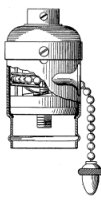 The Shell Is Marked With Two Patent Dates Aug.11.96 May 8.00 |
This model only has two patent dates on the shell. Aug.11.96 & May 8.00 It is assumed that the lid screw threads into the body of the shell by use of the threaded rivet hole as in the 1901 patent. Note that there is a 1903 version of this shell and socket that is marked with all four patent dates. There is also a 1905 version in a new rivet cap shell with all patent dates marked Harvey Hubbell Inc. This shell must had been made and sold up until mid 1905 when it would have been replaced with the Insulating Screw Shell. The screw shell was made for for use with Thomson-Houston lamps. The June 1905 patent number was 817484. E-Z IDENTIFICATION
|
RARITY
9.0 RESEARCH Patent No. 649308 May 8th 1900 Always Uses Socket Switch Square-A (TH) Cap Screw Threads On Shell Body Uses Pre-1904 Acorn Finial Uses Raised Bead For Filter |
||||
|
The
two sockets above used the older Thompson-Houston style sockets.
By the year 1900 the Edison screw type base owned over 60% of the market. It was for this reason that by the year 1900 almost all socket manufacturers chose to use the Edison screw base as their standard. Adapters were made for the Thompson-Houston style sockets so that they could easily adapt to the Edison style bulb. 1901 marks the year that Hubbell came out with a patent for their own Edison style socket shown below. |
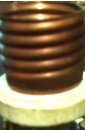 Edison Style Screw Base |
|||||
|
Manufactured
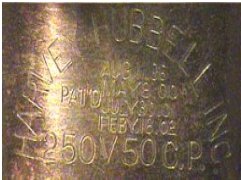
Jan, 1901 To July, 1901 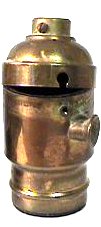 The Shell Is Marked With Three Patent Dates Aug.11.96 May 8.00 July 30.01 |
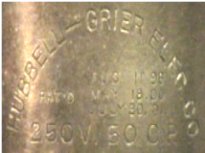 This
model has three patent dates on the shell. Aug.11th 1896, May 8th
1900 and July 30th 1901. This
model has three patent dates on the shell. Aug.11th 1896, May 8th
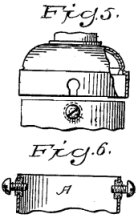
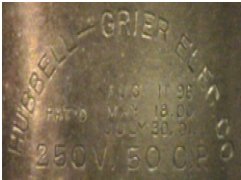
1900 and July 30th 1901.It is marked "HUBBELL-GRIER ELECT. CO." above the patent dates as shown to your right. The lid screw threads into the body of the shell by use of a threaded rivet hole as shown in the picture to your left. E-Z IDENTIFICATION
|
RARITY
9.0 RESEARCH Shell Patent for cap attachment No. 679316 July 30.01 Always Uses Socket Switch Square-A Has Cap Screw Threads On Shell Base Uses Pre-1904 Acorn Uses Raised Bead For Filter More about Grier |
||||
|
Manufactured
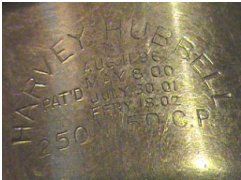
July, 1901 To May, 1902 The Shell Is Marked With Four Patent Dates Aug.11.96 May 8.00 July 30.01 Feby.18.02 |
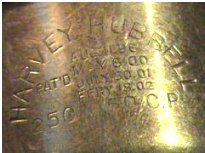 This
model has four patent dates on the shell. Aug.11th 1896, May 8th 1900,
July 30th 1901 and Feb.18th
1902. This
model has four patent dates on the shell. Aug.11th 1896, May 8th 1900,
July 30th 1901 and Feb.18th
1902.It is marked "HARVEY HUBBELL" above the patent dates as shown to your right. The 1902 patent was added for the entire socket. The 1901 patent was only used to show how the cap screw threaded into the base. This 1902 patent was the first patent to describe the switch. Other then this fact; The shell and switch are identical to the version above, with the exceptions of the "HUBBELL-GRIER ELECT CO." being replaced with "HARVEY HUBBELL" and the new patent date being added to the shell. Since the 1901 patent was so short lived, it may have had something to do with (or a convenient method of reason) in getting rid of the "GRIER" name. E-Z IDENTIFICATION
|
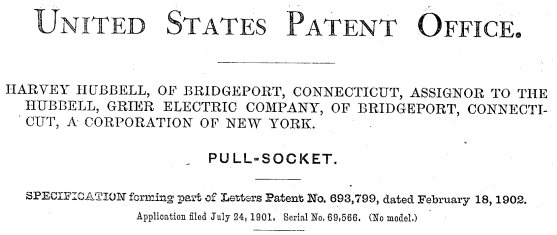
RESEARCH Shell Patent No. 693799 Feb 18 1902 Always Uses SocketSwitch Square-A Has Cap Screw Threads On Shell Base Uses Pre-1904 Acorn Uses Raised Bead For Filter |
||||
|
|
As
above, this model also has four patent dates on the shell. Aug.11th
1896, May 8th 1900, July 30th 1901 and Feb.18th
1902. It is marked "HARVEY HUBBELL" above the patent dates as shown to your right. After incorporating in 1905 this mark was changed to "HARVEY HUBBELL INC." Unlike the shell above, the lid screw threads into the shell cap by use of a hole strip which is riveted to the inside of the cap. This is shown in the picture to your left. The 1901 patent date did not apply to this shell. There was a new patent in 1903 that shows this new method of attaching the shell cap (Feb 17th 1903 pat no. 720808) which was not stamped on this new shell style. In fact as of the 1902 patent Hubbell rarely updated patent dates on their shells, even though newer patents had come out. During patent research I have found only one case so far where a new patent date was used on a shell dated 1908 which had all of the patent dates but missing the "1901" date which was replaced with the new cap patent number. In later years, patent dates were done away with entirely and replaced with the Hubbell Trademark Logo. E-Z IDENTIFICATION
|
RESEARCH Shell Patent 720808 Feb 17 1903 Commonly Use Socket Switch Square-A & Socket Switch Circle-A Has Screw Threads On The CAP Uses Pre-1904 Acorn & Post-1904 Acorn Uses Raised Bead For Filter Later Version With Rivets Post 1903 RARITY 6.0 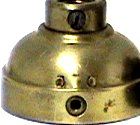 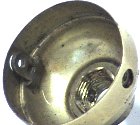 |
||||
|
Manufactured
Between 1904 To 1909 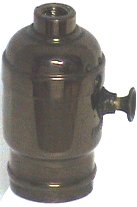 The Shell Is Marked With Four Patent Dates Aug.11.96 May 8.00 July 30.01 Feby.18.02 The shell above was based on the patent shown below 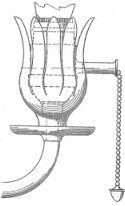 New Chain Guide For Pull Sockets RARITY 07 Patent # 817485 Applied For 07/14/1905 Approved On 04/10/1906 |
As
above, this model also has four patent dates on the shell. Aug.11th
1896, May 8th 1900, July 30th 1901 and Feb.18th
1902. It is marked "HARVEY HUBBELL" above the patent dates as shown to your right. After incorporating in 1905 this mark was changed to "HARVEY HUBBELL INC." 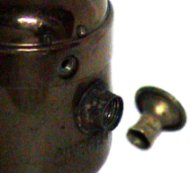 This
was a special offer of a factory installed patent 817485
extended guide. There was not a patent for this special modified shell
version of the giude. This version worked by having a factory installed
threaded hole on the shell that the guide screwed into. This
was a special offer of a factory installed patent 817485
extended guide. There was not a patent for this special modified shell
version of the giude. This version worked by having a factory installed
threaded hole on the shell that the guide screwed into. 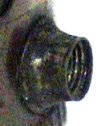 This
version is shown in the Hubbell 1906 catalog. Early versions of this
design (as shown to your left) have no threads on the guide itself.
Versions from late 1905 started threading the end of the chain guide
tube. This invention was replaced in 1909 with a new version that
attached directly on the switch which came with much stronger connections. This
version is shown in the Hubbell 1906 catalog. Early versions of this
design (as shown to your left) have no threads on the guide itself.
Versions from late 1905 started threading the end of the chain guide
tube. This invention was replaced in 1909 with a new version that
attached directly on the switch which came with much stronger connections.
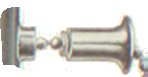 This
new beta guide would have allowed different lengths of guides for
those using it on a fixture, but the longer it gets, the less stable
it would become. The guide shown above in the beta version is thin
brass that bends and deforms easily. When it is screwed in tight,
it would not be a difficult task to break it off the threaded shell
body making it unusable. This was the reason for adding the threads
on the guide tube in the 1905 version as shown in the hubbell 1906
catalog picture to your right. This
new beta guide would have allowed different lengths of guides for
those using it on a fixture, but the longer it gets, the less stable
it would become. The guide shown above in the beta version is thin
brass that bends and deforms easily. When it is screwed in tight,
it would not be a difficult task to break it off the threaded shell
body making it unusable. This was the reason for adding the threads
on the guide tube in the 1905 version as shown in the hubbell 1906
catalog picture to your right.The invention shown on your left also had an added bonus of being able to attach over existing guides of other socket manufactures. E-Z IDENTIFICATION
|
1904
Prototype
No Patent Beta 1904 Version RARITY 8.0 1905 Version RARITY 7.0 RESEARCH Commonly Use Socket Switch 1-2 Has Screw Threads On The CAP Uses Post-1904 Acorn Uses Raised Bead For Filter |
||||
|
Manufactured
1905 To 1909 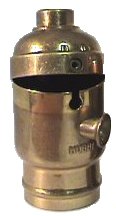 The Shell Is Marked With Four Patent Dates Aug.11.96 May 8.00 July 30.01 Feby.18.02 |
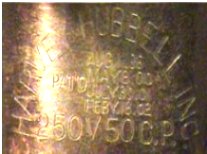 This
model has four patent dates on the shell Aug.11th 1896, May 8th 1900,
July 30th 1901 and Feb.18th
1902. This
model has four patent dates on the shell Aug.11th 1896, May 8th 1900,
July 30th 1901 and Feb.18th
1902.It is marked "HARVEY HUBBELL INC" above the patent dates as shown to your right. After incorporating in 1905 this mark was added to the shell. As in the example above,The 1901 patent does not apply to this shell. The only difference between this and the example above, is the "INC" being added to the shell. Since this is a latter example of the socket, it is commonly found with Post-1904 acorn finials and later switches such as the 1-2 and A2 switch types. E-Z IDENTIFICATION
|
RARITY
4.0 RESEARCH Shell Patent 720808 Feb 17 1903 Commonly Use Socket Switch 1-2 & Socket Switch A2 Has Screw Threads On The CAP Uses Post-1904 Acorn Uses Raised Bead For Filter |
||||
|
Manufactured
March 1907 To 1917 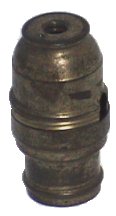 The Shell Is Marked With FIVE Patent Dates Aug.11.96 May 8. 00 Feb.18.02 Jan.14.08 Oct.13.08 Note that the patent date July 30.01 is not on this shell. |
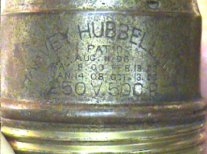 This
is the first socket example without the chain guide being attached
to the shell. This model was right before they stopped using patent
dates on their shells. This
socket shell screws together by means of a guide collar. It did not
require any screws to attach the cap. This
is the first socket example without the chain guide being attached
to the shell. This model was right before they stopped using patent
dates on their shells. This
socket shell screws together by means of a guide collar. It did not
require any screws to attach the cap.The cap and shell have different patents that were applied for the same day, though they were approved on different dates. The new shell cap used two sets of threads in the cap wire hole with a screw connecting them. When the screw is tightened, the threads tighten down around the fixture's threads causing it to lock solid into the top of the shell cap. For more information see the switch types section here E-Z IDENTIFICATION
|
RESEARCH Shell Pictured In Patent 876552 Shell Cap Patent No. 900854 Uses Socket Switch Type 0 Also note that this shell has been found with many other switch types (and factory installed parts) dating into 1917 Uses 1904-1909 Acorn Uses Raised Bead For Filter |
||||
|
Manufactured
July 1909 To Early 1910 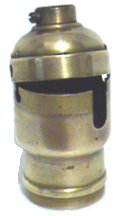 The Shell Is Marked With Four Patent Dates Aug.11.96 May 8.00 July 30.01 Feby.18.02 |
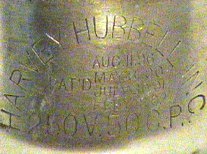 This
model was right before they stopped using patent dates on their shells
and has all four patent dates on the shell. Aug.11th 1896, May 8th
1900, July 30th 1901 and Feb.18th
1902
and is marked Harvey Hubbell INC. As in the example above,The patent
dates on the shell do not apply
to this socket. This
model was right before they stopped using patent dates on their shells
and has all four patent dates on the shell. Aug.11th 1896, May 8th
1900, July 30th 1901 and Feb.18th
1902
and is marked Harvey Hubbell INC. As in the example above,The patent
dates on the shell do not apply
to this socket.For more information on this mark see the switch types section here E-Z IDENTIFICATION
|
RARITY
7.0 RESEARCH Shell Pictured In Patent 943077 Shell Cap Patent No. 720808 Uses Socket Switch Type 1 Uses 1904-1909 Acorn Uses Raised Bead For Filter |
||||
|
Manufactured
July 1909 To 1912 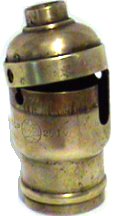 The Shell Is Marked With the Hubbell Globe Design |
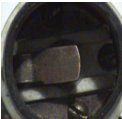
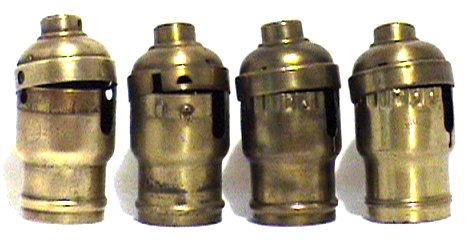
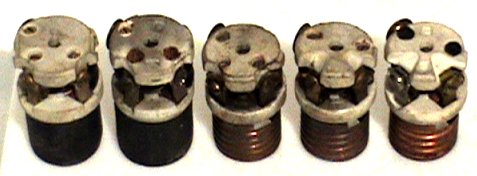
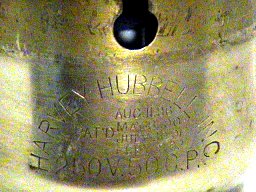
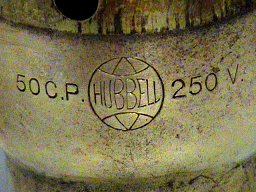
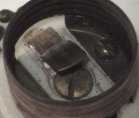
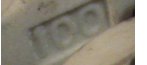
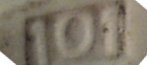
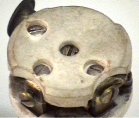
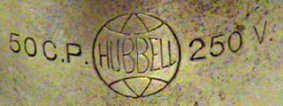 This is the first socket example where Hubbell stopped using patent dates marked on the shells. The switch used for this model was still a prototype using some of the same parts from the older switches. For more information on this mark see the switch types section here Marked 50 C.P. is to be dated pre 1910. If the shell is marked 250 W, it is a post 1910 version. Another easy way to tell the 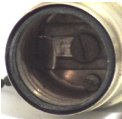 difference
between these early switches is to look under the tongue. If there
is a large screw under a long WIDE tongue. (as shown below), it is
an older 1909 prototype switch. If it uses a nut and not a screw,
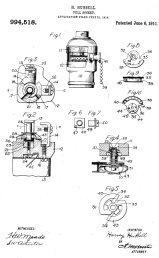
it is always a newer version dating post 07/21/1910 as in patent 994588.
Or If the tongue is more narrow then shown below, it could also be
a newer switch using a screw as in patent number 994518.
Also, older prototype switches from 1909 are also always marked on
the top inside of the ceramic switch with the number 100 as
shown here. difference
between these early switches is to look under the tongue. If there
is a large screw under a long WIDE tongue. (as shown below), it is
an older 1909 prototype switch. If it uses a nut and not a screw,
it is always a newer version dating post 07/21/1910 as in patent 994588.
Or If the tongue is more narrow then shown below, it could also be
a newer switch using a screw as in patent number 994518.
Also, older prototype switches from 1909 are also always marked on
the top inside of the ceramic switch with the number 100 as
shown here.E-Z IDENTIFICATION
|
RARITY
6.0 RESEARCH Shell Pictured In Patent 943077 Shell Cap Patent No. 720808 Uses Socket Switch Type 1 Uses 1904-1909 Acorn Uses Raised Bead For Filter |
||||
 It
will only have the two patent dates.
It
will only have the two patent dates.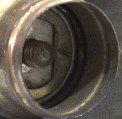
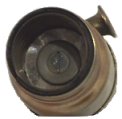
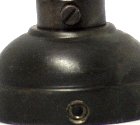
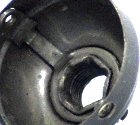
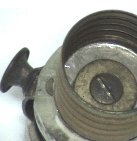
|
During this time in history, many different shell designs were tried and used. This was a great prototype era as Hubbell even reworked some shells from one design to another, while in some cases selling the re designed shells to the public. Hubbell finally decided on a standard which was one of Bryant's patents. For reasons unknown, he either traded or bought patent rights to Bryant's Wrinkle shell. Shown below are just some of the shell examples that you might find right before the Wrinkle shell era started. Note that Hubbell also used at least one other third party patent before making the deal with Bryant. He used a Weber patent (Pat No. 916812 ) shown in a shell example below. 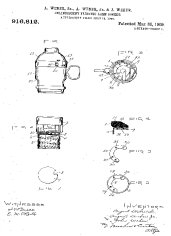 Through
the years both Harvey Hubbell and Harvey Hubbell Jr. came out with
other shell patents, BUT never stopped using Bryant's Wrinkle shell
during all of those years. Harvey Hubbell was fully capable of coming
up with his own inventions and shell cap designs. It could be that
Hubbell had designed a similar patent for the Weber shell that was
not approved, or for unknown reasons chose to make a deal to use
the Weber design as he did with the Bryant patent later. In any
case it is a mystery why he would be using other inventor's patents
in the place of his own inventions. As you go through different
patents during this era you will see many different louvered type
shells being invented. In fact as shown to your left Hubbell even
invented some louvered designs of his own, even though he never
stopped using the Bryant louvered design. Some believe that there
was a friendship that developed and a deal to swap or share patents.
This is mainly because Bryant started using Hubbell's patent for
his removable chain guide about the same time in history. Through
the years both Harvey Hubbell and Harvey Hubbell Jr. came out with
other shell patents, BUT never stopped using Bryant's Wrinkle shell
during all of those years. Harvey Hubbell was fully capable of coming
up with his own inventions and shell cap designs. It could be that
Hubbell had designed a similar patent for the Weber shell that was
not approved, or for unknown reasons chose to make a deal to use
the Weber design as he did with the Bryant patent later. In any
case it is a mystery why he would be using other inventor's patents
in the place of his own inventions. As you go through different
patents during this era you will see many different louvered type
shells being invented. In fact as shown to your left Hubbell even
invented some louvered designs of his own, even though he never
stopped using the Bryant louvered design. Some believe that there
was a friendship that developed and a deal to swap or share patents.
This is mainly because Bryant started using Hubbell's patent for
his removable chain guide about the same time in history. |
|||||
|
Used
By Hubbell |
Used By Hubbell 1910 - 1912 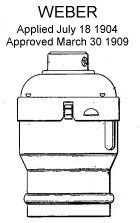 1910 is marked 50 C.P. RARITY 6.5 If the shell is marked 250W, it is a post 1910 version RARITY 6.0 Patent No. 916812 |
Example
of the Hubbell-Weber shell shown to your left.
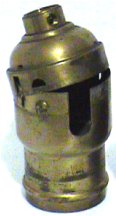 This shell was also used for key switches with a spring slit under the key hole. |
RARITY
8.0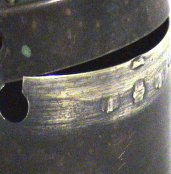 Here is an example of a prototype shell that is now a 1909 screw cap with rivets on the cap. It has been re worked by having the old shell locking test methods smoothed down and then converted to a riveted screw cap shell. |
||
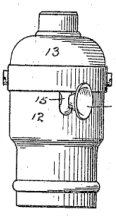
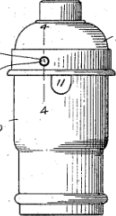
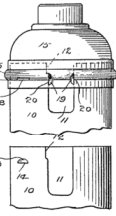
|
|
|||||
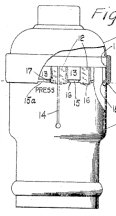
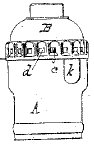 Bryant
offered the first Wrinkle shell July 20th 1907 (pat 872283) also
(pat 879819). The shell was not well received because it left
the rectangular slots on the cap exposed (as shown on your left),
which for this era of lamp making did not present a clean styled
appearance. On Oct 20th 1908 Bryant added a ring around the slots
(pat 958625) which caused the socket to get more of a market share.
On Oct 22 1909 (patent no 958626) loosely fit the slot device
into the shell cap. It would not surprise me if it was Harvey
Hubbell that personally gave Bryant the idea to use the modified
shell stops and the new method of securing the rectangular slot
device into the shell cap shown in patent no
Bryant
offered the first Wrinkle shell July 20th 1907 (pat 872283) also
(pat 879819). The shell was not well received because it left
the rectangular slots on the cap exposed (as shown on your left),
which for this era of lamp making did not present a clean styled
appearance. On Oct 20th 1908 Bryant added a ring around the slots
(pat 958625) which caused the socket to get more of a market share.
On Oct 22 1909 (patent no 958626) loosely fit the slot device
into the shell cap. It would not surprise me if it was Harvey
Hubbell that personally gave Bryant the idea to use the modified
shell stops and the new method of securing the rectangular slot
device into the shell cap shown in patent no 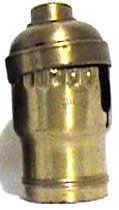 It
is this shell that is used (with only slight differences in the
stops) for the following Hubbell pull chain era.
It
is this shell that is used (with only slight differences in the
stops) for the following Hubbell pull chain era.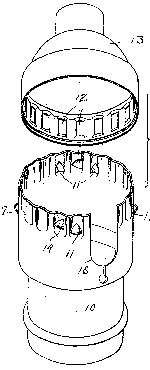
|
Other
Shell And Switch Types
|
|||||
 |
 |
|
 |
||
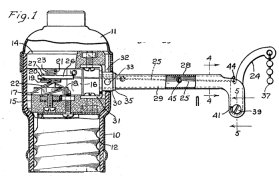
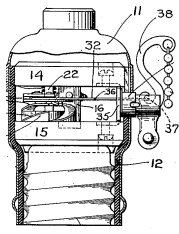
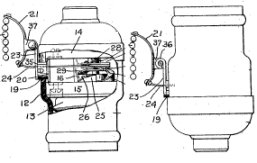
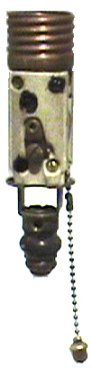 It
took almost five years for this candle socket patent shown to your
left and below to become approved. Because of this, you will find
many of these pull sockets with either no patent date at all or
simply a pat applied for mark on the bottom frame of the socket.
The socket uses the acorn patent 1504761 with a smaller size chain
and acorn finial. It is also marked with the Hubbell globe logo.
The patent was applied for on May 9th 1923 and approved on Oct.
18th 1927. It
took almost five years for this candle socket patent shown to your
left and below to become approved. Because of this, you will find
many of these pull sockets with either no patent date at all or
simply a pat applied for mark on the bottom frame of the socket.
The socket uses the acorn patent 1504761 with a smaller size chain
and acorn finial. It is also marked with the Hubbell globe logo.
The patent was applied for on May 9th 1923 and approved on Oct.
18th 1927. 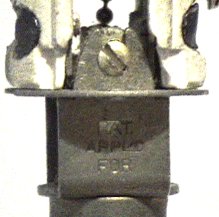 If it has the Patent Applied For mark it should be dated between 1923 to 1927-RARITY 6.0 If there is no patent mark or only the globe logo it should be dated post 1927-RARITY 4.0 |
Patent No. 1686813 This patent was applied for on 09-29-1923 and one of Hubbell's Wrinkle shell inventions. It can be identified easily because the Wrinkle does not go all the way around the shell. It stops by the chain where there are two stops. |
||||
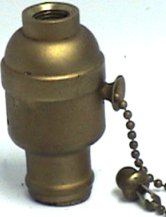 Miniature 2" Socket & Switch Used For Candle Bases |
RARITY
6.0 |
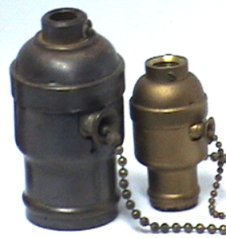 Shown compared to the standard size wrinkle shell. |
|||
 You
will find these switches used in many different configurations. As
far as I can tell, there is not a single patent to cover these other
then the 1901 shell patent. The switch so far is also the same old
ceramic found in each example right up to the newest shell examples. You
will find these switches used in many different configurations. As
far as I can tell, there is not a single patent to cover these other
then the 1901 shell patent. The switch so far is also the same old
ceramic found in each example right up to the newest shell examples.1901 Designs - RARITY 9.0 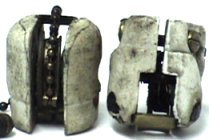 Each
switch is marked with 187 (with an anchor) on the left side and the
number 186 on the right. Each
switch is marked with 187 (with an anchor) on the left side and the
number 186 on the right.Depending on the switch model the mark can either be on the top round of the corner, or the center of the ceramic as shown below.
|
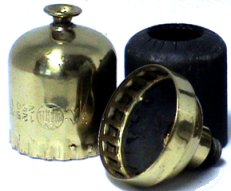 Shown above is the standard Wrinkle shell design which dates post 1913 RARITY 5.5 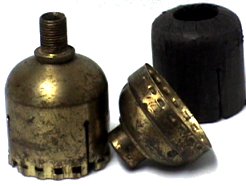 Shown above is the press and turn shell design which has two slits for extra spring. Dates Pre 1913 RARITY 5.0 |
||||
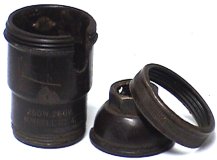 Bakelite Version Post 1938 RARITY 5.5 |
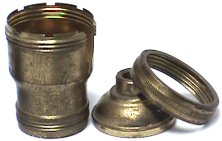 Brass Modified Version With Locking Slots 1936 to Post 1938 RARITY 5.0 |
||||
| Though these may not be as old, they tend to be more rare because there were not as many of these made as the Wrinkle shells. Also the Bakelite version was more prone to breakage. | |||||
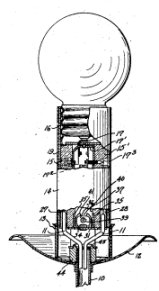
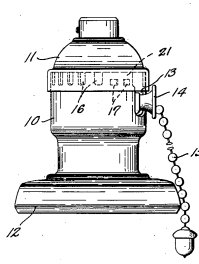
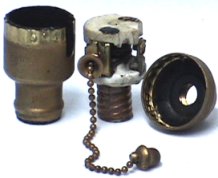 Everything
about this socket is the same as the patents for the Wrinkle shell
and newer switches only in miniature size. This socket is only two
inches high. It comes with a miniature removable chain guide, miniature
chain and acorn finial as well as the standard Wrinkle shell cap
in a tiny size.
Everything
about this socket is the same as the patents for the Wrinkle shell
and newer switches only in miniature size. This socket is only two
inches high. It comes with a miniature removable chain guide, miniature
chain and acorn finial as well as the standard Wrinkle shell cap
in a tiny size.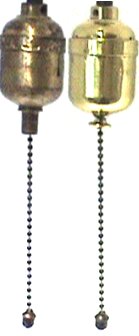
|
IMAGE
|
DATING HINTS -
Finials
|
DATE | ||||
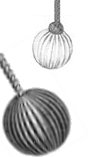 |
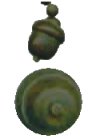
Hubbell
used this finial on the first pull socket that used the tuna line
silk cord .
|
1896
To 1899 RARITY 10 |
||||
 |
|
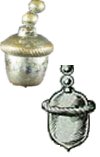
1899
To 1901 RARITY 9.5 |
||||
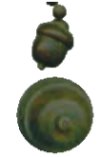 |
Hubbell
and some other sockets made before 1904 use these acorn finials.
|
1901
To 1904 RARITY 7.0 |
||||
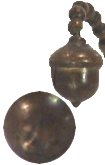 |
These
are hollow much lighter finials with a distinct point at the end.
These do not have flat tips at the bottom like those before 1904 or
the dented tip of those after 1909. The point is sharp and distinct and normally sticks out almost 1/16th of an inch. |
1904
TO 1909 RARITY 4.0 |
||||
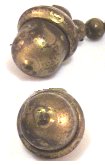 |
These
finials are the most common seen today, coming from the more common
Hubbell sockets without the chain guide attached to the shell.. The acorns are hollow just like those above, but without with a distinct point at the end. These finials have more of a dented or punched out tip. The point is not sharp or distinct at all and normally sticks out just enough to give it the form and appearance of a tip. |
AFTER
1909 RARITY 2.0 |
||||
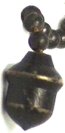 |
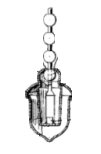
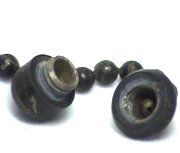 These
acorns unscrew. Like many other examples of Hubbell's prototypes,
the invention was not patented until the final product was decided
on. In this case the removable acorns shown below in patent 1504761. These
acorns unscrew. Like many other examples of Hubbell's prototypes,
the invention was not patented until the final product was decided
on. In this case the removable acorns shown below in patent 1504761.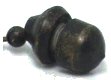 A special thanks goes to Don Shay from "Don's Lamps" who provided this example. |
AFTER
1903 & BEFORE 1910 RARITY 10 |
||||
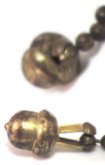 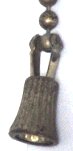 |
 Though
the patent for this finial was applied for in 1923, there are earlier
examples of crimp on acorns predating 1909. However this example
that uses the slide in clamp is most common and is is dated post 1922. Though
the patent for this finial was applied for in 1923, there are earlier
examples of crimp on acorns predating 1909. However this example
that uses the slide in clamp is most common and is is dated post 1922.This type of finial was used for different reasons. As a replacement: There was an ad put out by Hubbell that stated "Extra acorns can be furnished so that they may be fastened to chain by the use of ordinary wireman's pliers". This finial was also used for hard to get to areas such as a candle socket or cylinder lamp. Many of these hard to get into areas were only a few inches from the hole to the socket. However these became quite common and began to be used on newer sockets as a standard. 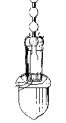 To
see if you have the slide in clamp model, you can squeeze the clamp
tight around the ball with your fingers. Now pull up softly. If it
is the 1922 model it will slide upward as shown. To
see if you have the slide in clamp model, you can squeeze the clamp
tight around the ball with your fingers. Now pull up softly. If it
is the 1922 model it will slide upward as shown. Tassels using this method started being offered late in 1923 though they became more common during the indicating pull socket era of 1926 to 1930. RARITY 2.0 |
|||||
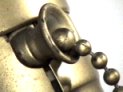 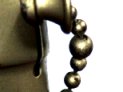 |
Indicating
pulls started being used in 1926 and shown in the patent for the Indicating
Pull Socket patent no. 1736285.
The Indicating Pull Socket was one of Harvey Hubbell's last inventions.
He died on December 17, 1927. This patent was approved Nov 19th 1929
after his death. His son Harvey Hubbell III, succeeded him as President
of Harvey Hubbell, INC. The indicating pull worked by crimping a larger brass ball cover, over one of the pull chain balls close up to the switch. The switch was designed to hold back some of the chain in the "off" position and release it in the "on" position. Depending on how close that you put the ball to the switch, it could cause the ball to be appear hidden when the switch was off and visible when turned on. Even though you may find these indicating chains on non-indicating sockets, the chain (if factory installed) dates your item to post 1926 which is when the pull was invented. |
AFTER
1926 RARITY 1.0 |
|
Note:
This section ONLY applies to shells with the chain guide attached
to the shell |
 Patent No. 679316 Approved July 30th 1901 |
||||
|
CAP
SCREW - THREADS ON CAP - May,
1902 & After
Quick Tip: To find the older Hubbell sockets at a quick glance, FIRST look for the chain guide being attached to the shell: Now look for a cap with a screw in it that is missing the rivets. You can also look for the chain guide attached to the shell WITHOUT the word HUBBELL under the guide. |
 Patent No. 720808 Approved Feb 17 1903 |
||||
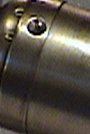
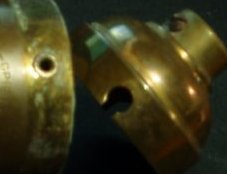 Notice that the cap screw on this model threads into the shell
base. The method of threading into the the shell base was updated
in later years. This was mostly because the base was thin and could
not support the screw with confidence. A new method of threading
the shell cap was developed and shown in a 1903 patent. This method
of attaching the shell cap was used on the patented 1901 examples
and it was also likely to have been used on the older 1900 patent
as well.
Notice that the cap screw on this model threads into the shell
base. The method of threading into the the shell base was updated
in later years. This was mostly because the base was thin and could
not support the screw with confidence. A new method of threading
the shell cap was developed and shown in a 1903 patent. This method
of attaching the shell cap was used on the patented 1901 examples
and it was also likely to have been used on the older 1900 patent
as well.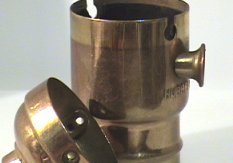 Notice
that the shell shown on your left does not have a threaded hole.
Notice
that the shell shown on your left does not have a threaded hole.
 Also notice that the shell cap has the thread bars riveted to the
cap in the picture shown to your right.
Also notice that the shell cap has the thread bars riveted to the
cap in the picture shown to your right. 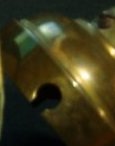
|
Handel
Sheet Brass Tag |
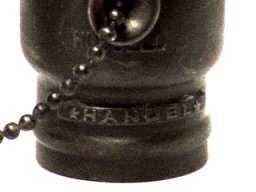 Though
the Handel lamp Company is known to have used some Bryant sockets,
they almost exclusively used Hubbell on most of their lamps.
Though
the Handel lamp Company is known to have used some Bryant sockets,
they almost exclusively used Hubbell on most of their lamps. |
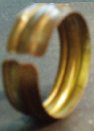
UNO
FILTER THREADS - Post 1914
There
was a lot of old beaded shell stock, so these type shells would
have still been used on items for several more years. However new
designed shells of this era started using UNO threads.
|

|
HUBBELL
PATENTS
For the current patent research click on the link below: |
 There
are some things that you will need to watch for when using patents
for
dates, but for the most part when it comes to Hubbell you are safer
using this section rather then going by only the dates found on
items.
There
are some things that you will need to watch for when using patents
for
dates, but for the most part when it comes to Hubbell you are safer
using this section rather then going by only the dates found on
items.
|
||||||||||||||||||||||||||||||||||||||||||||||||||||||||||||||||||||||||||||||||||||
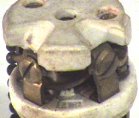
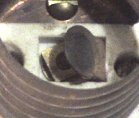
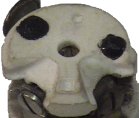
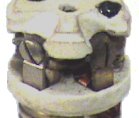
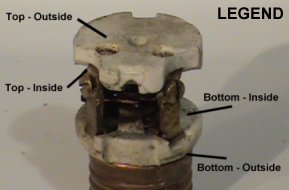 Ceramic
Switch Marks
Ceramic
Switch Marks (square a)
 / Bottom Inside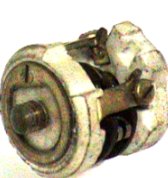
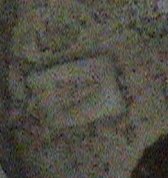
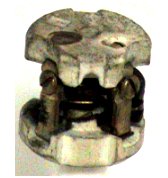
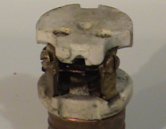
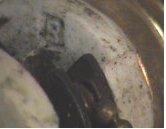
 (circle a)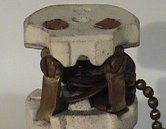
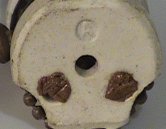
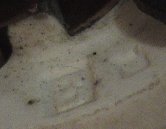
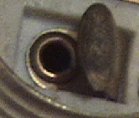
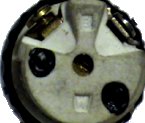
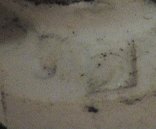 This
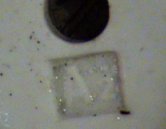
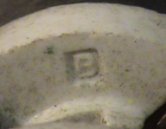
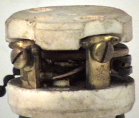
socket switch also has a few new marks. There is a [square]
indent next to the [B] on the bottom outside. Like the other
examples you can see the B mark by pulling on the chain and
looking under the switch. There is also a half moon with a circle
next to it as shown in the picture to your right.
This
socket switch also has a few new marks. There is a [square]
indent next to the [B] on the bottom outside. Like the other
examples you can see the B mark by pulling on the chain and
looking under the switch. There is also a half moon with a circle
next to it as shown in the picture to your right. + Prototype
 /Bottom
Inside+proto
/Bottom
Inside+proto
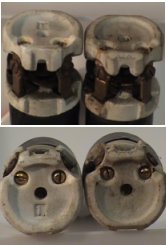
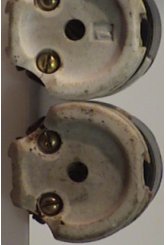
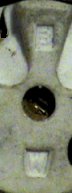
 You
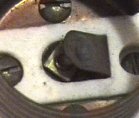
can also see in the picture below that more room was also added
for the shell screw. The prototype shows a more rough notched
out hole that gives a little more room then the previous A version.
When this new switch was completed, we see the more pronounced
factory finished shape. This 1-2 version is a rare switch that
was likely only meant to produce the more common final product
for this shell type, known as the A2 switch.
You
can also see in the picture below that more room was also added
for the shell screw. The prototype shows a more rough notched
out hole that gives a little more room then the previous A version.
When this new switch was completed, we see the more pronounced
factory finished shape. This 1-2 version is a rare switch that
was likely only meant to produce the more common final product
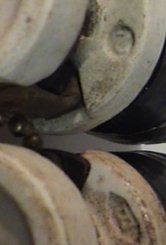
for this shell type, known as the A2 switch.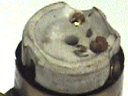 Close
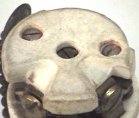
to the end of this 1-2 prototype or beta phase you can also
find many of the prototypes marked 1 - 2 by hand on the top
outside area. There is an example of this shown to your right.
Close
to the end of this 1-2 prototype or beta phase you can also
find many of the prototypes marked 1 - 2 by hand on the top
outside area. There is an example of this shown to your right. (square A2)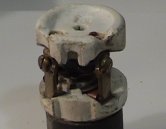
|
||||||||||||||||||||||||||||||||||||||||||||||||||||||||||||||||||||||||||||||||||||||||||||||||||||||||||||||||
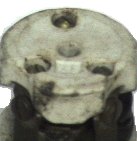
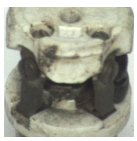


 This
switch also uses the first version of the removable
chain guide patent no.
This
switch also uses the first version of the removable
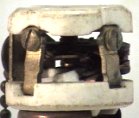
chain guide patent no. 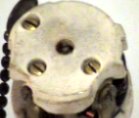

� COPYRIGHT ALL RIGHTS RESERVED
Contact
Us - Send Private Email To the Admin
