|
Learning
Tools And Research Material
|
User Forums
Post pictures of your items and ask questions or just
learn from reading the posts from others
Ad
Database
View or upload ads from antique magazines
Bulb
& Socket Bases
View images of the most well known bulb and socket bases
Patent Utilities
Patent
Linker
Lets You Pull Up Any Patent PDF File Or Link One Directly
To Your Web Page
Group Patent Dbase
Lets
You Download The First Page Patent Picture Of Every Patent On A Single
Day To View On Quickly Your Local Computer
MultiView Search
Lets
You Search For Patents Using Advanced Methods And Provides Hyper Links
To The Patent Office And Google Patents |
|
|
I
have not had much time to get many items in the forsale area below.
Please keep checking back as I will start adding more items soon.
Items
For Sale
Cord
Balls & Adjusters
NEW - My cord
pendant adjuster project, as well as a good history about them.
|
|
Socket
& Electrical Manufacturer's Items And Their History
|
GECO
Sockets
NEW
- This section will allow you to date
and learn how to tell one GECO socket from the other.
Hubbell
This is where this site started from. Since this page
was done, there has been much more Hubbell history and information
found which will make for a complete redesign of this page and section
in the soon future.
Hubbell Patents
This section has some early patent research on Hubbell.
It is mostly complete with only a few missing patents which will be
added in when this section is re done into the new format
Wheeler Reflector
Co.
NEW - A history of The
Wheeler Reflector Company and tips on how to tell if mirror has been
replaced on a shade
Other Manufacturers
This section is a lot of incomplete
work and will be updated shortly. For now it serves to give you some
extended information on some companies, but will be a much better
tool when it is complete
NEC
This section is everything you ever wanted to know about the National
Electrical Code (NEC) but had no one to ask. Downloads of old NEC's,
meetings and much extended information is provided.
|
|
Tutorial
And Early Lighting History
|
|
The Lighting Time Table
To
read the entire tutorial, you can just click on the first link and
then continue to the next section at the bottom of each page. Or,
you can select links below of interest to you.
PRE 1900 SECTION
Overcoming Obstacles
About Early Electric Lighting, Generators, Arc Lamps,
The First Edison Socket, Menlo Park, etc.
The
First Fixtures
About The Start Of The First Incandescent Lighting
Fixtures
Light
Reflection
About Early Light Bulbs And Candle Power vs. WATTS
Edison-Bergmann
About Sigmund Bergmann And The Start Of Bergmann
And Company Lighting Fixtures
Lighting
Break Down
A Quick Break Down Of Different Lighting Time Periods
Styles
1881 to 1884
Bergmann Fixtures And Styles
Other
Pre-1888 Styles
About Early Companies That Sold Lighting Systems
And The Fixtures That They Sold With Their Lighting Systems
The
U.S. Elect. Co.
The United States Electric Company History And Early
Items
The
Brush Elect. Co.
The Brush Electric Company History And Early Items
Thomson-Houston
The Thomson-Houston Electric Company History And
Early Items
Westinghouse
About The Westinghouse Manufacturing Company History
And Early Mergers
Mid
1880's Styles
About The Start Of Electrical Supply Houses and
how new lighting styles came about
Pre
1900 Sockets
About Early Light Sockets And How To Tell The Difference
1887
New Items
1888
New Items
1890
New Items
1891
New Items
1892
New Items
1893
New Items
1894-1896
Items
1897
New Items
1898
New Items
1899
New Items
Above are catalog items sold in different years. There is no space
to duplicate items, so only new and unique items from each year
are shown. You would need to view the catalogs for yourself to be
complete as I am only highlighting items. You can view catalogs
here.
EXTRA INFO
Victor
Shade Holder
About The Victor Shade Holder, Atwood And The Standard
Holder
I.P.
Frink 1899 Items
About
Frink & Wheeler
New
Wheeler Inverted
Three Links About Mirror Reflector Manufacturers
And Their Items And History.
Wheeler Reflector
Co.
NEW - A history of The
Wheeler Reflector Company and tips on how to tell if mirror has
been replaced on a shade
Early Desk Lamps
Some Help In Telling Them Apart
Vitrite And Luminoid
About The Vitrite Holders And Early Vitrite History
Brush-Swan Holder
About Brush-Swan Shade Holders
Cord
Balls
My cord pendant adjuster project, as well as a good
history about them.
POST 1900 SECTION
About
1900 Styles
This section covers a basic into into the 1900 section
covering information about the 1899 transition, electrical code
changes, lighting influence, sharing and licensing of patents and
then into the new section of electrical specialty manufacturers,
Electrical Specialty Manufacturers
Harvey
Hubbell
This section covers some early history periods of
pre Hubbell-Grier, Hubbell-Grier, Harvey Hubbell, Hubbell Company.
It also covers a number of items that helped change lighting styles,
Benjamin
This section covers some early history periods for
the Benjamin Electric MFG. Co, as well as a small section on Dale
and The Federal Electric Company
Dale
Federal
Electric
This post 1900 section continues to be under current
construction
Please Check Back.
|
|
The Lighting Time Table
A Walk Through History & A Display Of Rare Antique
Lighting
|
|
EARLY
ELECTRIC LIGHTING - OVERCOMING THE OBSTACLES
|
|
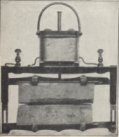 Electric
methods of lighting can can go as far back as
1859 when Moses Farmer lighted up the living room
of his home in Salem Massachusetts, using electric
lamps made of small pieces of platinum and iridium
wire operating in open air. There were many other
attempts to make incandescent lights and light
bulbs through these early years (pre-1879), but
most inventors went down the road of inventing
electric ARC lighting. Arc lighting was basically
two carbon rods that when brought to the right
distance from each other, would create an electrical
bolt or jump across the air from one to the other.
While this brilliant bright light was a good method
for lighting streets, it would be far to bright
for indoor lighting. Pictured on the right is
a Wallace-Farmer Arc Light from 1878 that used
two slabs of carbon between which a bright light
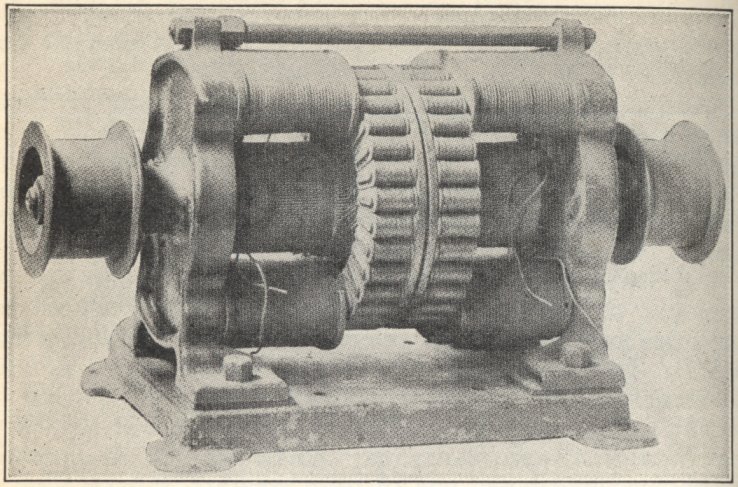
would Arc. (To see the Farmer Dynamo click
here and then on your back button). Electric
methods of lighting can can go as far back as
1859 when Moses Farmer lighted up the living room
of his home in Salem Massachusetts, using electric
lamps made of small pieces of platinum and iridium
wire operating in open air. There were many other
attempts to make incandescent lights and light
bulbs through these early years (pre-1879), but
most inventors went down the road of inventing
electric ARC lighting. Arc lighting was basically
two carbon rods that when brought to the right
distance from each other, would create an electrical
bolt or jump across the air from one to the other.
While this brilliant bright light was a good method
for lighting streets, it would be far to bright
for indoor lighting. Pictured on the right is
a Wallace-Farmer Arc Light from 1878 that used
two slabs of carbon between which a bright light
would Arc. (To see the Farmer Dynamo click
here and then on your back button).
Please keep in mind that even though these experiments
in Arc and Incandescent lighting had been going
on for years, there were other inventions taking
place that needed to be perfected before lighting
could ever be considered for the public.
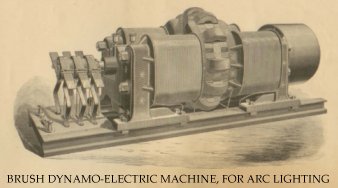 These
other inventions were sources of power, such as
Dynamo electric motors to generate the electricity. These
other inventions were sources of power, such as
Dynamo electric motors to generate the electricity.
There had also been early inventions and testing
for many years along the line of magnetism and
methods of making electricity.
It was not until these inventions were perfected,
that electric lighting could be offered publicly.
It was Charles Brush that took on this task and
helped solve the major problems before Arc lighting
could be publicly offered. More
on Brush...
 In
1876 Charles Brush
designed his first Dynamo which would power a
single Arc Light which was granted a patent in
April 1877. Also in 1876 two types of Dynamos
are exhibited, (Philadelphia Centennial Expo)
each able to light one single Arc Light. These
were the Gramme and the Wallace generators. In
1876 Charles Brush
designed his first Dynamo which would power a
single Arc Light which was granted a patent in
April 1877. Also in 1876 two types of Dynamos
are exhibited, (Philadelphia Centennial Expo)
each able to light one single Arc Light. These
were the Gramme and the Wallace generators.
In 1877 hard drawn
copper wire was invented and started being used
in transmitting electricity in the place of early
iron wire. Also in 1877 Charles Brush starts designing
the first successful electric street lighting
system in the United States. This was an electrical
Arc Light system that could be sold to the public.
(Single light generator and lamp) He is granted
a patent in October (patent number 196,425).
Also in 1877 Weston gives the first public exhibition
of Arc Lighting in the United States by installing
a corner street light in Newark NJ. Also in 1877
the first electric Arc Lights used in a store
were installed on December 26th in the John Wanamaker
store in Philadelphia. He was using the new Brush
System and it consisted of five Dynamos giving
power to four Arc Lights each for a total of twenty
lights.
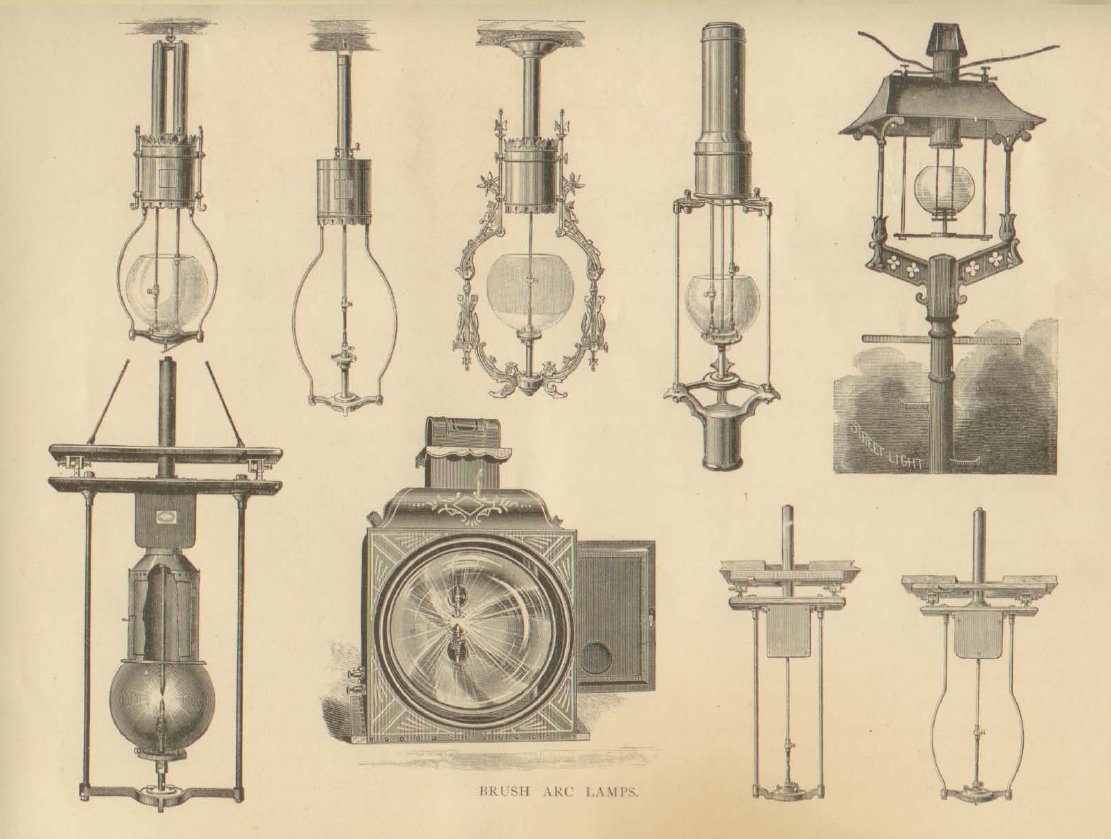
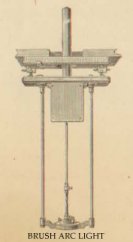
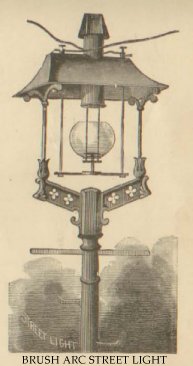
For more Brush Arc lights click
here and then on the back button of your browser.
 On
May 7th 1878 Brush is granted patent no 203,411
for the first series Arc Light. Also in 1878 Weston
makes progress in feeding current from one Dynamo
into a second Dynamo for industrial purposes. On
May 7th 1878 Brush is granted patent no 203,411
for the first series Arc Light. Also in 1878 Weston
makes progress in feeding current from one Dynamo
into a second Dynamo for industrial purposes.
On July 4th 1879 Niagara Falls is lighted by electric
for the first time.
This was by using a 16 light Brush Dynamo arc
Lights using a water wheel to turn the generator.
Also in 1879 Edison develops a Dynamo with 3 1/2
foot magnets which was the basis of three later
generators rated at 60, 150 and 250 lights.
On April 29th 1879, Brush is the first to light
an entire street in the United States using electric
lighting which consisted of 12 Arc Lights in the
Public Square of Cleveland, by use of his new
constant-current series generator.
While all of these new inventions in generating
electricity was taking place and looking forward
to the future of Incandescent electric lighting,
The Edison Electric Light Company is organized
by J. P. Morgan and other Edison financiers to
finance Edison's experiments on October 15th 1878.
Now that many of the major problems had been solved
in generating electricity, it was a prime time
for inventors to press forward into a new era
of electric lighting.
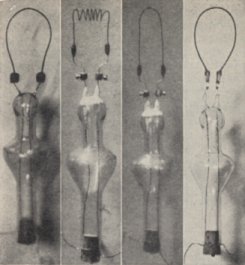 By
November 4th 1879, Edison applied for his first
incandescent lamp patent which was a filament
of a platinum wire spiral in a vacuum chamber.
(Edison was the first to use the word filament
which later helped during court cases) Different
filaments tried during experiments were (among
others) cotton threads, flax, jute silks, cords,
manila hemp, different hard woods, Chinese and
Italian raw silk, horse hair, fish line, teak,
spruce, boxwood, vulcanized rubber, cork, celluloid,
grass fibers from everywhere, linen twine, tar
paper, wrapping paper, cardboard, tissue paper,
parchment, holly wood, absorbent cotton, rattan,
California redwood, raw jute fiber, corn silk,
new Zealand flax, hair from the beards of some
of the men in the laboratory (with contests on
who's would burn longer). The final selection
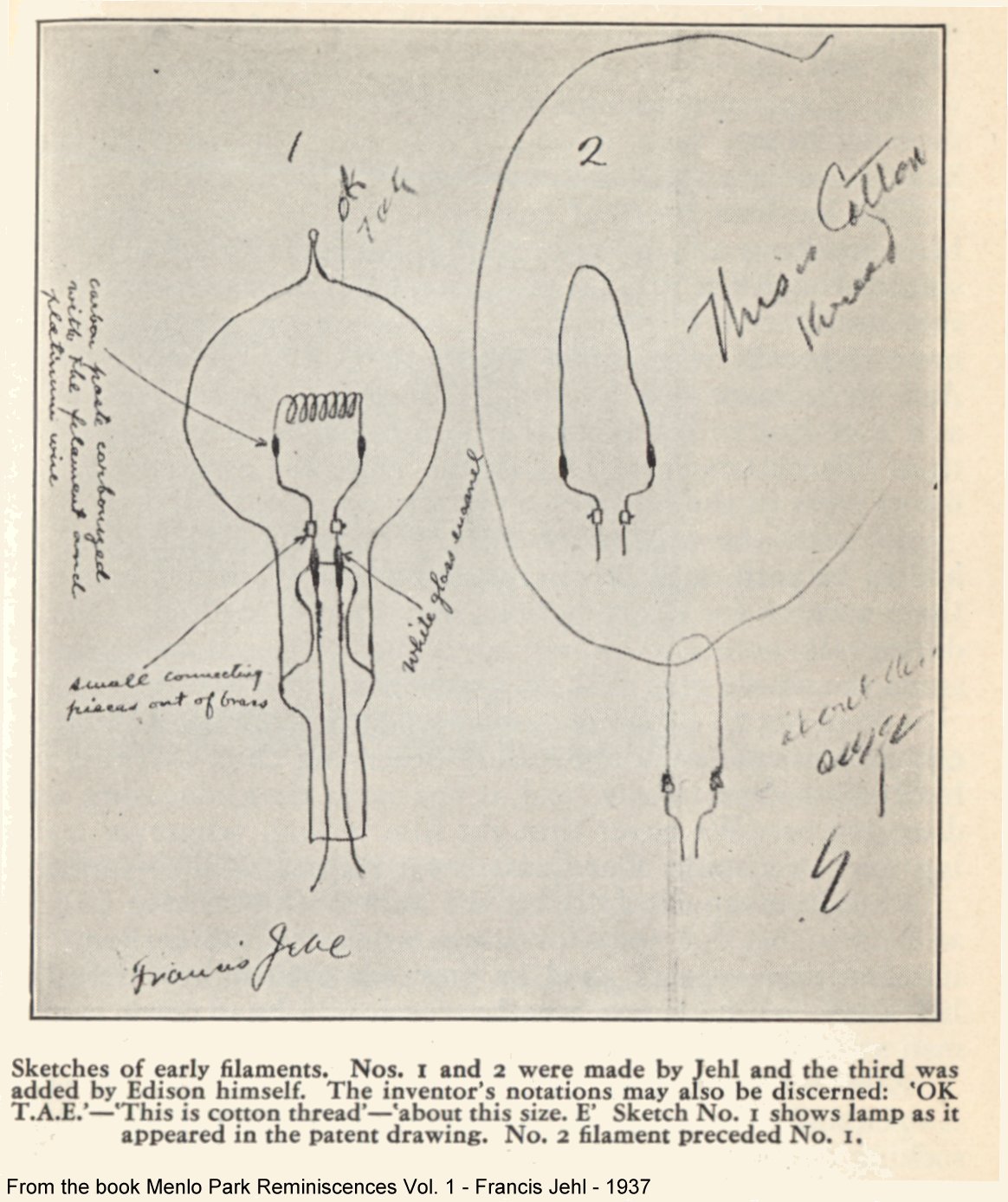
for a filament was a special cotton
thread made at the Clark Thread Mills in Newark.
This thread was carbonized and then connected
to copper wires that had short pieces of platinum
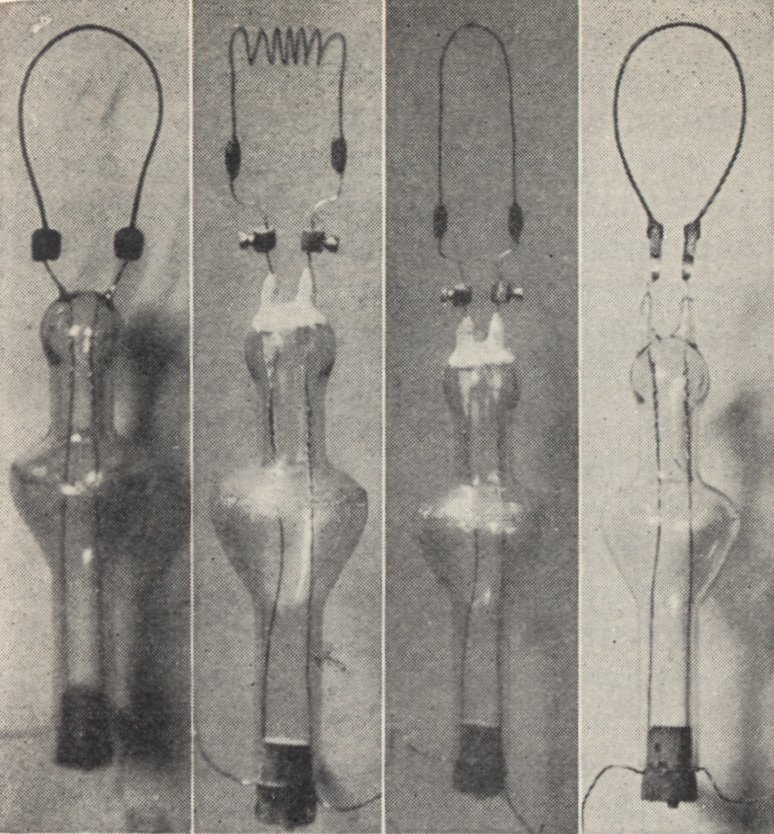
twisted onto them. Shown to your right are some
early mountings of experimental filaments. To
view a larger picture, click
here (or on the picture) and then the back
button on your browser. Edison's first carbonized
cotton filaments only burned for forty hours.
In his next experiment, he carbonized Bristol
board and it burned for several hundred hours. By
November 4th 1879, Edison applied for his first
incandescent lamp patent which was a filament
of a platinum wire spiral in a vacuum chamber.
(Edison was the first to use the word filament
which later helped during court cases) Different
filaments tried during experiments were (among
others) cotton threads, flax, jute silks, cords,
manila hemp, different hard woods, Chinese and
Italian raw silk, horse hair, fish line, teak,
spruce, boxwood, vulcanized rubber, cork, celluloid,
grass fibers from everywhere, linen twine, tar
paper, wrapping paper, cardboard, tissue paper,
parchment, holly wood, absorbent cotton, rattan,
California redwood, raw jute fiber, corn silk,
new Zealand flax, hair from the beards of some
of the men in the laboratory (with contests on
who's would burn longer). The final selection
for a filament was a special cotton
thread made at the Clark Thread Mills in Newark.
This thread was carbonized and then connected
to copper wires that had short pieces of platinum
twisted onto them. Shown to your right are some
early mountings of experimental filaments. To
view a larger picture, click
here (or on the picture) and then the back
button on your browser. Edison's first carbonized
cotton filaments only burned for forty hours.
In his next experiment, he carbonized Bristol
board and it burned for several hundred hours.
 December
31st 1879 Thomas Edison put together the first
public demonstration of incandescent lighting. December
31st 1879 Thomas Edison put together the first
public demonstration of incandescent lighting.
Because this display attracted so much attention,
the Pennsylvania Railroad ran special trains directly
to Menlo Park, New Jersey. Many people that were
unbelievers in electric lighting now saw the reality.
It was from this point on, that investors, inventors
and manufacturers all started moving towards the
real future of electric lighting.
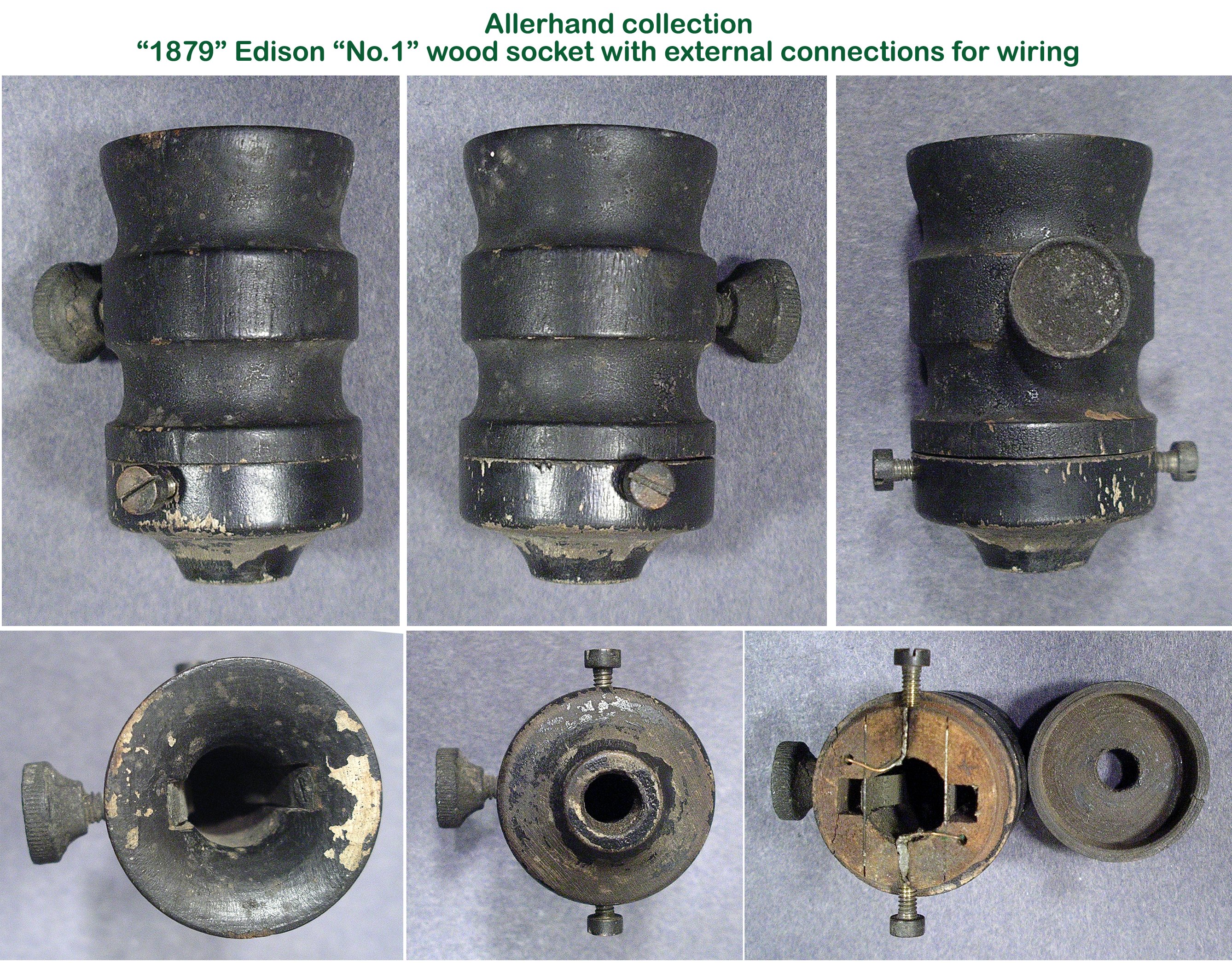
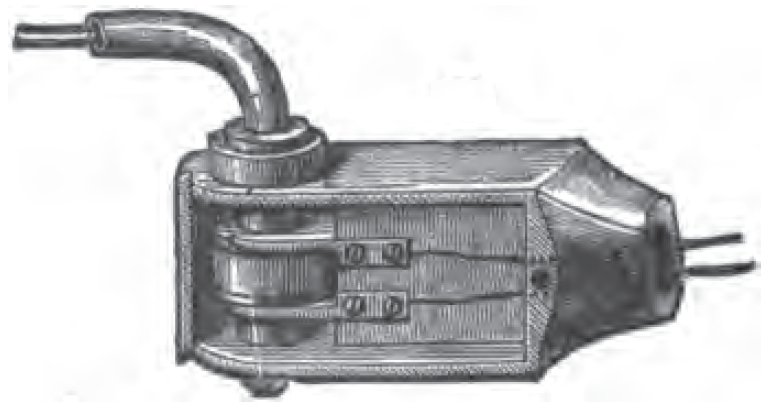
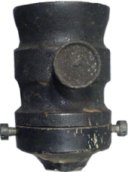
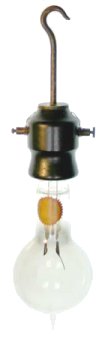
The socket pictured to your left was the first
1879 type socket that Edison made and is what
was used at this demonstration. The bulb was baseless
meaning that it did not screw into the socket.
The bulb pushed into the wood socket which had
two thin metal tabs inside of it. The bulb and
had two wire Leeds that came out of the base which
were then pushed under thin metal tabs (like those
inside of the socket) which were tied using thread
around the bulb base to hold them in place. These
tabs then made contact inside of the socket when
it was pushed down into it. The main electrical
wires connected to the side screws on the socket
that are shown in the picture above. The socket
to your left is shown from the Allerhand collection.
Click
here to see more pictures and then click on
the back button on your browser.
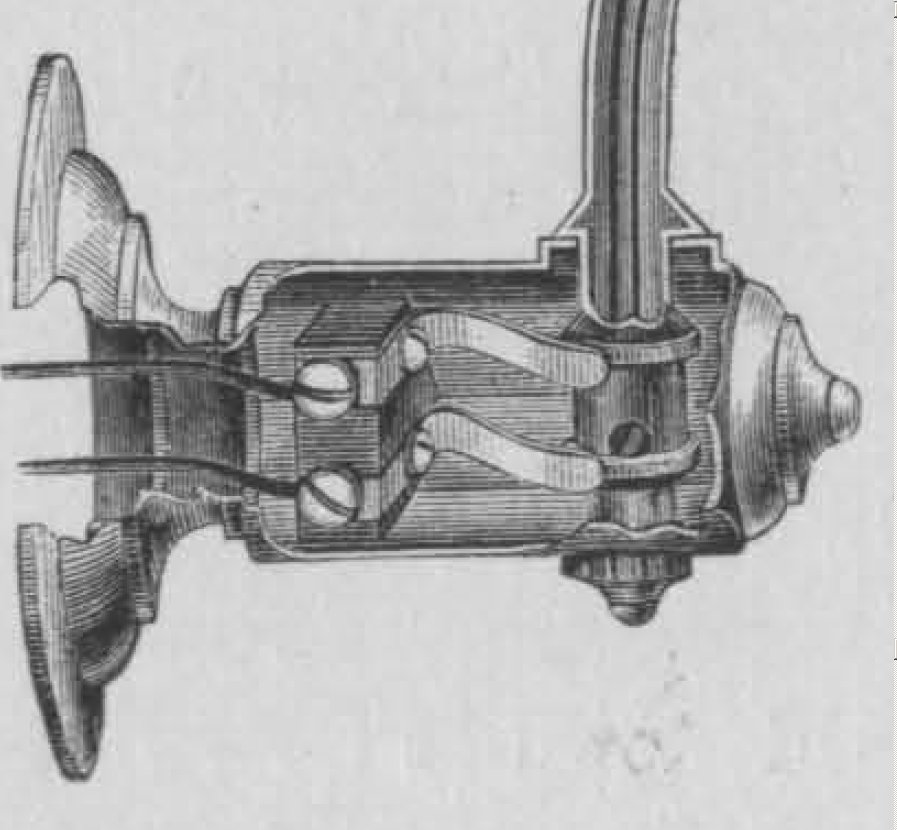
 Within
a short time Edison updated this socket by removing
the two screws and bringing the electrical wires
through a hole on the top of the cap like we are
use to seeing today. Within
a short time Edison updated this socket by removing
the two screws and bringing the electrical wires
through a hole on the top of the cap like we are
use to seeing today.
This new 1880 socket style is still considered
a "Number 1" Edison socket by collectors
today because of the short time span, but more
correctly named an "Edison Number 1b"
socket.
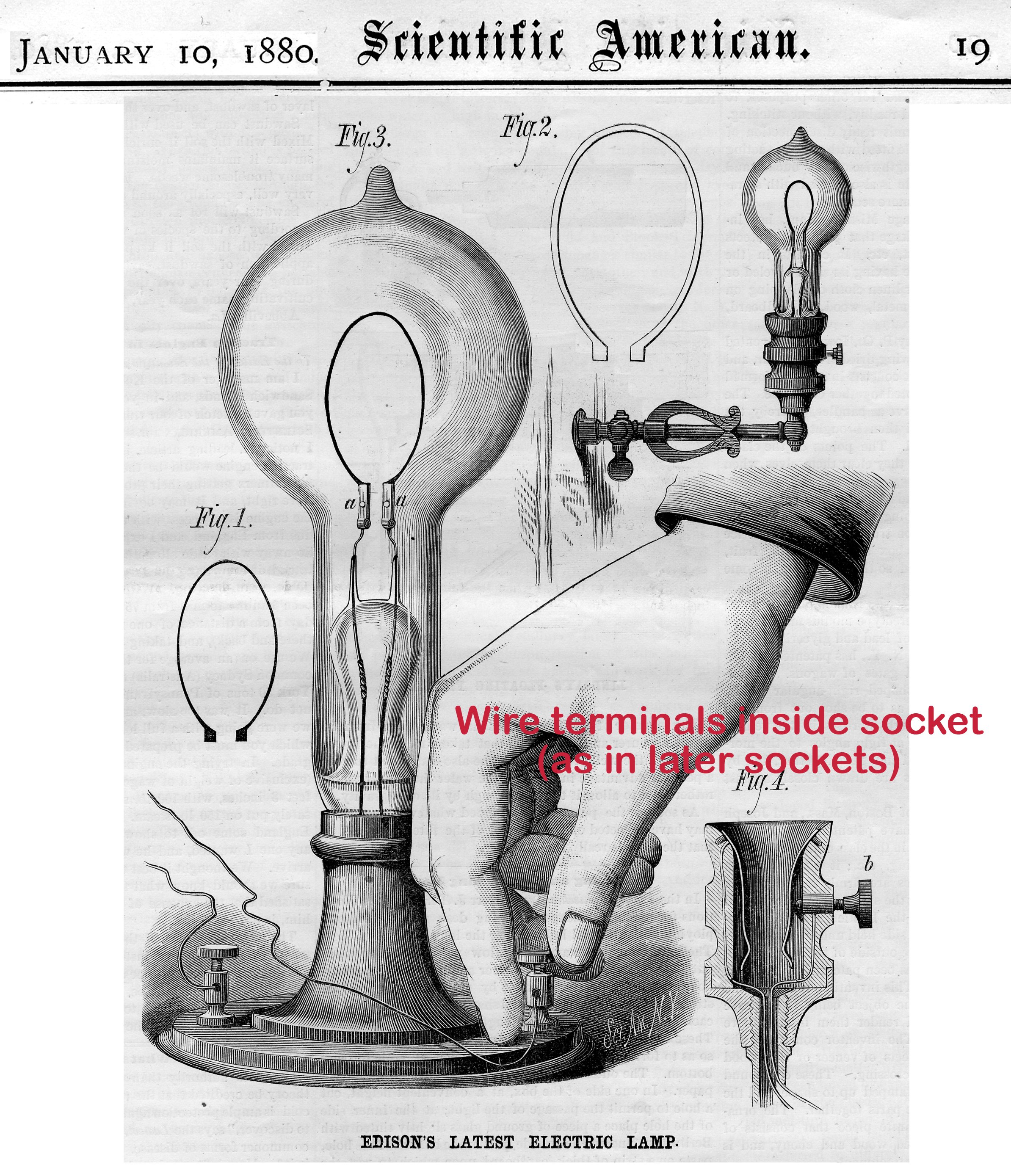
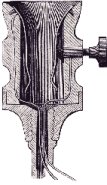
The picture to your right was taken from an article
in Scientific
American January 10th 1880 only 10 days after
the demonstration. This issue shows three pictures
and uses of the socket and all with the wires
coming through the cap and the screw terminals
removed. Keeping in mind that in those days people
did not know the dangers of electricity and the
fact about getting shocks, that during the demonstration
many people or even children may had touched the
terminals. In the January 2 1880 issue of the
Herald "Notices not to touch or handle apparatus
were disregarded". It is also stated that
on the second day, hundreds of people piled in
at a time and no room for the people working the
demonstration to even work their way through the
crowds. Items were broken and even bulbs stolen.
After the first demonstration (which went well)
more of the riffraff or people with no regard
to learning or science came in. Not to make a
doctrine out of this, as it is simple my personal
deduction. Also keeping in mind that many skeptics
came, those from gas companies, etc. and asked
rather pointed direct public questions to Edison
to try and disprove the economics, expense, and
"what ifs" of electric lighting, for
which it was said that he had a quick answer for
every question making believers out of everyone.
However, If ever there would be a time to notice
that the wires should not be exposed, this demonstration
would had been it. This must had been a large
issue for Edison, for the change in design to
be done within a week. As far as I know, there
is no evidence of a number 1b socket existing
prior to 1880. The issued patent picture shows
a number 1a and every picture I have examined
to do with the demonstration used a number 1a
with the wire terminals on the outside.
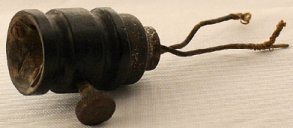 In
July of 2007 the Edison Number 1b socket shown
on your left was reported being sold for $50,000
by a collector in Ohio. In
July of 2007 the Edison Number 1b socket shown
on your left was reported being sold for $50,000
by a collector in Ohio.
 While
I can not confirm this private sale to be 100%
true in fact as far as exactly how much money
actually changed hands, the report was that the
socket was sold to a patent attorney. If you know
this person, please have him contact us so as
to help set a 'realized' price for this type of
item. These sockets are rarely found in the best
collections, much less coming up for sale. While
I can not confirm this private sale to be 100%
true in fact as far as exactly how much money
actually changed hands, the report was that the
socket was sold to a patent attorney. If you know
this person, please have him contact us so as
to help set a 'realized' price for this type of
item. These sockets are rarely found in the best
collections, much less coming up for sale.
The only other Edison Number 1 socket (that I
know to exist) other then these shown (and one
other), is the one shown on your right which is
found at the Sparks
Museum in their lighting section.
Within
a short time after Edison's demonstration, inventors
and companies such as Stanley, Brush, Westinghouse,
Bergmann, Thomson-Houston, Perkins, U.S. Electric
Co. And many others started inventing incandescent
lights, sockets, switches and many other electrical
parts.
|
|
| THE
FIRST INCANDESCENT FIXTURES & EARLY HISTORY |
|
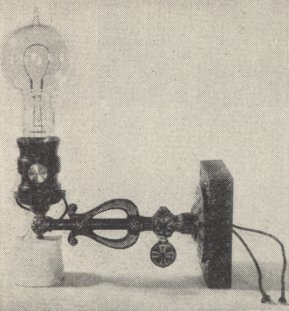 The
fixtures used in 1879 were simply gas fixtures
with electric sockets attached to them and were
the type used at the Edison Menlo Park demonstration
on New Years Eve. The picture shown below is one
of two Mitchell Vance Company four arm gas fixtures
that were hanging in Edison's home at Menlo Park.
Edison converted them for the demonstration. The
fixtures used in 1879 were simply gas fixtures
with electric sockets attached to them and were
the type used at the Edison Menlo Park demonstration
on New Years Eve. The picture shown below is one
of two Mitchell Vance Company four arm gas fixtures
that were hanging in Edison's home at Menlo Park.
Edison converted them for the demonstration.
There was only one fixture at this demonstration
that was made for electricity which was a wooden
lamp base made by Sigmund Bergmann for Edison
at his request.
Edison wanted to show the public that any material
could be used together with his new invention.
While
the demonstration at Menlo Park shook the public
and opened many eyes, it was still several years
before the general public was offered electricity
and electrical incandescent lighting items.
In the first years after, electrical "Systems"
were sold. These were for the rich, big business
or the technically inclined. A system consisted
of a personal generator (Dynamo), cutout(s), and
lamps, sockets, fixtures, etc.
Before incandescent lighting could be brought
to the general public, power stations needed to
be designed and built, standards needed to be
set, and big business needed to put their money
into the many different ventures. Gas companies
stood to loose the most from these new inventions,
and fought electric lighting at every possible
junction. Much disinformation was spread during
these early years, but electrical investors and
inventors pressed ever forward. While there were
many socket, bulb and electrical parts inventions
and improvements during the first four years,
it was not until about 1884/1885 that electrical
lighting started its first stage of leaping forward.
It seems that by every five years, noticeable
large changes took place that made the difference
and brought us closer to our electrical era. 1885-1890
was the prime time for manufacturers to invent
and produce electrical parts such as sockets,
cut-outs, bulbs, switches, rosettes, and many
other miscellaneous parts which we did not see
in the earlier years. Edison merges his Edison
Lamp Company, Edison Machine Works, Bergmann &
Company and the Edison Electric Light Company
into one entity called Edison General Electric.
 1890-1895
the change from materials such as Vulcanized
Fiber to Porcelain and more distributors and
manufacturers coming on the scene with thoughts
of mass production such as Bryant, Sawyer-Man
(Westinghouse), EE&S, Edison General Electric
is formed by a merge of Edison General Electric,
Thomson-Houston and others, into one entity General
Electric Co., The list goes on... 1896-1900 the
National
Electric Code is adopted, new standards take
place, more and more inventions. The point of
all of this, is that with each leap, more and
more people and more and more cities pile onto
the band wagon to take part in this ever growing
and changing industry. During these years, products
were invented and made such as fixtures which
entailed many different types of jobs along the
lines of casting brass, bronze, copper, etc.,
shades which entailed glass blowing, silk work,
tin, steel and many other forms of manufacturing
for other type shades such as reflectors. While
I could go on, I will stop for space and time,
but I think you get the idea, jobs opened for
many different people, wiring specialists, etc.,
etc. 1890-1895
the change from materials such as Vulcanized
Fiber to Porcelain and more distributors and
manufacturers coming on the scene with thoughts
of mass production such as Bryant, Sawyer-Man
(Westinghouse), EE&S, Edison General Electric
is formed by a merge of Edison General Electric,
Thomson-Houston and others, into one entity General
Electric Co., The list goes on... 1896-1900 the
National
Electric Code is adopted, new standards take
place, more and more inventions. The point of
all of this, is that with each leap, more and
more people and more and more cities pile onto
the band wagon to take part in this ever growing
and changing industry. During these years, products
were invented and made such as fixtures which
entailed many different types of jobs along the
lines of casting brass, bronze, copper, etc.,
shades which entailed glass blowing, silk work,
tin, steel and many other forms of manufacturing
for other type shades such as reflectors. While
I could go on, I will stop for space and time,
but I think you get the idea, jobs opened for
many different people, wiring specialists, etc.,
etc.
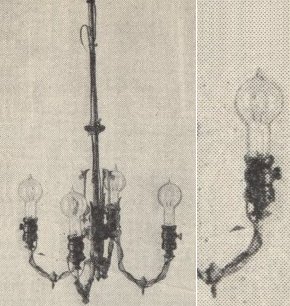
Please notice that the fixtures shown in this
section are gas fixtures from the gas valves.
Please also notice that these are Edison Number
1a sockets with the wire terminals on the out
side of the sockets.
|
|
| EARLY
CARBON FILAMENT INFORMATION AND PROPER LIGHT REFLECTION |
Before I get into how lighting styles and fixtures progressed,
I think that you need to understand the history and culture
at the time.
Remember, your Great - Great - Great - Grand Parents were
use to only a few different styles of lighting.
When new designs come out, they can't look that different
from what people are use to seeing.
Styles change over time.
Early lighting during this time, mostly took on the form
of candles/lard (wicks), gas flame and kerosene lighting.
While I am no expert in any of these forms of lighting,
it is known that each took on its own style and each style
appealed to different people.
When incandescent lighting first came on to the scene,
it had a sort of its own attraction which was the burning
filament inside of the lamp. People liked to see this,
just as those that would watch the flame shine through
a clear glass globe in a kerosene lamp.
 This
is much different then our days - We are use to bright
100 WATT bulbs that you can't even look at without hurting
your eyes. We cover these bulbs with frosted or white
finishes, we hide these bulbs under shades that also help
to hide the bulb so that we are not directly looking into
it. Or better yet, we use a florescent bulb that is easier
on the eyes. This
is much different then our days - We are use to bright
100 WATT bulbs that you can't even look at without hurting
your eyes. We cover these bulbs with frosted or white
finishes, we hide these bulbs under shades that also help
to hide the bulb so that we are not directly looking into
it. Or better yet, we use a florescent bulb that is easier
on the eyes.
When bulbs were first made, they came standard a 8 and
16 C.P. (Candle power). This is also what was on display
at Menlo Park with Edison's first demonstration according
to Francis Jehl who was there and worked along side of
Edison in the early days.
In these early days and until multi-filament, zigzag filaments
and Mazda tungsten filament bulbs were invented (which
were much brighter), many fixtures and shades used reflecting
methods to increase and direct the light of the bulb to
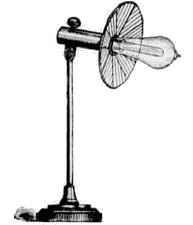
help increase the "Candle Power". The picture
on your right shows a lamp from 1882/83 that uses a flat
shade with corrugated mirror glass (made from mercury
in those days) to help reflect or increase the light that
this bulb was capable of giving out. (I should point out
that a rare lamp like this with the original socket and
an original bulb with an intact filament would sell in
a collectors market for over seven thousand dollars, depending
on the bidders, it could go much higher).
Today (and after 1910) we rate bulbs in WATTS.
In the old days Candle Power told the brightness of the
bulb, in other words the "Light Intensity" (which
was measured with a photometer). WATTS only describes
the power consumption and has nothing to do in accuracy
with the brightness or intensity You could have two 100
WATT bulbs and measure them with a photometer and get
totally different readings. One is efficient and one is
not. While it is true that if you use more power (WATTS)
the bulb will be brighter, WATTS really say nothing about
how bright the bulb is or how much light it is giving
out. You would need to rate it in Candle Power for this.
There is no way to convert Candle Power to WATTS. The
manufacturer would have had to calculate both WATTS and
Candle Power for us to know the true ratings. Different
light sources could have the same WATT ratings, but vastly
different Candle Power output. Unfortunately, they are
not directly related. For example, try searching Amazon.com
or a sales site that provides good descriptions for items.
You can find two different 12,000 candlepower flashlights
and one would be listed as 3 watt and another as 1 watt.
There is also another factor that you should be aware
of, and that is that these early carbon filament bulbs
would loose more then half of their rated candle power
long before their life limit was reached. Many times this
also came along with a blackening of the bulb glass.
For those that wish to display or use this type of antique
lighting, there are a few different suggestions that I
would make. Firstly; depending on the type of application,
using reproduction antique bulbs. Please note that these
are for display only as the filament in most reproduction
bulbs only glows orange. You need to look, some are brighter,
but the glowing bulbs are great for display of most fixtures
being used for decorative or display applications and
not as a primary source of light. Secondly, is to locate
antique 220 volt bulbs. These used hooked up to 115 volts
give about the same nice glow and look great for display.
I have found many of these on eBay for less cost then
reproduction bulbs. Lastly, use real antique or reproduction
40, 50, 75 WATT, or regular bulbs from the store along
with a dimmer. This way you can adjust the light to the
perfect setting every time. I have several 1000 WATT dimmer
circuits here where I control my many different fixtures.
Normally, I can hook from 10 to 15 lamps on each circuit.
I should also note that ACE Hardware sells a light bulb
saver called THE
BUTTON which is put out by Lemra
Products which can reduce the power and brightness
of a bulb thus saving it's life by about 10 times its
normal life. This is a simple button that sticks to the
bottom of the bulb as it is screwed into the socket base. |
THE
FIRST INCANDESCENT LIGHTING FIXTURES - SIGMUND
BERGMANN - BERGMANN & Co.
|
|
 The
first professional electric fixtures were made
by Bergmann & Company. The
first professional electric fixtures were made
by Bergmann & Company.
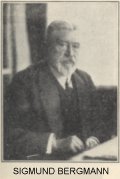
Sigmund Bergmann was a long time friend that worked
for Edison in 1870 and later went into business
for himself. Edison also rented space in Bergmann's
building in New York and kept a laboratory there.
Edison also owned a share in Bergmann's business.
While Edison converted gas lamps for his first
demonstration of electric lighting, there was
one fixture at the display that was made for electric.
This fixture was made out of wood and was designed
and made by Sigmund Bergmann for Edison's display.
Francis Jehl stated that Edison wanted to show
that any material could be used in electric lighting
for the display. There is no know picture of this
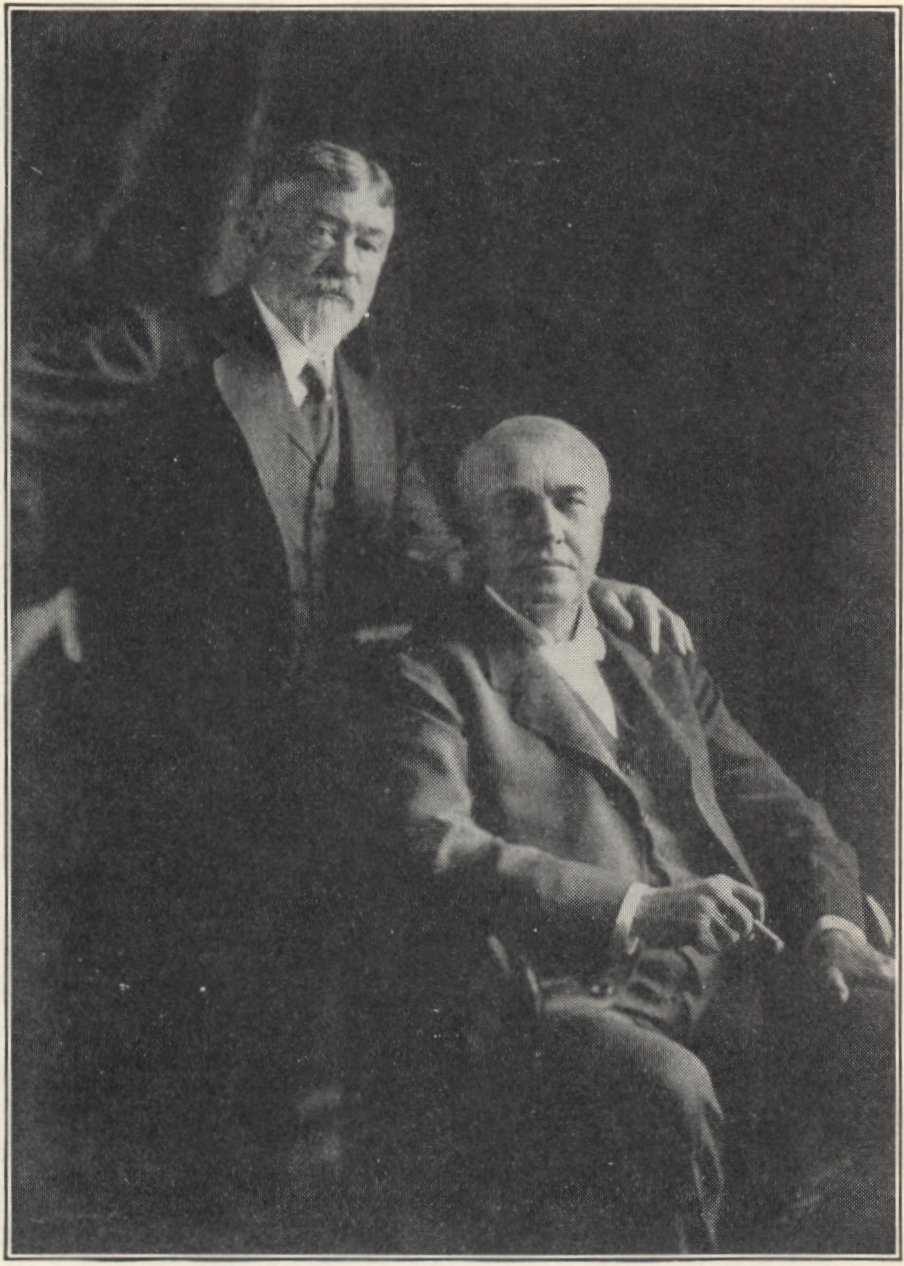
fixture. To see a picture of Edison and Bergmann
together, click
here and then on the back button on your browser.
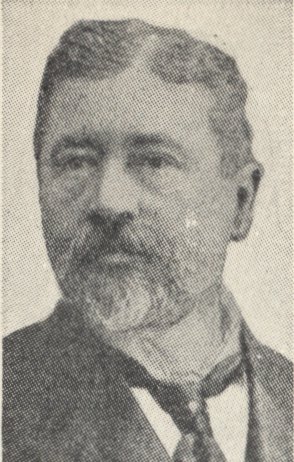
To see an picture of Bergmann from the early days
you can click
here.
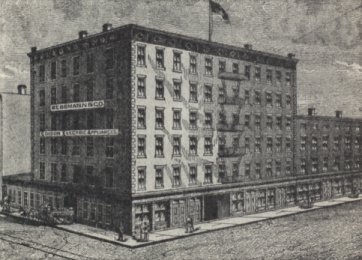 Edison
made an exclusive agreement with Bergmann allowing
him to make fixtures. Sockets however were still
made by Edison at his laboratory in these early
days, but later a three way partnership was formed
(September 1882) which brought another close associate
(Edward Johnson) into the new business. Edison
made an exclusive agreement with Bergmann allowing
him to make fixtures. Sockets however were still
made by Edison at his laboratory in these early
days, but later a three way partnership was formed
(September 1882) which brought another close associate
(Edward Johnson) into the new business.
This new "Bergmann & Co." Produced
fixtures, sockets, connectors, and other assorted
small devices for the Edison system.
Consistent with the personal trust at the center
of the relationship, the new partnership was not
to be legally formalized for another year. To
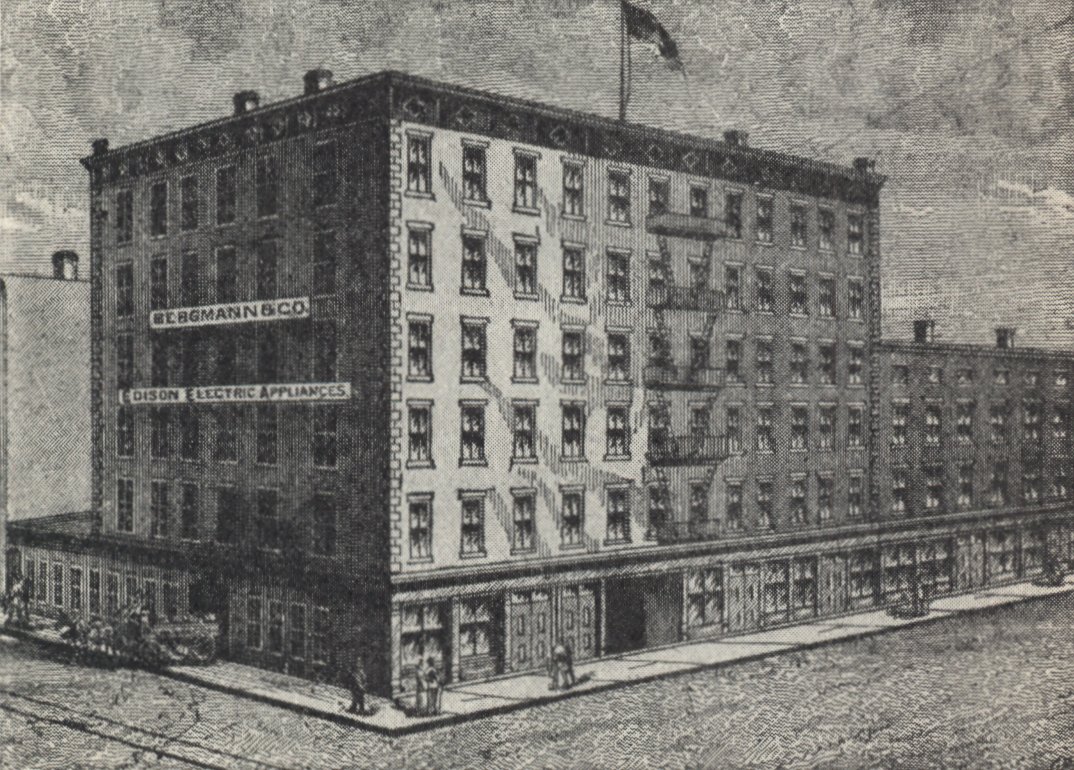
see a larger picture of the Bergmann & Co.
Building, click
here.
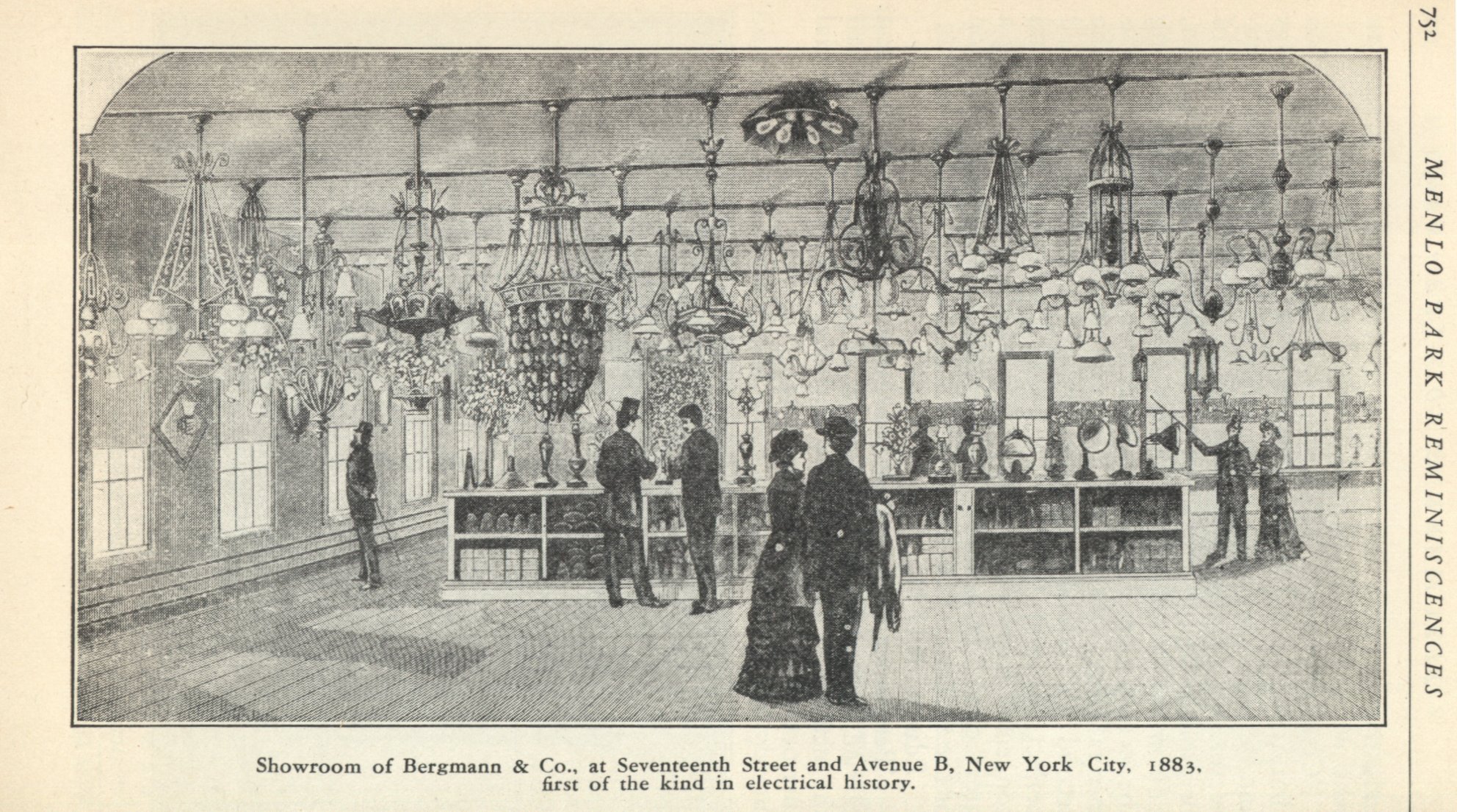
By early 1883 the first show room in the United
States for electric fixtures was open to the public.
This show room featured not only electric fixtures,
but combination gas and electric fixtures as well.
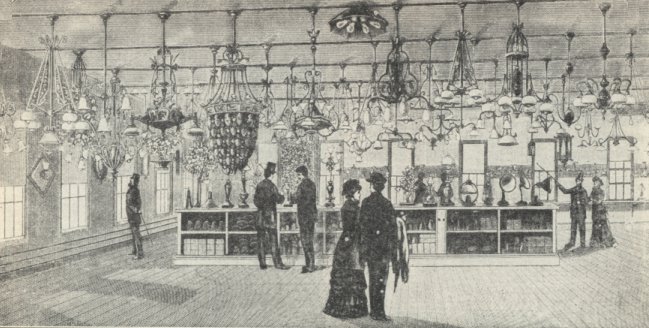
It was this showroom and the fixtures and parts
made by Bergmann & Co. That grandfathered
the great electrical fixture awakening that was
to come. While it is true that many new designs
came from other inventors through the years to
come, and the fact that many old styles of gas
and other lighting were followed, it was this
company that was on the forefront of it all. To
see the 300 DPI picture of the showroom click
here and then the back button on your browser.
Fact:
Did you know that Bergmann & Co. Was
the first EVER to patent a shade holder
that attached on to the socket shell?
Patent Number 293,552
Applied for October 9th, 1882
Allerhand
|
On this site, I break fixtures up into three different
categories.
Early PRE 1890
The early pre-1890 fixtures and parts are extremely
rare and are in a time line of their own.
Materials used to manufacture them normally use
wood or fiber insides and more ornate cast brass
on the outside being used for socket turn keys,
fixtures and fixture parts.
1890 to 1899
This was the start of the "Catalog"
or "Electrical Distributor" era which
was the beginning of the BOOM in electrical lighting
inventions that started in 1900. From 1890 to
1900 large distributors of gas and other household
items turned to electrical items. New electrical
supply distributors also came on the scene looking
for new inventions and designs to be added to
their catalogs. This opened the job market for
individuals to become independent or opened doors
to start their own companies. These items (while
some still quite rare) use porcelain insides in
place of fiber, turn keys start being made more
commonly of different hard rubbers.
After 1900
The
BOOM takes place. MANY more Electrical Distributors
come life and the blooming for Electrical Specialties
businesses takes place. One of the largest electrical
parts companies today "Hubbell Inc."
started in 1901 with their 12 page catalog mixed
up of only a few parts configured in different
views. In other words they offered their socket,
socket on cluster, cluster alone, socket on base,
pull chain for socket and chain coupling device.
This could had been a three page catalog. I am
not putting down Hubbell in any way - I am simply
pointing out how one company could grow from such
a small company into one of the largest in the
world today. Hubbell started with the specialty
item of a pull socket, then a separable plug and
then on to many more awesome inventions. There
were many more electrical specialty companies
that bloomed during this time such as P&S,
Arrow, Bryant, Marshall, Benjamin, Federal Electric
as well as too many more to mention here without
stopping and saying "and more", so I
will just stop now.
There were so many changes after 1900, that we
could create 10 or more splits in time lines between
1900 and 1921, which would not only be just too
much work for me, but, would make for too much
info of little value. For this reason, I will
only highlight on some companies and items during
this time frame.
| THE
FIRST ELECTRIC FIXTURE STYLES - 1881-1884 |
|
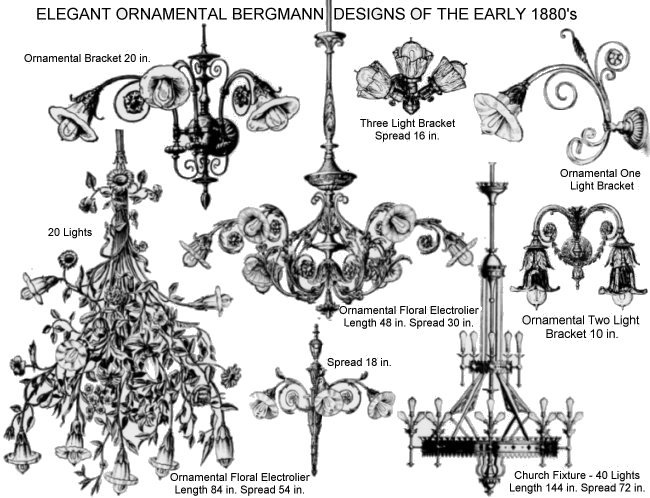
I should note that the fixtures shown below
are only meant to show some of the early
styles and are not intended to be complete
in any way. The Edison-Bergmann product
line can be seen in the Bergmann catalog
as well as the Edison General Electric catalogs
in our catalog section on this site.
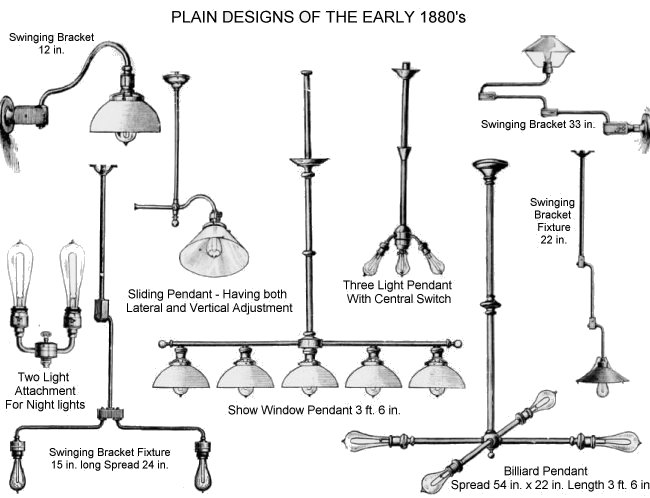
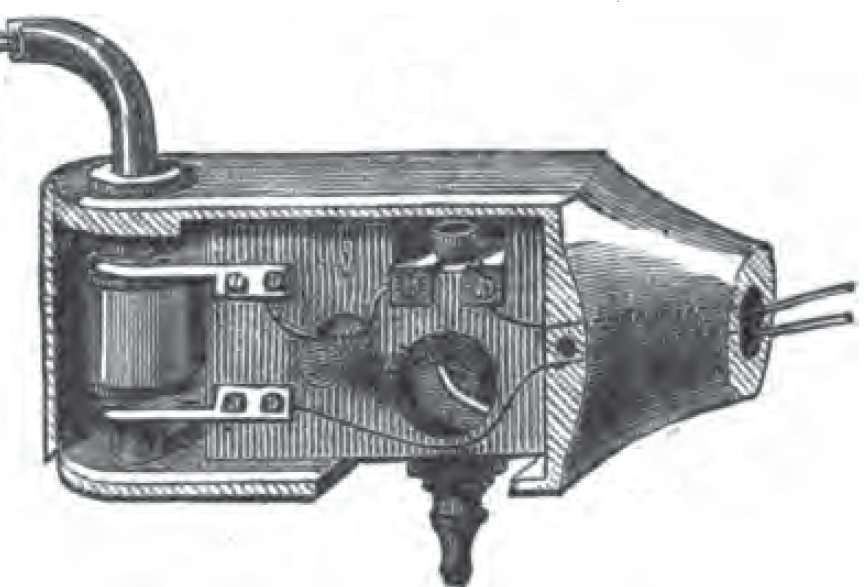
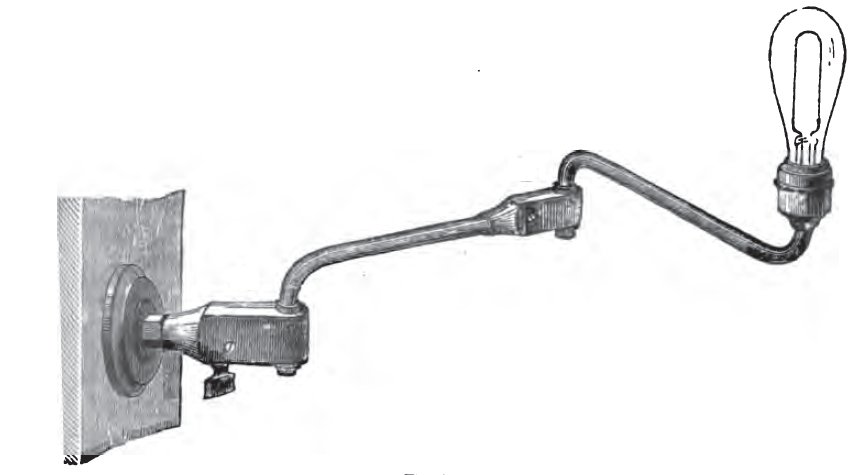
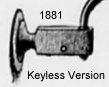 These
plain designs started with an electric swivel
(the squared design) that Bergmann made
for Edison's display at the Paris Exposition
in 1881. The joint for the swivel and basic
concept was taken from an early gas fixture
that had an electric igniter. This patent
(Sept. 24, 1878 No. 208,389)
by Charles Gibson also of New York, is shown
in the 1883 Bergmann catalog for these fixtures.
The only part of the patent that was used
in this swivel, was for the joint. The electrical
contacts, insulated wood plate and body
design were all Bergmann's unique design.
The later Ornamental swivel designs shown
below in the Ornate Section, used a different
contact method then this earlier design.
Click
here to look inside of the keyless version;
Or click
here to see the inside contacts of the
later ornate keyless fixture. These
plain designs started with an electric swivel
(the squared design) that Bergmann made
for Edison's display at the Paris Exposition
in 1881. The joint for the swivel and basic
concept was taken from an early gas fixture
that had an electric igniter. This patent
(Sept. 24, 1878 No. 208,389)
by Charles Gibson also of New York, is shown
in the 1883 Bergmann catalog for these fixtures.
The only part of the patent that was used
in this swivel, was for the joint. The electrical
contacts, insulated wood plate and body
design were all Bergmann's unique design.
The later Ornamental swivel designs shown
below in the Ornate Section, used a different
contact method then this earlier design.
Click
here to look inside of the keyless version;
Or click
here to see the inside contacts of the
later ornate keyless fixture.
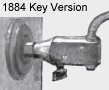 Later, in 1884, a switch was added to this
bracket design which now gave the consumer
a choice of having a bracket with a keyless
socket and switch on the bracket itself,
or to have the key on the socket and a plain
bracket. Click
here to look inside of the key version;
Or click
here to see the fixture using a key
version.
Later, in 1884, a switch was added to this
bracket design which now gave the consumer
a choice of having a bracket with a keyless
socket and switch on the bracket itself,
or to have the key on the socket and a plain
bracket. Click
here to look inside of the key version;
Or click
here to see the fixture using a key
version.
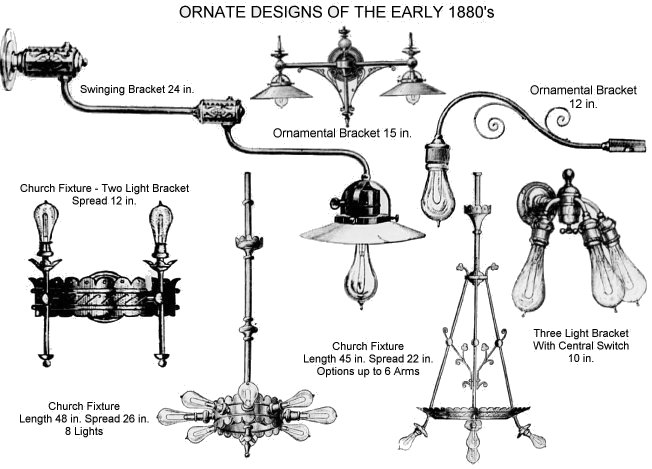
These
fixtures were all offered in many different
configurations to choose from. Examples
of choices would be the number of lights,
the number of arms, size, etc. It was all
multiple choice as shown below:
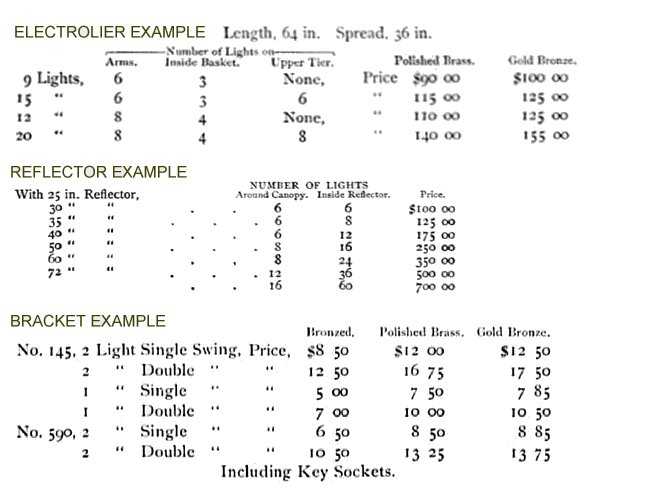
Even the most plain of these fixtures share
an AWESOME beauty that you need to see to
believe.
The choices in finish on most items were
Bronzed, Polished Brass or Gold Bronze.
Other finishes were also offered such as
"Beaten Brass Pinks, Blue Plush, Colors
and Gilt, Plain Bronze, Extra Ornate, Cut
Extra Ornate", etc., etc.
 When
you count up all of the beauty and rarity
there is nothing that compares to any of
these pre 1890 fixtures. When
you count up all of the beauty and rarity
there is nothing that compares to any of
these pre 1890 fixtures.
We are not comparing or talking about a
normal brass fixture, like the ones that
you would find on eBay that over the years
tarnished or lost its finish. Or the run
of the mill brass or copper electric pendant
from the 1920,s. We are talking about quality
items that in most cases were only found
in the most elegant of homes, offices or
exclusive down town stores.
When you put it all together; The original
sockets with Vulcanized Fiber Interiors,
original finish, original parts, original
hand blown glass shades, etc., There is
nothing that can match the awesome look
and feel to this REAL ANTIQUE. Many of these
items are one of a kind (unless found at
the same source) and rarely even come up
even at the most exclusive auctions (unless
a mansion is being liquidated).
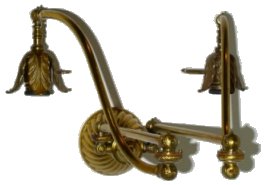
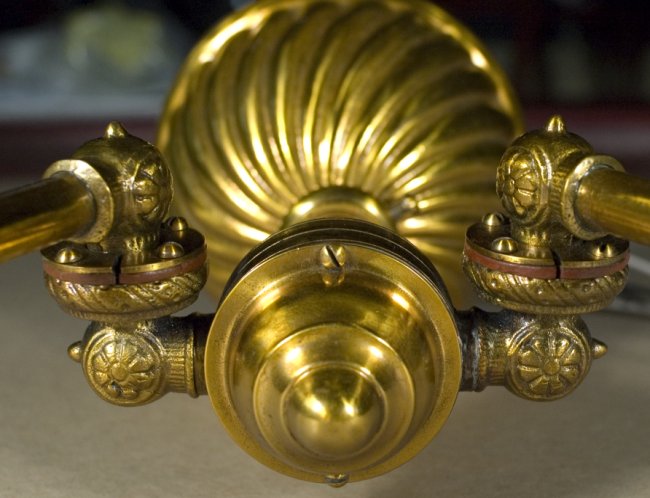
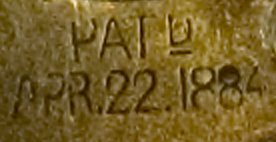 Below
is a close up of the finish on a Bergmann
double swing arm bracket. Notice the Red
Vulcanized Fiber half washers used on the
joints. The swivels are stamped with the
patent date April 22 1884 which is a Bergmann
patent that was applied for December 12,
1883 (pat no. 297269)
and assigned to Bergmann & Co. Below
is a close up of the finish on a Bergmann
double swing arm bracket. Notice the Red
Vulcanized Fiber half washers used on the
joints. The swivels are stamped with the
patent date April 22 1884 which is a Bergmann
patent that was applied for December 12,
1883 (pat no. 297269)
and assigned to Bergmann & Co.
I show this close up picture so that you
can get a feel for the finish and better
see what you are really looking at in these
black and white images that you are seeing
on this page. I wish that I had many real
examples to show you, but unfortunately
they are just too rare to come by. The catalog
pictures should help you get an idea of
the styles and what to look out for.
The fun of collecting is even greater for
a few reasons; Firstly the public awareness
is not at the place yet to know what these
type of items are. "It is a nice ornate
fixture" ... "it is circa late
1800's"... "Do I hear $350.00?
(no answer) ...$300.00? So, if you study
these styles you can still pick up some
real deals. A good example would be a pair
of 1882 Bergmann key sockets that I purchased
on the collectors market not long ago for
$1500.00. Though these are really rare,
I also found one on eBay not long ago and
won it for $60.00. Bergmann Acorn sockets
that I have paid from $350.00 to $450.00
for on the collectors market, I have found
from $30.00 to $60.00 elsewhere from those
that were not aware of their value (salvage
stores are great for picking up items like
this).
Education on these types of items is hard
to come by. At present, there is a small
circle of collectors and dealers out there
that know their stuff (and a few that think
they do). When I use the term "know
their stuff", I am speaking of people
that see something, know what it is and
buy it at almost any cost because they know
that they will likely rarely (or never)
see another one again. While sometimes an
item can cost them several thousand dollars,
most times it ends up only costing only
hundreds.
I am a rebel when it comes to teaching (the
reason for this site) and feel that everyone
should have the opportunity to learn (if
that is their desire). BUT... to learn,
there needs to be something to read and
there is not much out there. I have had
to go to EXTREMES and put out uncountable
dollars to learn what I have, and am told
to shut up at every turn. The Motto is ...
"Do Not Educate The Public". By
the time that I am done with this site,
people will be able to tell if their lamp
is not all original; they will know (or
have a good idea) what their items are worth;
they will know who and what to watch out
for, etc., etc.
Secondly; When you find an item (such as
one of these shown here), you are not getting
a Handel Parrot shade that hundreds of other
people also own. You are not getting the
Tiffany Piano Lamp that almost every Tiffany
collector has three of - You are getting
a piece that is a true EXTREMELY RARE antique
that has a beauty all of its own with a
real history behind it. I am not putting
down Handel or Tiffany, those items will
be covered on this site when I get to those
dates, but for now, we are learning about
1880's items and the unique 'rarity' of
them.
Lastly;
These items are a great investment. There
are sill many items out there to be found
at good (or in some cases give away) prices.
I have been watching the trends, as more
people start collecting - more people buy,
and soon common items that come up now,
will rarely come up for sale at all much
less the prices that you can presently get
them for. Also because some of these items
are so rare, you can just about name your
own price on them (within reason) even now.
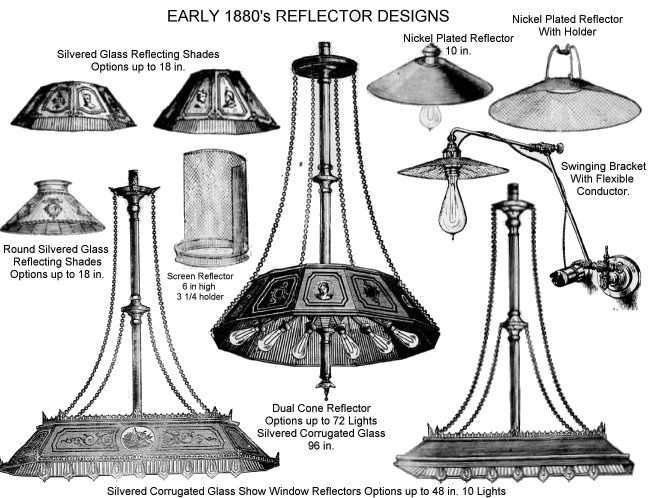
I have a friend that purchased a (Frink)
4 foot dual cone reflector like the one
above for $100.00 at Brimfield with its
original sockets and intact glass. If I
owned it, I would be asking 8,000.00 for
it, which is probably still to cheap. (If
it was a Bergmann the price would be much
more).
.Many of the fixtures shown above use Acorn
sockets. You can always tell a Bergmann
Acorn because the inside of the socket will
not be made out of Porcelain, it will be
Vulcanized Fiber. While I still need to
update the page greatly, you can see some
examples of Acorns and other Bergmann sockets
on this this
page.
When the fixtures shown on this page were
used together with shades, they were used
with shades that were available during the
period. Some of these in the early days
were those that were made for gas fixtures,
and as the time progressed, more and more
shades were made for electrical fixtures.
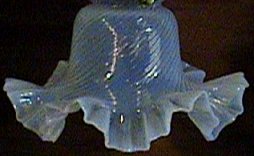 Either
way, your 1880's example should have a shade
(or reflector) of the period on it. This
means preferably of an ornate nature depending
on the fixture. Bergmann offered many ornate
and some plain shades. These shades came
in different colors and styles such as Flowers,
Etched Globes and Shades, Opal and Opalescent
Globes and Shades as well as Decorated Globes.
These came in colors such as Ruby, Opalescent,
Pearl, Dark Amber, etc. Flowers came in
White and Pink, White and Yellow, Pale Green,
etc. Styles of shades came in Squat, Pan,
Scalloped Pan, Crown, Cut Crown, etc. Then
there were offered the more standard glass,
porcelain and tin style shades and reflectors. Either
way, your 1880's example should have a shade
(or reflector) of the period on it. This
means preferably of an ornate nature depending
on the fixture. Bergmann offered many ornate
and some plain shades. These shades came
in different colors and styles such as Flowers,
Etched Globes and Shades, Opal and Opalescent
Globes and Shades as well as Decorated Globes.
These came in colors such as Ruby, Opalescent,
Pearl, Dark Amber, etc. Flowers came in
White and Pink, White and Yellow, Pale Green,
etc. Styles of shades came in Squat, Pan,
Scalloped Pan, Crown, Cut Crown, etc. Then
there were offered the more standard glass,
porcelain and tin style shades and reflectors.
I will cover shades in much more detail
on this site later, but the first and most
important thing in looking at shades is
to know the difference between a hand blown,
mold blown and molded or pressed glass shade.
Knowing this difference will aid you in
knowing the period of your shade. It can
also help you ID some bad reproductions.
Also look for imperfections in the glass
(which is good). I have seen so many times
in talking to antique vendors; "Oh,
it has a groove Or dent.. Imperfection in
the glass" BUT - What they are actually
saying is this shade is not going to cost
you as much. In most cases this is just
plain silly! While I will take the price
cut if offered, I come more from school
and understanding to pay a bit more for
those unique imperfections. It is also worth
mentioning that older and hand blown shades
are normally much lighter in weight and
more delicate (paper thin) then those that
came in later dates using different production
methods.
|
You
can view a demo
of the 1883 Bergmann catalog here (or if you
would like more information about it for trading
or to purchase a full copy of of it click
here).
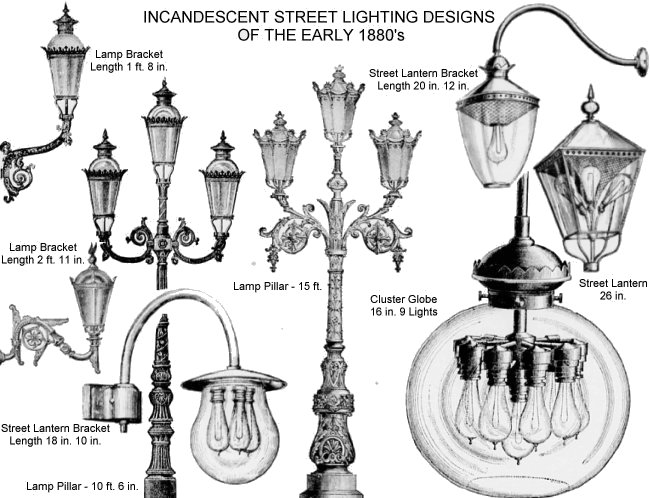
I am searching for one of these the cluster globes
shown above (or any multiple socket clear globe
fixture). If you have one or know of someone with
one, please contact me.
For more information on Bergmann, click
here. For more information on Edison, click
here.
|
|
| OTHER
MISCELLANEOUS ELECTRIC FIXTURE STYLES - 1881-1888 |
|
As shown in the beginning of this page, there
were a few different inventors during this time
inventing Dynamo motors to generate electricity.
Since we are dealing with such an early period
in time for incandescent lighting, there is not
much to show for fixture design. If it was not
for Bergmann & Co., This web page would likely
be really small!
Each company selling an electric "System"
offered a line of products to go along with that
system.
Some companies such as Brush, were late in offering
incandescent lighting and fixtures because they
were targeting a different market namely ARC lighting.
Arc lighting was mostly used for outside or factory
lighting. Both have their place, and bugs needed
to be worked out of both systems as time progressed.
It was Edison that leaned more towards fixing
the issues to do with incandescent lighting, but
as incandescence caught on and was in wider use,
those that had been offering Arc systems slowly
began selling incandescent products.
The main inventors at this time; Edison (we already
learned about), Weston (The United States Electric
Lighting Company), Brush (The Brush Electric Company),
Thomson-Houston (The Thomson-Houston Electric
Light Company of Philadelphia) and Stanley (who
later teamed up with Westinghouse).
| THE
UNITED STATES ELECTRIC LIGHTING COMPANY |
The United States Electric Lighting Company was
formed in 1878 along with a merger from The Weston
Electric Light Company that had been organized
in 1877.
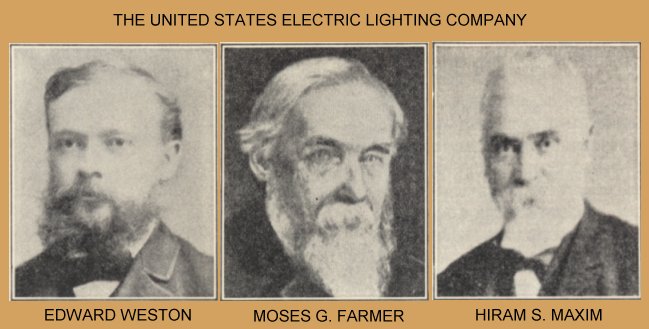
This new company was basically made up of three
major inventors which were; Edward Weston (for
his ARC lighting system.), Hiram Maxim (for incandescent
lighting system (regulator and his incandescent
lamp/filament patents) and Moses Farmer (who had
a long time first hand experience with generators
and early incandescent lighting).
You can view a demo
of the 1882 United States Electric Company
catalog here (or if you would like more information
about it for trading or to purchase a full copy
of of it click
here).
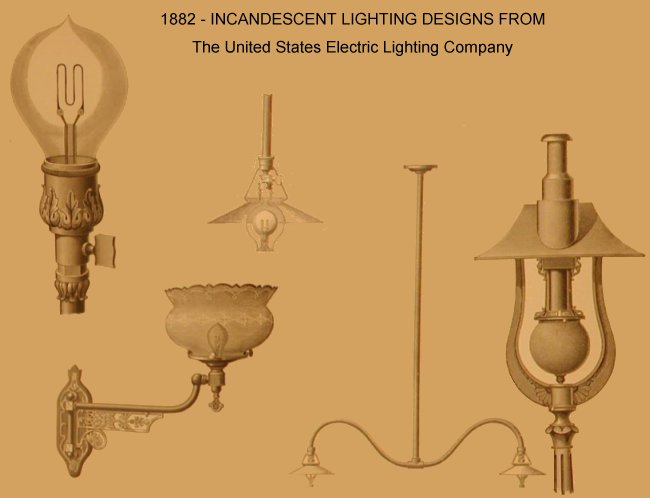
In the 1882 United States Electric Lighting catalog,
we find many different examples of Arc lighting
fixtures. There are only two incandescent lighting
fixtures shown and one street light with a note
that it can be converted for use with incandescent
lighting.
On the page where they show the first incandescent
fixture they say:
"For incandescent lamps ordinary gas-fixtures
can be used by properly attaching the lamp-holders,
and the conducting wires may be carried to the
lamps either through the pipes or along side of
them". The United
States Electric Lighting Company Catalog 1882
Page No. 23
Most people when they started using electric lighting,
still used gas as well. They had some gas lighting
and some electric, and many also had combination
fixtures such as were being offered by Edison.
It looks to me like the concern was there that
some people did not wish to mess up their old
gas seals on their fixtures or that there might
be some other problems, so just let the wires
hang on the out side of the fixture. WOW -- I
can see the Governor's Mansion being wired like
this. This is NOT sounding really professional
or elegant to me after seeing what Edison-Bergmann
was doing. Who are these people? In any case it
is clear that it was not this company that brought
us into the awesome electrical age that we live
in. Be it known that I am not downgrading any
of the products or inventions here, I have a love
for all three of them, however, it seems that
there should have been a forth person added to
this company with a talent for decorating.
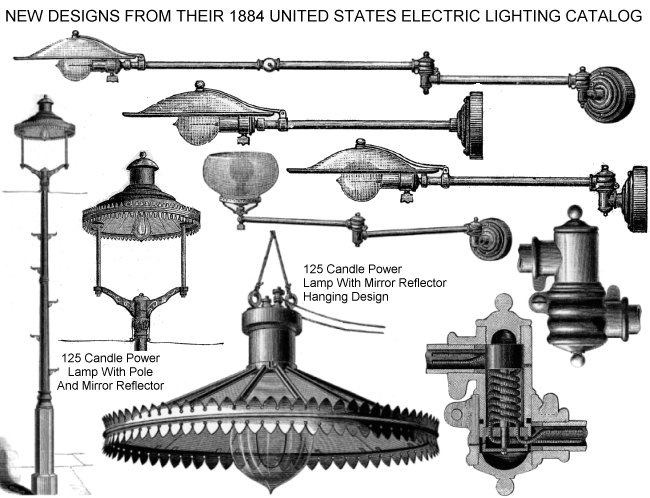
This
1884 United States Electric Company catalog has
not yet been scanned into pdf, please contact
me if you are interested in a copy for sale
or trade.
| THE
BRUSH ELECTRIC COMPANY |
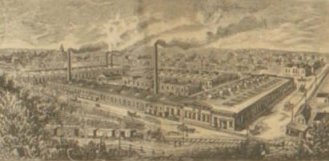 By
1880 Brush had solved several major problems in
arc-lighting. He invented a 16 hour double carbon
arc lamp, an automatic regulator for multiple
lamps, and introduced copper plated arc carbons.
These three inventions solved all of the major
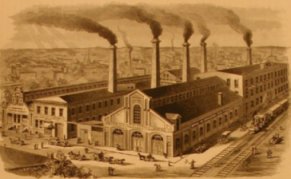
problems in arc lighting in the early years. Pictured
on right The Brush Electric Company in 1883. By
1880 Brush had solved several major problems in
arc-lighting. He invented a 16 hour double carbon
arc lamp, an automatic regulator for multiple
lamps, and introduced copper plated arc carbons.
These three inventions solved all of the major
problems in arc lighting in the early years. Pictured
on right The Brush Electric Company in 1883.
After the main issues in Arc had been solved,
there were no major changes in arc systems for
the next ten years. Now, with
all of the attention being drawn to these new
inventions and Charles Brush himself, it was not
a hard thing for him to move forward and break
into the open market with his new kind of electric
lighting.
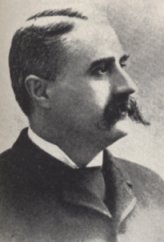 The
Brush Electric Company was one of the first to
bring Arc Lighting to the public. Charles Brush
(picture shown on the left) teamed together with
Joseph Swan (picture below) of the Swan United
Electric Light Co. Limited in England, before
the Edison partnership in 1883. The
Brush Electric Company was one of the first to
bring Arc Lighting to the public. Charles Brush
(picture shown on the left) teamed together with
Joseph Swan (picture below) of the Swan United
Electric Light Co. Limited in England, before
the Edison partnership in 1883. 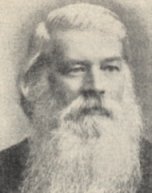
A new company was formed in 1882 to introduce
the Swan system, which was called The Swan Incandescent
Electric Light Company of New York.
Later (in 1885) another company was formed in
Cleveland Ohio called The Swan Lamp Manufacturing
Company.
Brush offered Swan bulbs and sockets as early
as 1882 as seen in the 1883 Brush catalog. At
this time in 1883 Brush and Swan only offered
baseless bulbs and sockets like the ones shown
below in this section.
While it is not as yet a proven fact, I personally
believe that The Swan Lamp Manufacturing Company
was formed and controlled by Brush. My reasoning
is:
1.) There was already a New York Swan company,
which was not successful enough to require another
location.
2.) Brush was in Cleveland Ohio.
3.) It is also a known fact that Brush was manufacturing
Swan bulbs. When Edison won his legal battle against
the British firm Woodhouse & Rawson in 1886
the courts also upheld infringement against Brush.
This was solved by the statement "The Brush
company agreed to give up the production of incandescent
lamps until the Edison patent expired". (The
Electric Lamp Industry - Bright page 108)
4.) I think it is safe to assume since a new company
would need someone to oversee it, and the fact
that we live in a big world, it is more then chance
that this company would start in Cleveland Ohio.
After all, who else in this industry was selling
Swan in the U.S. ? Brush is the only answer that
I know of.
Brush later sold his controlling stock in the
Brush Electric Company to Thomson-Houston (October
1889) at 75.00 per share and a total of 3,000,000.
This was Thomson-Houston's was to settle their
legal problems with Brush. (Men
And Volts - page 163). When Thomson-Houston
and other companies merged in 1892 to form General
Electric, Brush decided to retire and pursue independent
laboratory operations.
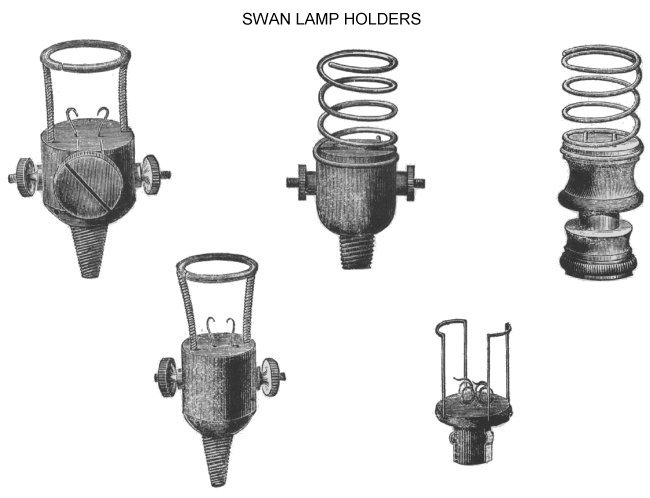
You can view a demo
of the 1883 Swan Company catalog here (or
if you would like more information about it for
trading or to purchase a full copy of of it click
here).
The images above are taken from an English Swan
United Electric Light Company Limited catalog
that was published in 1883. This catalog was put
out early 1883 before the Edison merger and company
name change.
 The
early Brush 1883 catalog (New York, January, 1883)
is called BRUSH-SWAN - Electric Light- The Swan
Incandescent Electric Lamp, The Brush Arc Light
and Storage Systems. The
early Brush 1883 catalog (New York, January, 1883)
is called BRUSH-SWAN - Electric Light- The Swan
Incandescent Electric Lamp, The Brush Arc Light
and Storage Systems.
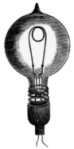
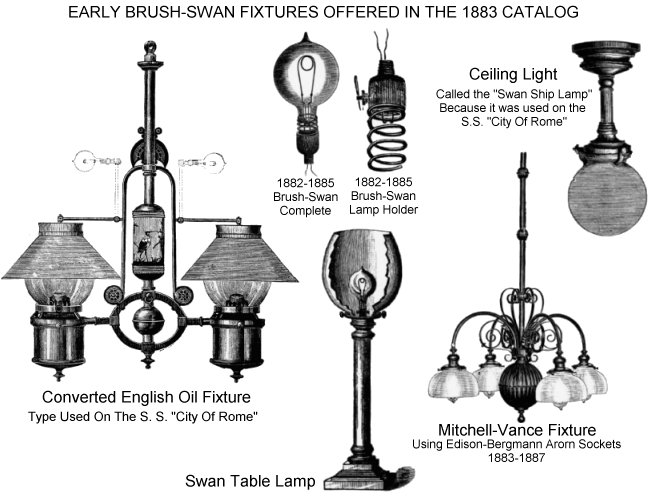
The 1883 Brush catalog shows fixtures that were
being offered by the Swan company and one Mitchell-Vance
fixture that was shown in this early catalog as
well as the Brush 1885 and 1887 catalogs. This
fixture was fitted with Edison-Bergmann acorn
sockets which were sold in the Edison catalogs
as a separate item. Also shown and being sold
for the Brush system is the Brush-Swan lamp holder
which is displayed alone and with a bulb in it
described as "The Swan Lamp Complete"
as shown to your right.
This 1883 Brush Electric Company catalog has not
yet been scanned into pdf, please contact
me if you are interested in a copy for sale
or trade.
.
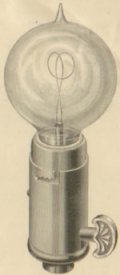 Later
in 1885 Brush invented his own socket and base
which is called today the Brush-Swan socket. Later
in 1885 Brush invented his own socket and base
which is called today the Brush-Swan socket.
This socket is shown in the 1885 and 1887 Brush
catalogs.
The 1887 catalog shows the more common longer
Brush-Swan bulb.
Though Brush had at his access, his own socket
(as well as Swan sockets and bulbs), he still
offered fixtures in his catalogs with Edison-Acorn
sockets on them.
These third party fixtures were sold along with
his systems. One of these fixtures (shown below)
was made by the Mitchell-Vance Company. Mitchell-Vance
was the most well known gas fixture company during
these early years and known to provide the most
elegant fixtures.
Also, as we already learned in the beginning of
this page above, two Mitchell-Vance gas fixtures
were converted by Edison for his demonstration
at Menlo Park as well.
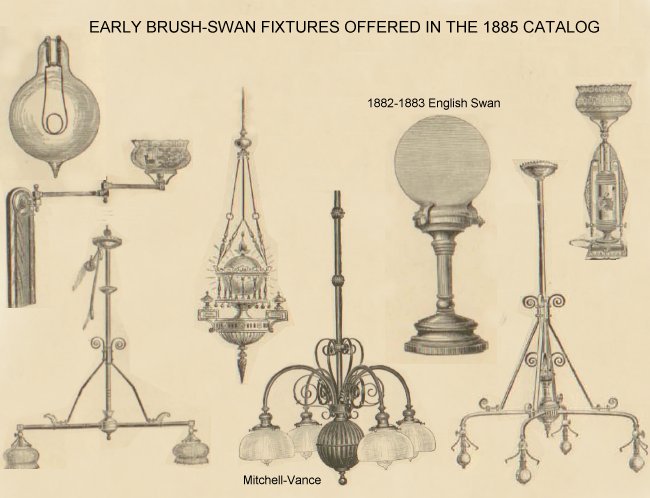
You can view a demo
of the 1885 Brush Company catalog here (or
if you would like more information about it for
trading or to purchase a full copy of of it click
here).
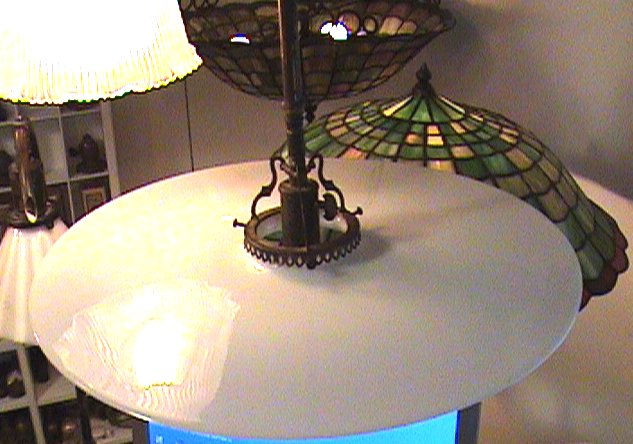
Below is a picture of an early Brush-Swan over
a flat white opal glass reflector of the period.
It is also pictured using a shade holder that
later (October 1888) was offered by Thomson-Houston
before their merger with Brush in 1889. If you
have any other information about this shade holder,
I would be glad to hear it.
For more information about Brush, or for close
up pictures of the Brush-Swan socket click
here.
| THE
THOMSON-HOUSTON ELECTRIC LIGHT COMPANY |
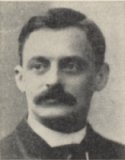 Elihu
Thomson was born in Manchester, England in 1853.
He came to the United States with his parents
at the age of five and was raised and educated
in Philadelphia. After graduation from High School,
Thomson returned to his alma mater as a teacher
of physics and chemistry. He joined with Edwin
Houston, a fellow teacher, experimenting in things
such as arc-lighting and centrifugal force. They
made several inventions and improvements in both
fields. He began work at the American Electric
Company in 1882. He eventually founded the Thomson-Houston
Electric Company and ultimately took over the
business of his previous employer. He continued
work in many important fields including arc lamps,
transformers, electric motors, and the Thomson
electric meter. Thomson also patented an electrical
welding process. In 1888, Thomson founded a second
company, Thomson Electric Welding, of Lynn, Massachusetts. Elihu
Thomson was born in Manchester, England in 1853.
He came to the United States with his parents
at the age of five and was raised and educated
in Philadelphia. After graduation from High School,
Thomson returned to his alma mater as a teacher
of physics and chemistry. He joined with Edwin
Houston, a fellow teacher, experimenting in things
such as arc-lighting and centrifugal force. They
made several inventions and improvements in both
fields. He began work at the American Electric
Company in 1882. He eventually founded the Thomson-Houston
Electric Company and ultimately took over the
business of his previous employer. He continued
work in many important fields including arc lamps,
transformers, electric motors, and the Thomson
electric meter. Thomson also patented an electrical
welding process. In 1888, Thomson founded a second
company, Thomson Electric Welding, of Lynn, Massachusetts.
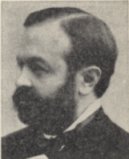 Thomson
attended Yale after this merger and then continued
on to Tufts where he received a Ph.D. He worked
steadily on with the General Electric Company
in Lynn, Massachusetts as director of the electrical
division until his death in 1937. His career spanned
five decades during which Thomson was granted
696 United States patents. Source Thomson
attended Yale after this merger and then continued
on to Tufts where he received a Ph.D. He worked
steadily on with the General Electric Company
in Lynn, Massachusetts as director of the electrical
division until his death in 1937. His career spanned
five decades during which Thomson was granted
696 United States patents. Source
Edwin
J. Houston (1847�1914 shown on the right) was
an American electrical inventor.
He helped design an arc light generator with Elihu
Thomson.
The Thomson-Houston Electric Company was formed
in 1883 from the merger of the Elihu Thomson's
American Electric Company and the interests of
Edwin Houston.
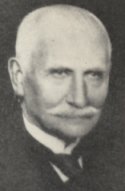 The
president of The Thomson-Houston Electric Light
Company of Philadelphia, was Charles Coffin a
former shoe manufacturer with a unique and shrewd
business outlook. Coffin had an everlasting constantly
renewed vision that was never complete or satisfied. The
president of The Thomson-Houston Electric Light
Company of Philadelphia, was Charles Coffin a
former shoe manufacturer with a unique and shrewd
business outlook. Coffin had an everlasting constantly
renewed vision that was never complete or satisfied.
He was not comfortable with waiting for profits
or success, he went out of his way to make it
happen.
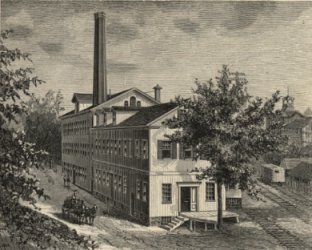 When the company first started in 1883 Coffin's
main business target was Arc Lighting. As the
company grew (also with some noted bankers on
his side), he began buying out competitors (or
controlling interests in those companies) that
had a foothold in the area of patents or production.
This was about the same time that Edison had merged
his electrical companies into The Edison General
Electric Company and also buying out other companies.
Finally in 1892 Thomson-Houston and Edison General
Electric Company merged by forming a new company
called "General Electric". By 1891 Thomson-Houston
was already worth 10 million which was greater
then the Edison companies. After the merger was
complete The new General Electric Company had
a capitol stock of 35,000,000 which was distributed
to the shareholders of the old Edison General
Electric Company, Thomson-Houston and others in
exchange for their holdings. The Thomson-Houston
side of the ownership was much greater then the
side of the Edison interests, so control was on
the Thomson-Houston side and Coffin took his place
as the first president of General Electric the
largest Electric Company in the world. Coffin's
vision continued which was a big part of bringing
us into the electrical age that we now live in.
When the company first started in 1883 Coffin's
main business target was Arc Lighting. As the
company grew (also with some noted bankers on
his side), he began buying out competitors (or
controlling interests in those companies) that
had a foothold in the area of patents or production.
This was about the same time that Edison had merged
his electrical companies into The Edison General
Electric Company and also buying out other companies.
Finally in 1892 Thomson-Houston and Edison General
Electric Company merged by forming a new company
called "General Electric". By 1891 Thomson-Houston
was already worth 10 million which was greater
then the Edison companies. After the merger was
complete The new General Electric Company had
a capitol stock of 35,000,000 which was distributed
to the shareholders of the old Edison General
Electric Company, Thomson-Houston and others in
exchange for their holdings. The Thomson-Houston
side of the ownership was much greater then the
side of the Edison interests, so control was on
the Thomson-Houston side and Coffin took his place
as the first president of General Electric the
largest Electric Company in the world. Coffin's
vision continued which was a big part of bringing
us into the electrical age that we now live in.
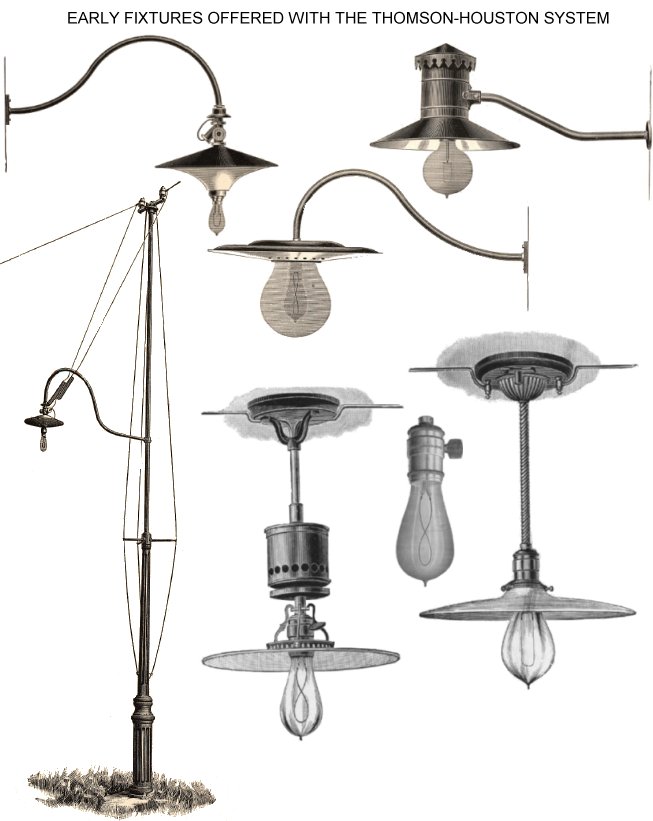
Thomson-Houston Catalog Demos
1883,
1886,
1886-SM,
1888,
1890
& 1892
- Catalogs for sale or trade info here
| UNION
SWITCH & SIGNAL COMPANY - GEORGE WESTINGHOUSE |
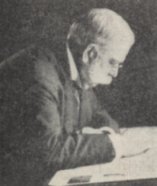
About the same time period (1883) George Westinghouse
(shown on the left) who had already built his
empire manufacturing railroad equipment, started
looking forward to expanding his empire into electric
lighting.
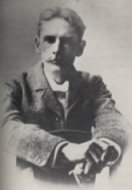 He was introduced to William Stanley (shown on
the right) in 1884 by his brother (who had just
invented a steam engine that could be used to
drive a Dynamo).
He was introduced to William Stanley (shown on
the right) in 1884 by his brother (who had just
invented a steam engine that could be used to
drive a Dynamo).
Stanley had invented a self regulating Dynamo
and an incandescent lamp that used a carbonized
silk filament. Stanley's current lamp patents
were assigned to Swan of which Westinghouse purchased
for 50,000 and then put Stanley on his payroll
at a salary of 5,000 per year. Stanley also agreed
to assign all future inventions to Westinghouse
providing he sold them and paid him 10% of any
profits made on them to which Westinghouse agreed.
In 1883 Westinghouse started selling incandescent
lighting systems through the Union Switch &
Signal Company.
THE WESTINGHOUSE
ELECTRIC COMPANY
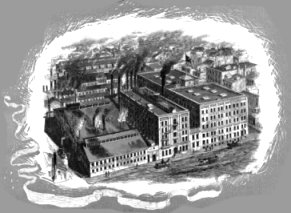 The
Westinghouse Electric Company was formed by January
8th 1886 with a stock capitol of 1,000,000. This
was after George Westinghouse had read about a
new way of transmitting electricity using alternating
current. The
Westinghouse Electric Company was formed by January
8th 1886 with a stock capitol of 1,000,000. This
was after George Westinghouse had read about a
new way of transmitting electricity using alternating
current.
Though he was opposed by everyone, he had a vision
and pressed forward which ended up revolutionizing
the electrical industry.
Westinghouse then began buying up other patents
and electric lighting companies just as Thomson-Houston
was doing at that time. Within a few years it
owned controlling interest in the United States
Electric Company, Consolidated Electric, Waterhouse,
Sawyer-Man, etc. 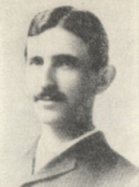
By 1890 Westinghouse had declared assets of over
12,000,000
In 1886 Westinghouse bought the patents of a European
born alternating current inventor by the name
of Nikola Tesla for 1,000,000 plus royalty of
1.00 per horse power.
Telsa (shown on your right) continued working
for Westinghouse until 1888 as a consultant.
As Westinghouse started moving in to alternating
current, other major concerns were close behind
him such as Thomson-Houston.
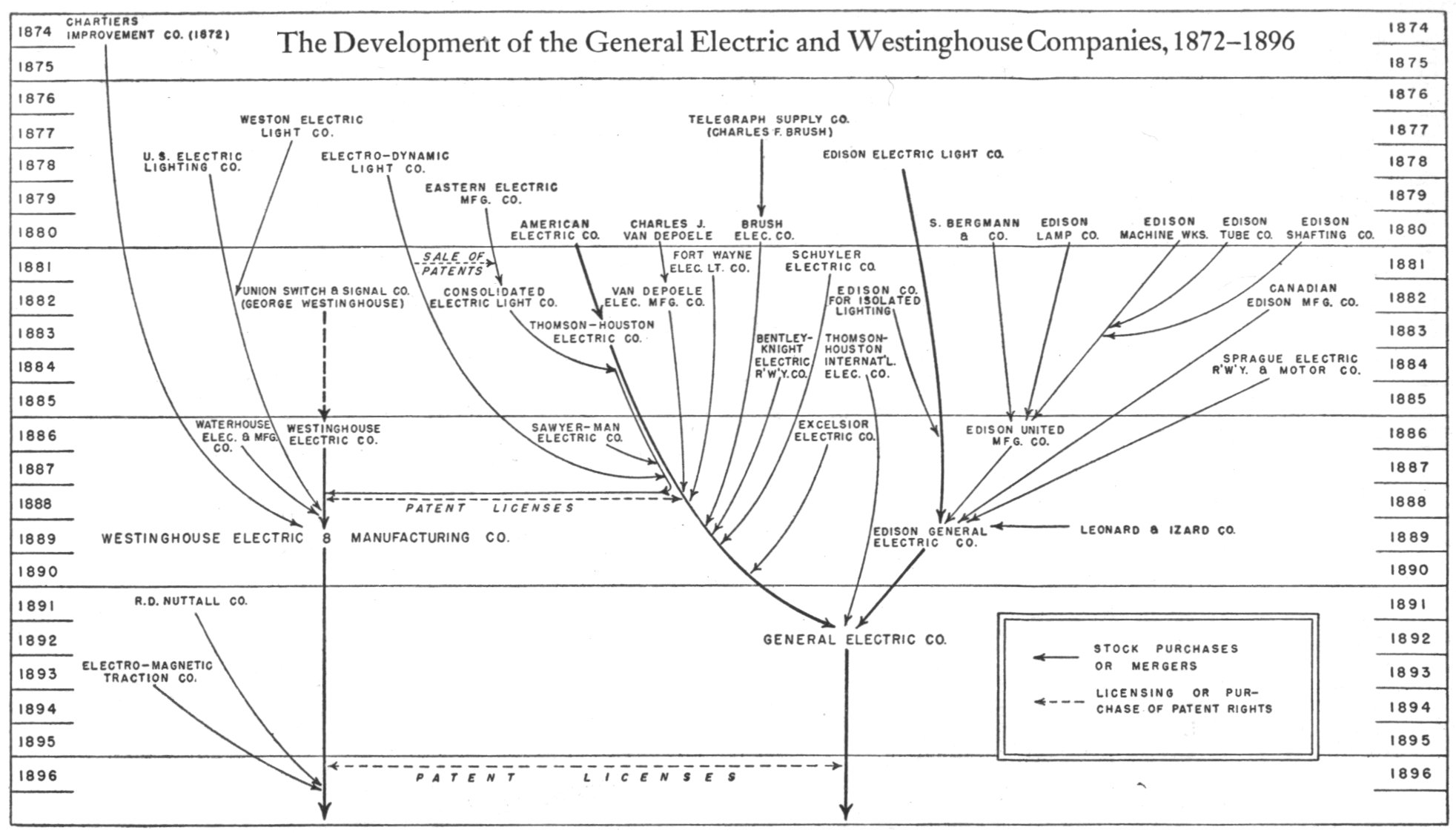
TO VIEW A TABLE OF THE DEVELOPMENT OF THE GENERAL
ELECTRIC AND WESTINGHOUSE COMPANIES FROM 1872
UNTIL 1896 CLICK
HERE. This table covers all of the mergers
and stock purchases as well as licensing or purchase
of patent rights of both of these major companies.
It is best viewed in raw mode or downloaded or
printed. If you have problems viewing the image
link above try viewing or printing the
PDF version of the table here.
To view some early Westinghouse items, click
here and then back on your browser.
Westinghouse Catalog Demos
1888,
1890-SM,
1892
Electrical Engineer - 1886 - Westinghouse Article
Electrical
World - Westinghouse Article - 1887
|
|
|
|
FIXTURE
STYLES FROM THE MID-1880'S
|
CLICK BELOW
TO CONTINUE TO THE NEXT SECTION
http://antiquesockets.com/lighting-timetable2.html
|
� COPYRIGHT ALL RIGHTS RESERVED
Contact
Us - Send Private Email To the Admin
|