|
BERGMANN
& COMPANY
1881
to 1889
|
THIS PAGE WAS CONTINUED
FROM HERE
http://www.antiquesockets.com/bergmann3.html
|
Common Terms Relating To This Bergmann Socket Section
|
I will start this Bergmann socket section with a some basics about
Bergmann sockets, so that you may easier understand this section
as we go through it.
To get a more detailed description of the parts below, click on
the text next to the picture which will automatically take you to
that information line below the pictures.
After reading the top line, click back on your browser and then
click on the next picture that you wish more information on.
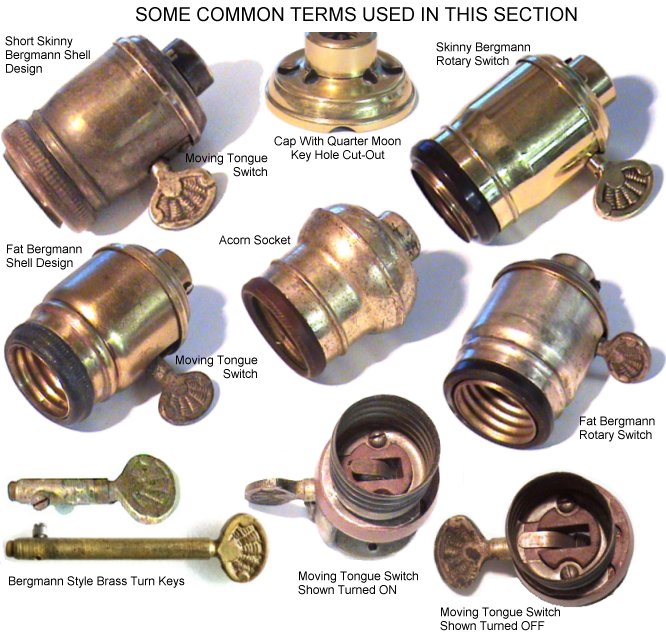
Skinny
Bergmann
The older Bergmann sockets were not as wide in diameter, as the
more fat Bergmann sockets which came out later. It is also easy
to tell the difference between a skinny and fat socket design at
a glance by the screws used. The skinny sockets used rectangle screws
to hold the cap. They also have a narrow ornate rib above the end
of the socket tube. The later fat sockets have much more thick plain
rib as you can compare in the examples above.
Short Skinny Bergmann
The short skinny socket is just as above, only slightly shorter.
The difference in size is caused by less room for a shade holder
below the ornate rib.
Fat Bergmann
A fat Bergmann socket was a newer design, in which the diameter
of the socket became much wider.
The Fat Bergmann uses a new twist lock cap style with round screw
heads. The ornate rib was also replaced with a thick plain rib.
Rotary Switch
There were two different rotary switches used in Bergmann sockets.
One was used in a skinny shell and the other in a fat Bergmann shell.
These rotary switches are easy to identify at a glance, because
the turn key will be at the top of the socket directly under the
cap. All other Bergmann sockets have the turn key coming out of
the socket shell about half way down the the shell as shown in the
pictures above.
Acorn Socket
The Acorn sockets were a design that was shaped like an Acorn. This
socket line branches down to Edison General Electric, as well as
The General Electric Company, which both manufactured their own
designs and improvements of the Acorn down through the years.
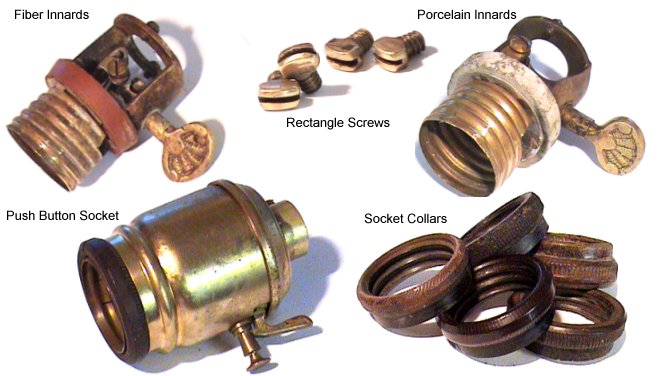
Push Socket
The Push button socket was a Bergmann design of a push socket, which
included a lever to release the switch. This socket is also sometimes
called the "Push/Pull" socket.
Cast Brass Keys
Bergmann's cast brass key design was unique to Bergmann sockets
and some Edison General Electric sockets. The last EGE catalog to
show these keys (or sockets using the keys) for sale, was the September
1st 1891 (with update price list for January 15th 1892). Standard
brass keys are about an inch long, but extra long keys were also
made for special fixture needs. By the time General Electric took
over in 1892, these sockets and keys were no longer sold.
Quarter Moon Cut-Out Cap
The quarter moon cut-out can be found on most skinny Bergmann sockets.
Though it was only needed for the rotary skinny sockets, Bergmann
only manufactured one cap for all. Once the Rotary socket came out,
the quarter moon cap became the cap for all other skinny sockets.
It is noteworthy that the fat Bergmann sockets (including the new
fat rotary socket) no longer used the quarter moon cut-out on any
of these new designs.
Fiber Innards
Innards is a term used for the inside of the socket. The term is
interchangeable with other terms such as guts, switches, insides,
etc.. The term fiber innards is reference to the material that the
insides are made from and in this case vulcanized fiber. Fiber colors
included red, brown, white and black.
Porcelain Innards
This is the same as above, but with the innards being made out of
porcelain.
Socket Collar
Bergmann used a screw on collar at the end of the socket tube to
insulate the Edison threads from the socket shell. In most cases
these collars were made of different fibers, hard rubber, composition
or porcelain.
Rectangle Screws
Rectangle
screws were used on early socket caps. On these caps you will also
find rectangle holes for them. When using rectangle screws, you
only need to turn the screw a half turn to remove the cap since
the screw is a bit smaller then the rectangle hole.
Moving Tongue
The Moving Tongue sockets contained an early switch invention unique
to Bergmann sockets. The center contact (being the tongue) laid
flat until the key was turned. When turned the tongue would move
up and make contact with the bulb, thus "The Moving Tongue".
The
Bergmann No. 1 Socket
|
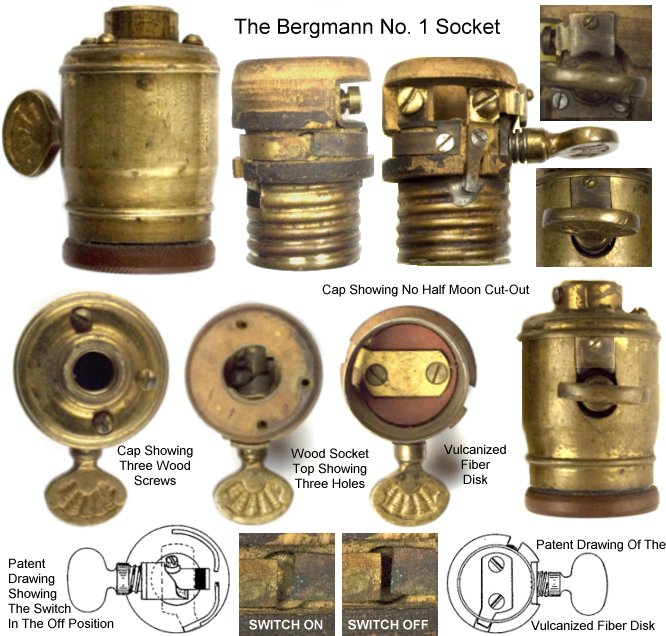
The Bergmann no.
1 socket (as like the Edison sockets before it), still use wood for
the main cylindrical block.
This socket incorporates a plate (thin round disk) of vulcanized fiber,
which is set on the wooden socket and what the center contact attaches
to. Other then this small plate, this socket is entirely made of wood
and covered with a brass shell. This makes the no. 1 Bergmann not
only the last Edison socket that used wood as an insulator, but a
kind of "missing link" between 'Edison sockets' and the
common 'Bergmann sockets' that we are used to seeing today.
|
How
To ID This Socket At A Quick Glance
|
If you are
looking at this socket from a picture or illustration in a catalog,
from the outside it would be easy to mistake it for a Bergmann moving
tongue socket.
Here are a couple tips to make an ID at a glance.
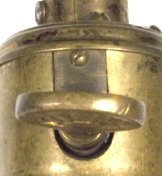 First
look at the socket key where it goes into the shell.
You will notice that the key is much thicker in diameter then other
skinny Bergmann sockets. If you compare the Bergmann no. 1 on your
right, to the socket on your left you will notice this fat key which
no other Bergmann socket will have. You can also notice the width
of the key hole is much wider too. First
look at the socket key where it goes into the shell.
You will notice that the key is much thicker in diameter then other
skinny Bergmann sockets. If you compare the Bergmann no. 1 on your
right, to the socket on your left you will notice this fat key which
no other Bergmann socket will have. You can also notice the width
of the key hole is much wider too.
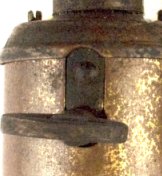 Also,
as long as you are looking here, also look at the cap above the
key hole. The cap on the moving tongue and other skinny Bergmann's
(except real early moving tongue sockets) have a half moon cut-out.
While the cut-out on the cap was not needed for the moving tongue,
there was another socket at the time that did require it. This was
the first rotary switch socket. Since the key shaft was so close
to the top of the top of the socket, it required the cut-out. It
was then added to moving tongue sockets so that only one cap needed
to be manufactured. This made it easier in the way that there was
no need to manufacture or keep track of two different caps. Caps
for skinny Bergmann's without the half-moon, are really rare. If
you see one of these caps on a skinny shell, it would either be
this wood socket, or a REALLY early moving tongue socket that we
call the LAVA version (because it used lava as an insulator). You
can also take note that this socket uses wood screws, and a screw
in the place of a rivet for the key hole cover. The last point in
the identification would be that the socket would likely have rectangle
screw heads. The socket shown above has rectangle screw holes in
the cap, which would suggest that this socket had it's rectangle
screws replaced with round head screws at some point in time. All
of the illustrations that I have seen of this socket also used rectangle
screws. Also,
as long as you are looking here, also look at the cap above the
key hole. The cap on the moving tongue and other skinny Bergmann's
(except real early moving tongue sockets) have a half moon cut-out.
While the cut-out on the cap was not needed for the moving tongue,
there was another socket at the time that did require it. This was
the first rotary switch socket. Since the key shaft was so close
to the top of the top of the socket, it required the cut-out. It
was then added to moving tongue sockets so that only one cap needed
to be manufactured. This made it easier in the way that there was
no need to manufacture or keep track of two different caps. Caps
for skinny Bergmann's without the half-moon, are really rare. If
you see one of these caps on a skinny shell, it would either be
this wood socket, or a REALLY early moving tongue socket that we
call the LAVA version (because it used lava as an insulator). You
can also take note that this socket uses wood screws, and a screw
in the place of a rivet for the key hole cover. The last point in
the identification would be that the socket would likely have rectangle
screw heads. The socket shown above has rectangle screw holes in
the cap, which would suggest that this socket had it's rectangle
screws replaced with round head screws at some point in time. All
of the illustrations that I have seen of this socket also used rectangle
screws.
|
Dating
The Bergmann No. 1
|
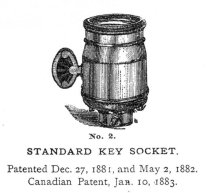 The
patent for this socket was applied for on October 9th 1882 and approved
on May 13th 1884. It was assigned patent number 298,658. The
patent for this socket was applied for on October 9th 1882 and approved
on May 13th 1884. It was assigned patent number 298,658.
Prior to the patent being approved, (in the circa 1883
Bergmann catalog (broken link) that we talked about (on
page number 3 linked here) there is a drawing of this socket
that gives some additional patent information.
This catalog provides the patent dates of December 27, 1881 (which
was the Edison patent for the screw
shell), May 2nd 1882 (which was the Bergmann patent for the
center
contact and Canadian patent January 10th 1883, which was (the
Canadian patent for the center contact patent no. 16095,
and assigned to E.H. Johnson. (This information is deducted from
the January 10th patent date also being used in the Bergmann catalog
for the Acorn socket and Standard Receptacle). E.H. Johnson was
also the assignor to another Bergmann & Co. Canadian patent,
as well as other later Canadian electrical patents as seen here.
If the patent information was kept updated, the absence of the May
13th 1884 patent, could tells us that the Bergmann catalog would
be no later then May or June 1884, since the socket had not yet
been approved. We also now know (from the patent information above)
that the catalog had to have been published some time after January
10th 1883.
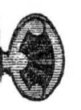 Please
also take note that in the Bergmann catalog, the socket is pictured
with the standard design for the turn key. Please
also take note that in the Bergmann catalog, the socket is pictured
with the standard design for the turn key.
 In
the 1883 The Edison
Light (broken link) and an Electrical World article dated September
1st 1883 (broken link) the socket is shown with a different (possibly older)
turn key design. The illustration in the Electrical World was taken
directly from the Edison Light (so we can not use it for dating).
Also, we can not say for sure that this socket was ever sold with
this key design until more evidence is produced. In
the 1883 The Edison
Light (broken link) and an Electrical World article dated September
1st 1883 (broken link) the socket is shown with a different (possibly older)
turn key design. The illustration in the Electrical World was taken
directly from the Edison Light (so we can not use it for dating).
Also, we can not say for sure that this socket was ever sold with
this key design until more evidence is produced.
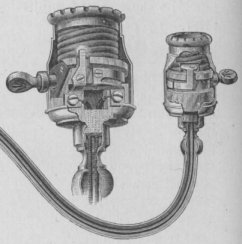 This
socket was also published in another
publication (broken link) in 1882 (Electric Lighting With Instructions For
The Proper Inspection Of Equipments) This
socket was also published in another
publication (broken link) in 1882 (Electric Lighting With Instructions For
The Proper Inspection Of Equipments)  which
shows a key design (on page 54 of the book) shown here left and
right. This key design is much closer to the standard design. This
book would have had to be published some time after June 13th 1882,
since on page 30 it shows an item that is marked with this patent
date. The book also includes an electrical code dated May 25th 1882. which
shows a key design (on page 54 of the book) shown here left and
right. This key design is much closer to the standard design. This
book would have had to be published some time after June 13th 1882,
since on page 30 it shows an item that is marked with this patent
date. The book also includes an electrical code dated May 25th 1882.
So here we have the common key design being used in June of 1882
and an Edison Light showing another key design in 1883. It is still
possible that the 1883 Electric Light used an older illustration,
but, with a patent applied for date of the socket at October 9th
1882; And the new common design being used in a publication dated
June 13th 1882 (and we need to account time for preparation of the
book); would make for a very short lived design if it had actually
ever been sold to the public.
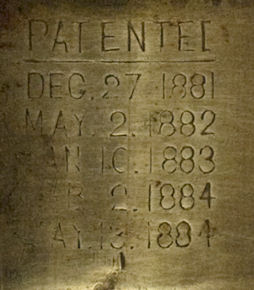 The
socket shell for this Bergmann No. 1, has the patent dates shown
below marked on the shell: The
socket shell for this Bergmann No. 1, has the patent dates shown
below marked on the shell:
DEC.27.1881
No. 251,554 & 251,596
(first Edison screw-thread)
MAY.2.1882 No.
257,277 (center contact for Edison-base)
JAN.10.1883
No. 16095 (Canadian patent for the center contact)
FEB.12.1884
No. 293,552 (acorn socket and shade holder)
MAY.13.1884
298,658 - This socket (turnkey socket with wood innards)
The first version of the Bergmann socket no. 3 (the moving tongue),
will have much in common with this socket. For this reason, I will
include more of the patent history in that section
Starting with this example, Bergmann started putting patent dates
on their sockets. However, there may be a version of this socket
missing one or all patent dates. This is because this socket example
has its own patent date of May 13th 1884 stamped on the shell. This
patent was applied for on Oct. 9, 1882, which means that for 19
months there was another shell that was being used that could not
have had the May 13th patent date on it (since it did not yet exist).
It is the same for the moving tongue socket (Bergmann No. 3). While
the early moving tongue was still in the patent applied for stage,
it only had dates up to May 13th 1884. After the patent was approved,
the moving tongue shells had their patent date of Jan. 20 1885.
New patent dates were added and removed to the moving tongue line
up of sockets through the years, so it only makes sense to cover
all of the dates in one place. I will add a link here, when that
section is complete.
|
The
Bergmann No. 2 Socket - The Acorn Lineup
|
To continue
the socket research to the next part:
Click Here http://www.antiquesockets.com/bergmann5.html
|