|
BERGMANN
& COMPANY
1881
to 1889
|
| |
|
SOCKET
RESEARCH SECTION - Acorn Sockets
|
THIS PAGE WAS CONTINUED
FROM HERE
http://www.antiquesockets.com/bergmann4.html
The Bergmann No. 2 Socket - The Acorn Lineup
|
ABOUT
THE LINEUP
The No. 2 Bergmann socket is part of a lineup.
A socket line up simply means that the socket design was carried
through different companies and through different periods of time.
In this case starting as an Edison/Bergmann invention and then living
on through later company mergers.
The lineup shown below for the acorn socket is mostly the joint
research between myself and Adam Allerhand, which we started working
on sometime around January of 2008. Please check back from time
to time for updates to this section. If a future update is ever
added to this page, it will be added in the format of a
red dated headline to make it easy to find.
Since the No. 2 (acorn socket design) extended through many years,
we will cover the entire lineup of acorn sockets and then move on
to the Bergmann No. 3 socket, which would be the next oldest socket
after the first acorn socket.
ABOUT THE FIRST
ACORN SOCKETS
One of the most popular Bergmann sockets of the early days was the
acorn socket.
It was an early design that held to the test of time. During the
history of this socket, only a few small changes were made in the
design which we cover in detail below.
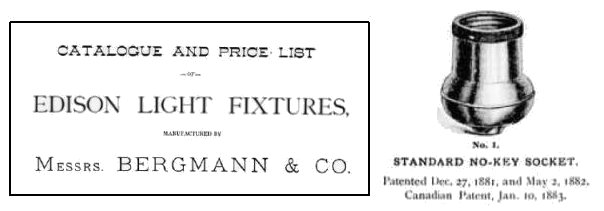
The
acorn was the standard socket used for fixtures that did not require
a method to turn the fixture off and on.
Thus, the acorn is and always has been a keyless socket.
THE DATING DILEMMA
The acorn is one of the hardest sockets to date and keep track of,
because of its many slight changes with no real way to document
exactly when those changes took place. Most of this problem was
caused by catalogs using old illustrations. The worst case examples
of this would be found in the Bergmann & Co. catalogs (more
about this topic here),
which show the same illustrations in 1889 (their last year of business)
as they did in their early 1883 company catalog.
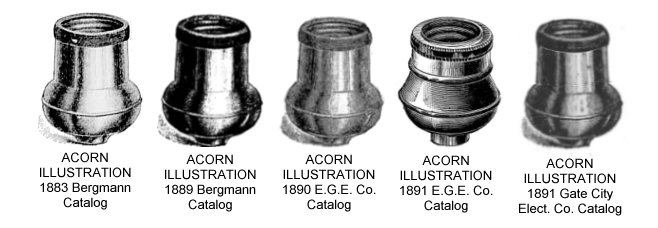
As you see from above, the catalog illustrations did not change
until after the first merger took place. The Bergmann catalog shows
the same socket illustration until they merged into Edison General
Electric in 1889. EGE then uses the same illustration in their company
catalog, but finally updates the image in their September 1891 catalog!
The problem here however, is that between 1883 and 1892 there were
FIVE different acorn styles!
Also note that electrical supply catalogs of the era did not normally
make their own illustrations of the items that they sold. They took
illustrations from other supply catalogs, magazines, trade catalogs,
etc. This is another dilemma in itself as seen in the capture above
of the 1891 Gate City Electric Company catalog image, which appears
to be selling the no. 1 acorn in 1891.
I should mention that most times catalogs are a great dating tool.
I am only pointing out a worst case scenario here, in order to help
keep you from possible future mistakes.
THE ACORN PATENT
The acorn patent was applied for on October 9th 1882 and approved
on February 12th 1884. Sigmund Bergmann is listed as the inventor
and the patent was assigned to Bergmann & Co. The patent was
given patent no. 293,552.
Also, because these later changes to the socket (talked about above)
did not change the claims that were in the patent, no new patents
needed to be filed to document the changes.
We are however able to give a fairly accurate lineup in the order
that they were produced, based on materials used, styles of ribs
and early pictures or illustrations that are dated.
Noteworthy is the fact that the acorn socket was Bergmann's first
socket to use all fiber insulation (without the inclusion of wood).
Sometime around 1890, porcelain started being used.
Please also note the fact that there could be other (so far unknown)
later variations missing from our lineup of acorn sockets.
|
Acorn No. 1 - The Bergmann Ribless Acorn
|
 Acorn
No. 1 - "The Bergmann Ribless Acorn" Acorn
No. 1 - "The Bergmann Ribless Acorn"
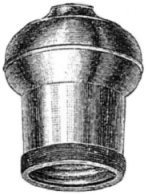
This first acorn was ribless as you can see from the smooth tube
above the collar. It is also shown without a rib in the patent,
as well as the circa 1883 Bergmann catalog.
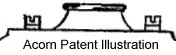 Also,
note in the patent and catalog illustration, that the cap on the
first ribless acorn, did not yet use the heavy threaded cast piece
of later acorns. This gives this first acorn a more unique look
then those to come after it. Also,
note in the patent and catalog illustration, that the cap on the
first ribless acorn, did not yet use the heavy threaded cast piece
of later acorns. This gives this first acorn a more unique look
then those to come after it.
So far we know that the first acorn existed, when the patent was
applied for in October of 1882. However, because previous Bergmann
patents were not allays applied for right away, we can not rule
out it existing prior to this date. It would not be logical for
it to have existed before February 25th 1882 since this was the
patent date for the center contact.
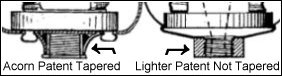 We
can also (more then likely) rule out the ribless design being manufactured
after August 13th 1883, since we know that a design with a rib had
already been invented and used in some early patent illustrations.
One of these illustrations is shown below taken from patent no.
307,759
which was for for a cigar lighter (assigned to Bergmann and Johnson).
This patent proves that the next version of the acorn existed in
August of 1883. It shows not only the rib existing, but the non-tapered
cap as well. This is clearly shown in the compared the acorn
and lighter
patents shown above on your right. We
can also (more then likely) rule out the ribless design being manufactured
after August 13th 1883, since we know that a design with a rib had
already been invented and used in some early patent illustrations.
One of these illustrations is shown below taken from patent no.
307,759
which was for for a cigar lighter (assigned to Bergmann and Johnson).
This patent proves that the next version of the acorn existed in
August of 1883. It shows not only the rib existing, but the non-tapered
cap as well. This is clearly shown in the compared the acorn
and lighter
patents shown above on your right.
Also note that the cigar lighter was likely already being manufactured
and sold before the patent was applied for, because as shown below
in the real example, it is still ribless.
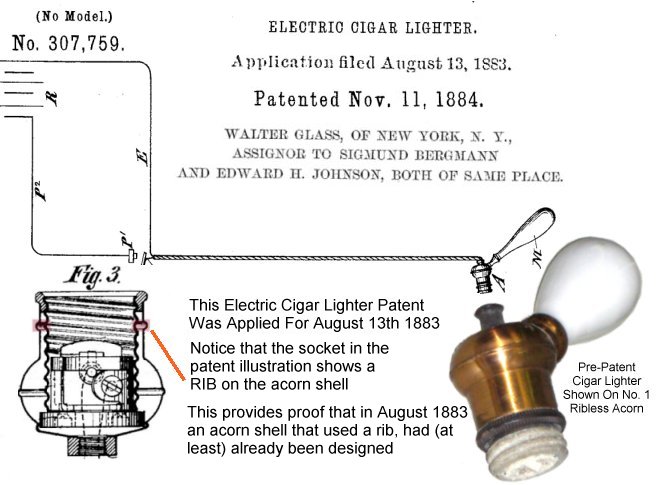
Note that the photo of the ribless cigar lighter shown above
was taken by David Christian (a member of our
forums), which was on display at the Edison Winter Estate Museum
in Fort Myers Florida.
To identify the no. 1 acorn at a glance, simply look for the
missing rib and the tapered cap.
I should mention that I have found one later sleeve without a rib
(which I know very little about). When seeing a ribless acorn, it
might be worth making sure that it uses rectangle screws and uses
the first cap design. Another thing to be sure of, would be that
it uses a beveled sleeve which is explained further below for the
no. 2 acorn.
|
Acorn No. 2 - The First Bergmann Acorn With A Rib
|
BERGMANN
NO. 2 ACORNS
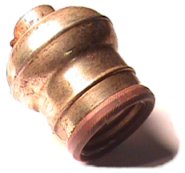 Acorn
No. 2 - The First Bergmann
Acorn With A Rib Acorn
No. 2 - The First Bergmann
Acorn With A Rib
The second Bergmann acorn is much like the first design, with only
a couple minor changes. These changes were documented above, the first
of which was the new heavy cast brass cap bushing.
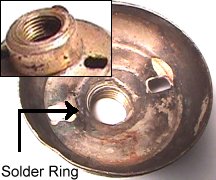 The
new cap bushing was inserted into the cap and then held with a ring
of solder as shown in the picture on the left. This new style bushing
will be seen on other newer acorns and sockets, as we work through
this and other sections. The only real change to the bushing will
be a crimp along with the solder, and much later much later (around
1890) when a new crimp method is used without the use of solder. The
new cap bushing was inserted into the cap and then held with a ring
of solder as shown in the picture on the left. This new style bushing
will be seen on other newer acorns and sockets, as we work through
this and other sections. The only real change to the bushing will
be a crimp along with the solder, and much later much later (around
1890) when a new crimp method is used without the use of solder.
The other change talked about above, was the addition of the ornate
rib on the shell, which is shown in the picture above on your right.
The rib will go through many changes, as you will see as we step through
this section. Some of these changes will even solely designate an
entire new acorn version. While it is not documented, it is believed
that changes in the rib placement took place to make room for new
designs of shade holders. Later, when the ornate rib is changed to
a larger plain style, it was likely done to conform to other socket
designs that were using newer style clamp on holders above the rib.
It is noteworthy though that Edison shade holders (using the collar
attachment) were almost always used with these sockets. The plain
rib was only a cosmetic style. Acorn sockets were not designed to
use a shade holder above the rib, as other sockets of the era were.
I will now cover the items that did not change.
This will help to identify not only this No. 2 acorn, but also the
No. 1 acorn at a glance (since after this acorn version noticeable
changes take place that only these two acorns share in common).
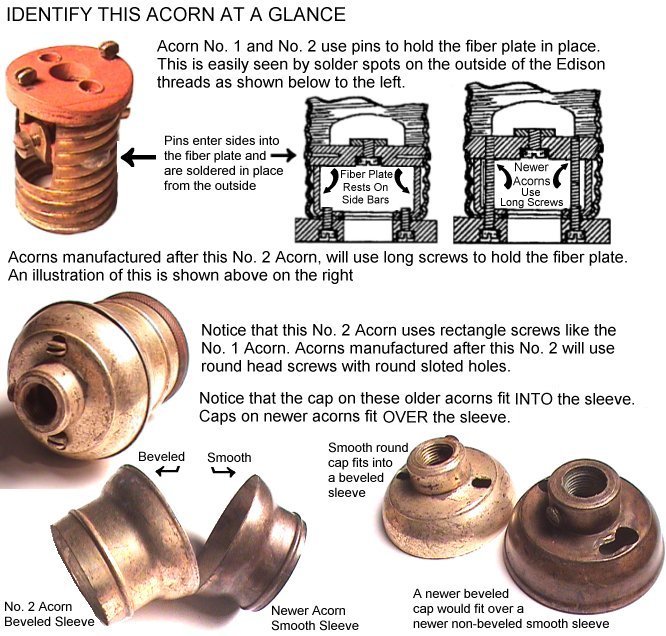
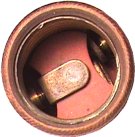
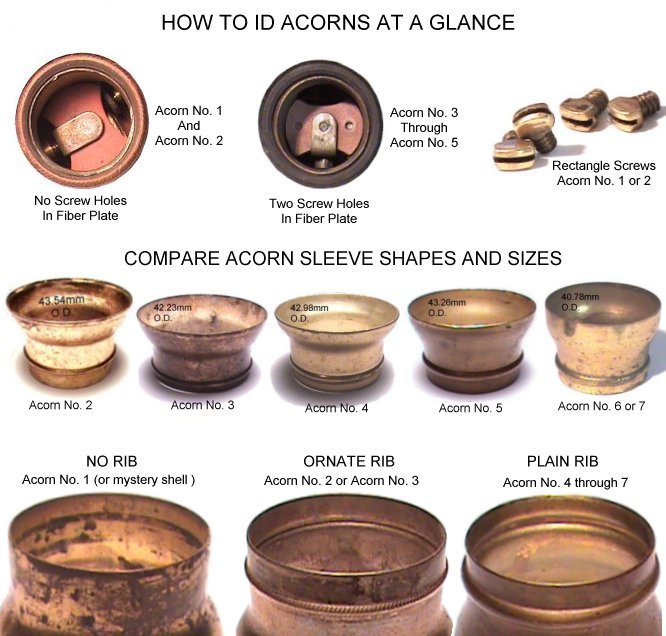
If you are looking down into the socket tube at the center contact,
take notice if there are NO screw holes in the fiber plate. If there
are no holes (as seen in the picture on your right), then it is a
No. 1 or No. 2 acorn innard. As shown in the illustration above, newer
acorns use longer base plate screws. This new method (used on acorns
after these) required holes to be drilled into the fiber plate for
the screws to thread into. These threaded holes come through and show
on this opposite side of the plate. Since there are no holes in the
picture shown on your right, it would need to use the first method
of securing the plate which was the side soldered pins.
Compare the picture above on your right, with the picture below of
the No. 3 acorn center contact to notice the difference.
As for dating, we only know that this socket likely already existed
on August 13th 1883. This is because it was used in patent no. 307,759
as an illustration for a cigar lighter, that was assigned to Bergmann
and Johnson.
|
Acorn No. 3 - The First New Innards & Last Acorns To Use
The Ornate Rib
|
BERGMANN NO. 3
ACORNS
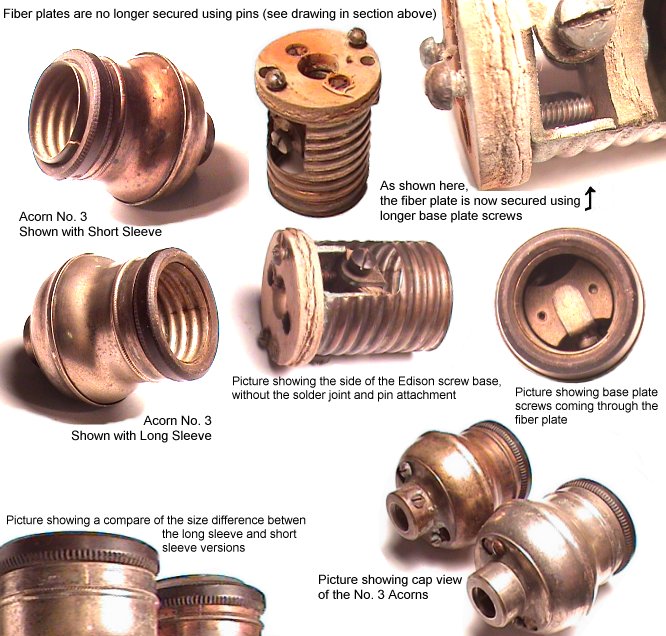
Some quick notes on the pictures shown above: (1.) Both of the innards
shown above are made from a white (paper like) fiber material, of
which one is discolored. All other Bergmann acorns that I have seen
are made from red fiber. (2.) At this time there is no real way
of knowing which of the no. 3 shells came first (short or long sleeve).
(3.) The long sleeve socket came to me as a shell only (no innards)
and filled with an extra innard that I had in stock (so, it is not
original to the shell). (4.) The bottom pictures of the two sockets
compared, makes it appear that one socket is larger then the other.
This is only an optical illusion. (5.) At this time there is no
dating documentation for this socket or its innards.
Acorn No. 4 - The First Bergmann
Plain Rib Acorns
|
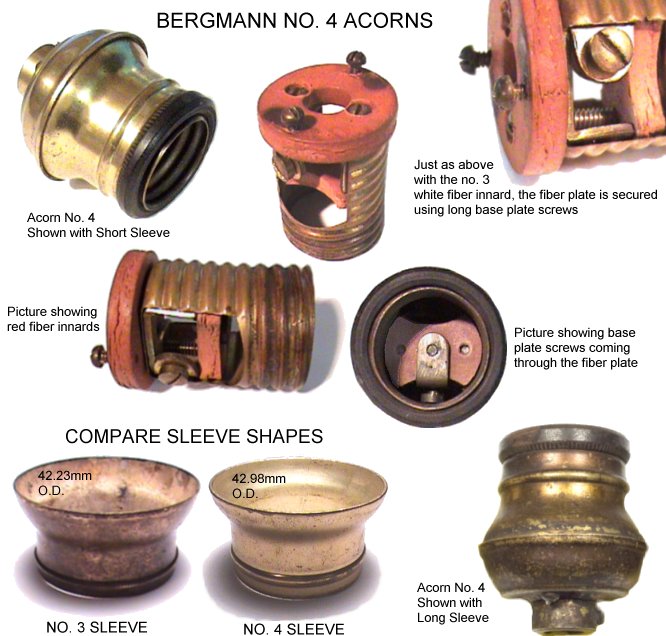
December 30th 2010 (Added rotary patent
info and links)
There is not that much dating information about this acorn version.
We only know that it was used prior to the porcelain version shown
below as no. 5. It is likely that this plain rib acorn started about
the same time as the FAT Bergmann shells. At this time we can only
document the start date or first use of the FAT shell design to
the first rotary
switch patent, which was applied for on June 2 1888 (read
here and also here
for more info). We also have documentation to show that acorn no.
5 (below) was being used during 1891. In this light it could be
safe to at least assume that this acorn stopped being used by 1890/1891.
Noteworthy is the fact that porcelain innards would fit this shell,
so left over inventory of these shells could had been used (though
I have not seen any of these shells with porcelain innards yet).
December 30th 2010
Also noteworthy is the fact that we have also found porcelain /
fiber transitional acorn no. 4 sockets. These are of the same design
as shown above, made of half porcelain and half fiber. How this
fits together with the acorn no. 5 migration shown below, I do not
know at this time. I will however take a much closer look at this
when I research this and post up the new information and pictures
which will be right here in this area soon.
A special thanks goes to David P Christian from our
forums who provided the information and pictures of the samples
I will be adding.
Added July 19th 2009 (Acorn No. 4b)
The acorn shown above described as "acorn no. 4 with long sleeve",
has a slightly different sleeve (hereafter referred to as acorn
4b).
On close examination, you will notice that the rib is a bit thicker
and extends just a bit more towards the collar.
The sleeve measurement also measures larger.
This is likely a transition between acorn no. 4 and acorn no. 5.
As you will notice from the sleeve pictures below, this acorn 4b
sleeve shares the rib and rib placement of the no. 5, while sharing
the similar top bevel as acorn no. 4.
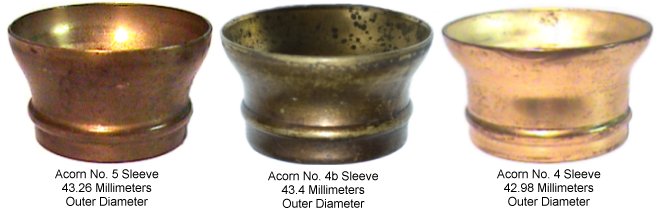
A thank you goes to Adam Allerhand for providing the 4b acorn
sample.
|
Acorn No. 5 - The New Shape - Migration Into Porcelain &
E.G.E Co.
|
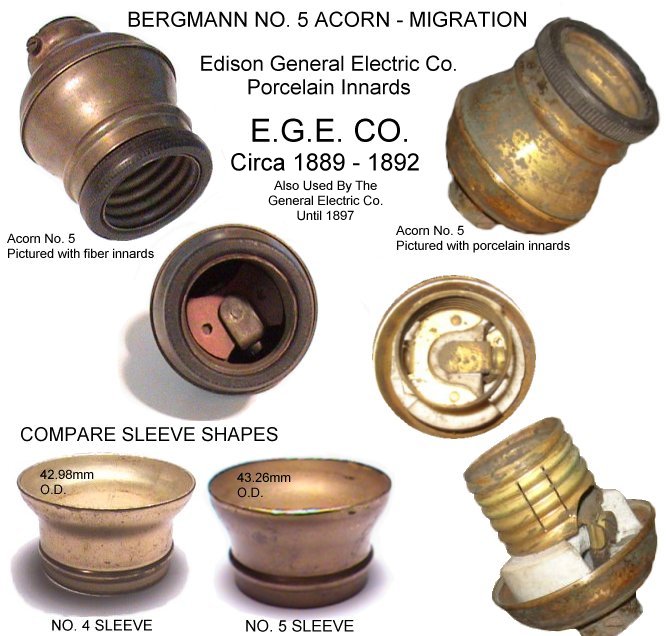
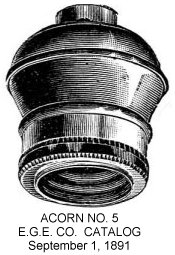 The
no. 5 acorn has a real unique shape, that is not easily noticed
from the photos shown above. The
no. 5 acorn has a real unique shape, that is not easily noticed
from the photos shown above.
This acorn was most obviously made for porcelain innards. However,
because of the close timeline of the conversion from fiber to porcelain
(1890/1891), you can find these acorns with fiber innards (just
as the one shown above on your left).
The outer diameter of the shell is over 43 millimeters!
A cap from the no. 3 will not fit this shell. If you try, you might
be able to get an uneven or tight fit with a no. 4 cap.
Since the top of the sleeve has been greatly widened, it has almost
completely lost the more bulbous (bulgy) shape of the acorns that
came before it. The catalog illustration shown on your right shows
a good depiction of the almost completely straight line angle from
the cap to the rib.
In 1889 Bergmann & Co. was merged
into a new company called Edison General Electric.
This no. 5 acorn was the design that was used during the entire
life of the EGE company (1889-1892).
As also shown below, G.E. used this acorn design from 1892 until
1897
|
Acorn No. 6 - The G.E. Acorn
|
 The
next merger that took place was
in 1892, at which time Edison's electrical companies were taken
over by the Thomson-Houston company. Thomson-Houston merged the newly
owned Edison companies as well (as their own electrical companies)
into a new company that they formed called "General Electric".
During this merger, stock holders of the old companies were paid and
the new company was basically Thomson-Houston with a new name. General
Electric, now owned Edison's patents as well as his name rights for
electrical items. The
next merger that took place was
in 1892, at which time Edison's electrical companies were taken
over by the Thomson-Houston company. Thomson-Houston merged the newly
owned Edison companies as well (as their own electrical companies)
into a new company that they formed called "General Electric".
During this merger, stock holders of the old companies were paid and
the new company was basically Thomson-Houston with a new name. General
Electric, now owned Edison's patents as well as his name rights for
electrical items.
I note this strongly for those that like to think that they are strong
personal "Edison" or "Bergmann" fans.
When it comes to these last areas, take note that "Bergmann"
(the person) had nothing to do with these electrical items (starting
with the date of the EGE company). ALSO, "Edison" (the person)
had nothing to do with these electrical items (starting with the date
of the General Electric Company). After this 1892 date; when you see
the Edison name being used by General Electric, it is simply Thomson-Houston
wearing their Edison Halloween mask.
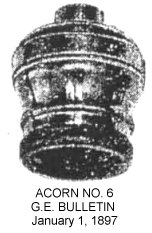
The first acorn that G.E. designed, was the one shown and announced
in the G.E. bulletin shown above on your right and also described
below.
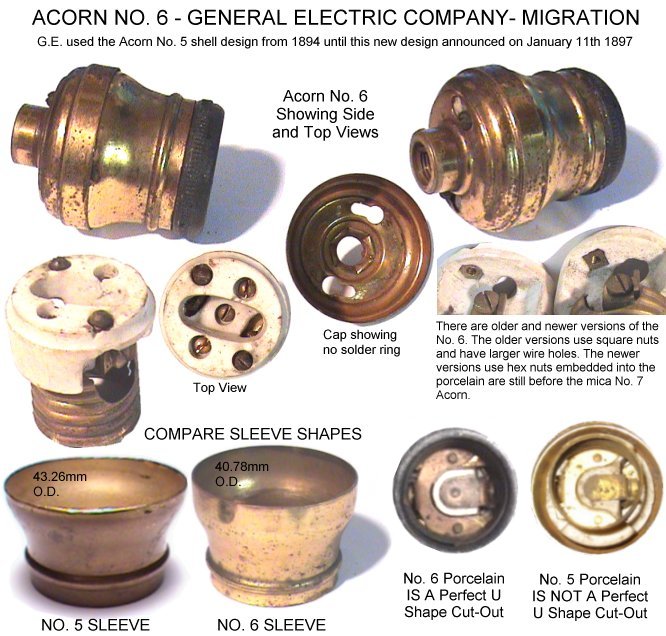
Noteworthy is the fact that I have seen one mica acorn that used square
nuts.
|
Acorn No. 7 - The G.E. Acorn With Mica
|
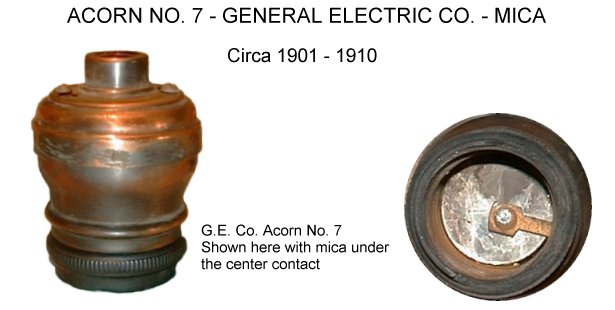
Note
that another later version of this no. 7 acorn existed after this,
without mica under the center contact. This acorn would date from
about 1910 until 1919.
As a general
rule, manufacturers used mica under the center contact from
the years 1900 until 1910 at which time mica began to disappear
from new items. This acorn no. 6 was offered in G.E. supply catalogs
as catalog number 66225 starting in 1897. It was changed to catalog
number 50750 in 1904 (the next catalog, now this no. 7 acorn), until
1919 at which time it was removed from their catalogs and no longer
offered.
|
HOW
TO ID ACORNS AT A GLANCE
|
|
The
Bergmann No. 3 Socket - The Moving Tongue Lineup
|
To continue
the socket research to the next part:
Click Here http://www.antiquesockets.com/bergmann6.html
|